Wine Mythology II

June 8, 2007

You might remember my entry about the Celtic god of wine and the vintners in the Mosel river valley, Sucellus (the good striker: the prefix “Su” meaning “good”, and the Celtic word “cellus/cellos” meaning “striker”). In Jakarta we have very talented stone masons. They usually work with soft white stones. Well, I showed them my picture of Sucellus (from Kinsheim) and they produced a replica. Unfortunately, I did not explain to them who Sucellus was. I did not explain to them how powerful he was and how he was loved by the Celts and how he was worshipped in the Southern and the Eastern parts of Gaul. – Traces of him are found from Geneva to Lausanne, from the Mosel river to places in Alsace and even in York in England. He was also part of Lusitanian mythology which was heavily influenced by it’s Celtic and Roman invaders.

My beardless Sucellus

So instead of a middle-aged man with a curly beard, I got back a handsome young Sucellus without these insignia of the Celtic forest god. Fortunately, the long-handled hammer (or mallet) was depicted rightly. He also holds grapes as in the original. The only un-bearded Sucellus in this world is now in my possession and I will put him up in my small winery on Two Hills vineyard to remind me of my Celtic heritage and all the many people before me who enjoyed growing grapes and making wines.

I try to imagine 10.000 years from now when to some archaeologists’ surprise, a statue of the Celtic god is found far from Europe in the rolling hills of Two Hills vineyard near Glenburn, Victoria. Then finally also Australia will be on the map of the Celtic god searchers of the universe.


Country Inns in Germany: Asparagus and river perch

May 18, 2007

While travelling in Germany recently, I had a lot of fish and seafood dishes, the reason for this being that I accompanied a group of visiting Indonesians to a number of coastal towns on the East and the North Sea. Since Germany had a splendid spring, this was the more enjoyable.

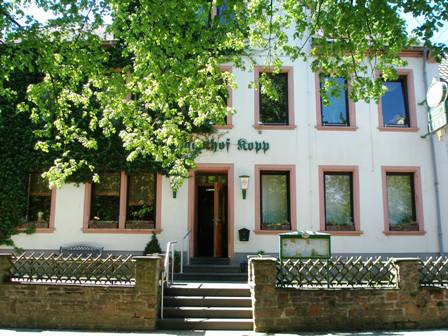
Later, together with my brother and my old folks in Trier, I visited one of the traditional German country inns so prevalent in my home area, the Mosel River Valley, the Landgasthof Kopp (www.landgasthofkopp.com) in Hentern, a small village between the Mosel tributaries Ruwer and Saar.

p4300582web.jpg

Landgasthof Kopp main entrance

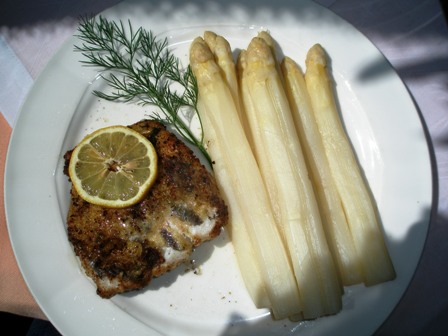
Springtime in Germany is ‘asparagus time’. Everywhere the lush white sticks can be purchased or consumed. All four of us ordered some kind of an asparagus dish. I had asparagus with perch (German: Zander).

p4300579web.jpg

River perch with asparagus

With this delicious meal, I drank the house wine, Ockfener Scharzberg Riesling, a local product from a small village on the Saar river called Ockfen (www.ockfen-home.de). Ockfen has about 700 inhabitants and of the agricultural used land of 246 ha about 90 ha are under vines on very steep slopes. The most famous terroir is ‘Ockfener Bockstein’ which is among the best wines from the Saar. The wines from this location are very dry, minerally and fruity with a good structure.

From the Middle Ages onwards it was the monasteries along the Saar river that cultivated vines and promoted the wine industry. The wealth and prosperity of Ockfen was almost exclusively based on its wine industry. The many small villages and towns along the Saar river are worth visiting (among them Saarburg, Ayl, Kanzem, Oberemmel, Serrig, Wiltingen to name only a few. I highly recommend this very beautiful part of Germany.

As regards the inn, the Landgasthof Kopp, this place is a must, not only because of the superb quality of the food and the service. The price too was a pleasant surprise, unbeatable, I must say. For the four of us, including drinks, we spent a total of only 60 Euro for a memorable family lunch.


Murrindindi

February 15, 2007

What is “Murrindindi”, you might ask? This is a location in central Victoria along the Murrindindi River. It is also the name of the shire where Two Hills Vineyard is located (www.murrindindi.vic.gov.au).

According to Wikipedia the Woiwurrung people lived in these parts of the Upper Goulburn when the first white settlers arrived in 1837. In the Woiwurrung language Murrindindi means “living in the mountains” and indeed this part of the Upper Goulburn Wine Region (www.uppergoulburnwine.org.au) is quite hilly and mountainous. It was all covered by forests.

There has never been a Murrindindi town. The first settlers (squatters as they are called in Australia) cleared the forests and farming and timber became the main industries in this region. A short lived gold rush began in 1868.

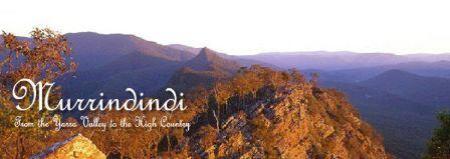
Murrindindi

Mountain view in Murrindindi

Although most of the area was deforested by the early 20th century, systematic protection and re-planting of trees has occurred and today the eastern part of the Melba Highway from Glenburn to Yea is in some parts quite densely forested again with Mountain Ash and other gum varieties.

Tourism is on the rise (www.murrindinditourism.com.au). Accommodation is easily available. There are good opportunities for trail riding, fishing, trail biking, and bush walking, specially along the Wilhelmina Falls and along the Murrindindi River.

Also the wine industry has made Murrindindi its home. Since the late 1980ies and the early 1990ies some vineyards were established in the Murrindindi area. In comparison with my native Mosel River, this might seem a rather short history of wine production. Indeed, vintners and winemaker here are true pioneers. There are fours vineyards in the vicinity:

▪ Penbro Estate
▪ Murrindindi Vineyards
▪ Yea Valley Vineyards and
▪ Two Hills Vineyard

All are members of the Upper Goulburn Wine Growers Association but only Penbro Estate has a website (www.penbroestate.com.au). There cellar door used to be the Glenburn Pub in Glenburn. Murrindindi Vineyard’s cellar door is at Marmelades Café in Yea, a small country town about 25 km to the north along the Melba Highway.

Whereas the Celtic Treverer had hundreds of years of site and varietals’ selection opportunities, so that today a rich and extensive knowledge base exists in the Mosel wine industry with well established vineyards and wineries.

The vintners in Murrindindi had only a couple of years of trial and error and are still searching.

We at Two Hills had to pull all our Cabernet grapes out because they would not ripen in the cool and harsh climate with its short autumns. They were replaced with Pinot Noir.

Last year was our first but promising Pinot vintage. The variety seems to be better suited to our conditions then the long ripening Cabernet. We plan to extend our vineyard and plant 0.4 ha of Chardonnay this year.

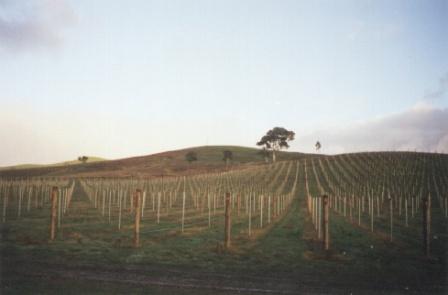
Vineyard in Murrindindi

Vineyard in Murrindindi