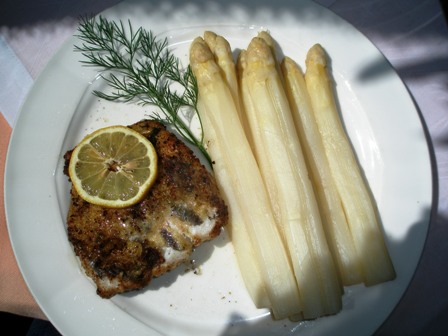
The weekend came and went like a storm, exhausted I am sitting on my desk at Monday lunchtime and contemplate about the good times gone by. As always, we had great food on Sunday. My wife Margit prepared a “Wehlener Specksalat”, which translates into English as “Wehlener potato salad”. With it we had a wonderful fresh water trout. The wine we enjoyed with the food was a Riesling of course, a 2003 Kaseler Riesling from the Reichsgraf von Kesselstatt Estate.
The settlement of Wehlen/Mosel is part of the district of Bernkastel-Kues, a small but famous town in the Mosel valley, about 50 km downriver from Trier. Wehlen has one of the best vineyard sites among the Middle Mosel producing outstanding Riesling wines. The world renowned site is called “Wehlener Sonnenuhr” (Wehlener sundial). The vines are cultivated on steep slopes (50%) on an altitude between 110 and 190 meters above sea level. The soils are very stony and are classified as Devonian slate soils. The wines produced are elegant and deep, full-bodied and fruity.
Wehlen goes back to Roman times when Celts established this village. The settlement has a tradition of more than 1100 years of vineyard cultivation and wine production. In a historical document of 874 the Arch Bishop of Trier requires the vintners of Wehlen to deliver 10% of their produce to the local church. Only the vineyards allocated to local monks were excluded from this tax. Unfortunately, the website of Wehlen is only in German but you might still visit and enjoy the impressive pictures (www.wehlen.de).
Back to the food. The “Cookbook of the Mosel” (Author Gisela Allkemper, published by Wolfgang Hoelker) was given to my wife many years ago as a Christmas present by my mother. And ever since, Margit has referred to it and experimented with its recipes. Wehlener Specksalat has become our favourite potato salad. Here is how you prepare it:
Wehlener Specksalat
Ingredients: 1 kg of potatos, 2 table spoons of oil, 5 ts of vinager, 2 onions, salt, pepper, a pinch of sugar, 75-100 grams of smoked streaked bacon
Peel the potatoes and cook them, still warm, cut them into cubes and mix them with the dressing; cut the beacon also into cubes, fry it in a pan and add it with the fat to the salad; keep the salad warm, mix it from time to time. Serve it with backed or fried fish, and/or sausages or other fried meats.
We drank one of my last bottles of ‘2003 Kaseler Riesling’, Reichsgraf von Kesselstatt – The Riesling Estate (www.kesselstatt.com). Kasel is a small village at the Ruwer River, some 10km from Trier on the right hand side. When we were at high school my brother Wolfgang used to earn some pocket money by working for family vineyards during harvesting season. That’s hard work because the slopes are steep, the weather often wet and unfriendly. He reported about the great hospitality of the vintners and the fun he had with the co-workers of the labour crews employed for picking during vintage time. I never got to it and regret this now at the tender age of 52. Another lost opportunity.
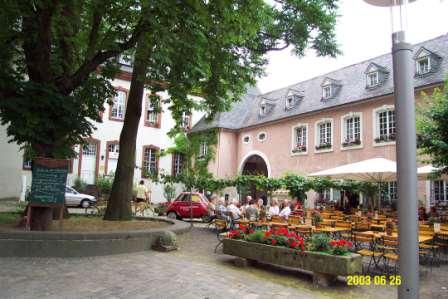
The Wine Bar and Garden of Reichsgraf von Kesselstatt in Trier
Reichsgraf von Kesselstatt maintains a beautiful website (www.kesselstatt.com) in three languages; German, English and Chinese. The latter made me very happy. Having lived in China and Chinese speaking cultures for more than eight years, it is always a pleasure to see Chinese characters. I guess that many of the Chinese tourists visiting Trier, the birth place of Karl Marx, also belong to the customers of the estate. Let us hope that many visitors from the Far East become lovers of wine from the Mosel river and its many vineyards, wineries and wine estates. Kesselstatt, by the way, owns also a vineyard in Wehlen (according to the website 0.3 ha) in the location “Sonnenuhr”.
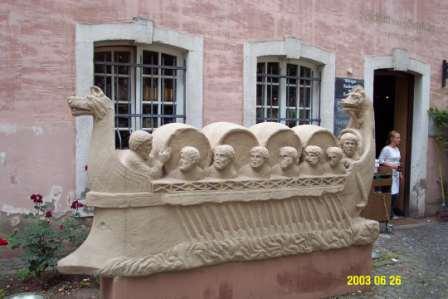
The “Neumagener Wineship”, replica in front of the Kesselstatt Wine Bar.
Similar to the “village-system” of Burgundy, Kesselstatt produces regional wines. The fruit for this Riesling is sourced from around Kasel. Kesselstatt itself owns two holdings there (top locations Nies’chen 4.4. ha on a 60% slope and Kehrnagel 1.8 ha on the valleys finest sites). Some of the vineyards belonged to the St Irminen monastery. By the way, I grew up at Irminenfreihof 5 in Trier (the neighbourhood was locally also knows as Brittany), next to the monastery located in the middle of the city of Trier.
The Wine: 2003 Kaseler Riesling dry
This full-bodied fine Riesling shows all the characteristics of the typical Mosel Rieslings. It’s very minerally (because of the slate soil) and fruity, depicting pineapple, peach, apple and lemongrass characteristics. It’s is also well balanced, dry with a lingering finish. The alcohol level is rather high for a Mosel Riesling (12.5%). But 2003 was a most astonishing year. Throughout the year temperatures were higher then normal; the year was also much drier. Because of these favourable conditions growth was exuberant. When temperatures hit the 40° Celsius in August sunburns were widespread. The grapes ripened quickly and picking started much earlier along the Mosel river and its tributaries then in most years. The fruit picked was usually healthy and showed aromas which were not depicted in other years. Unfortunately, I have only another two or three bottles left of this treasure. I will reserve it for special occasions with more Wehlener potato salad and fresh trout.



 Posted by themanfrommoselriver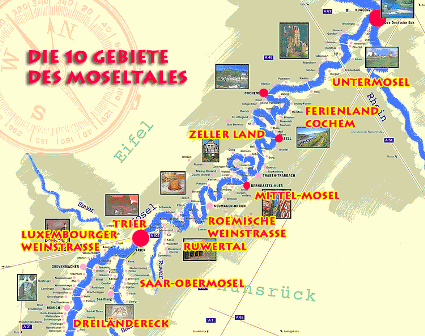


 The Man from Mosel River