Together with my mother and my brother Wolfgang, we visited the hometown of my maternal grandfather for a family reunion. The small village of Reichenberg, near the city of Würzburg was our destination. My mothers father, Hans Heinrich Schüssler, was the one who introduced me to wine and wine drinking. When I was about 16 years old he took me to the Juliusspital (one of the three big wineries in the city and winner of this years ‘Riesling of the World’ Challenge in Canberra) in Würzburg where I had my first ‘official’ glas of Franconian wine.
Würzburg is another ancient city where the Catholic church and its archbishops reigned. Needless to say that vineyards and wine production are an old and beloved feature of the local culture and the economy influencing its specific social habits and customs. The castle of Würzburg is one of the main features. On its slopes vines are grown as well.
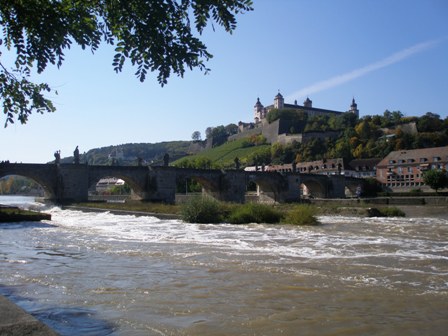
The castle in Würzburg, with the historic bridge and the vineyards on the castle slopes
Franconia is the name of the wine region. It currently has about 6,000 ha under vines. The proportion of red varieties is low (19 %). Main varieties are white grape varieties such as Müller-Thurgau (32 %), Silvaner (21 %) and Bacchus (12 %). But, as along the Mosel river, red varieties are on the increase. ‘Franken’ (Franconia) produces some excellent Pinot Noir wines as well. Nowhere in Germany does Silvaner produce such stunning wines as in Franconia.
The shape of the local wine bottles ‘Franconian style’ is very special too. It’s called “Bocksbeutel” in German and usually reserved for higher quality Franconian wines.

The “Bocksbeutel” bottle, trademark of Franconia
The above bottle from “Staatlicher Hofkeller”, the second of the three big wineries in Würzburg (the third one is “Bürgerspital”), was the first I drank with a glas enclosure in my life. It was a “2005 Hammelburg Trautlestal, Silvaner Kabinett, dry” which displayed all the characteristics of an excellent Franconian Silvaner wine. For newcomers to Franconian wine I can highly recommend this drop.
The next day after the family reunion, we visited Würzburg and had lunch at ‘Juliusspital’ (www.juliusspital.de). ‘Juliusspital’ does not only own vineyards, a winery, a historic cellar door and restaurants but also a hospital, a retirement home, an academy, a conference centre and other facilities. “Spital” also means ‘hospital’.
Juliusspital Foundation was founded in 1576 by the prince bishop Julius Echter of Mespelbrunn (a wonderful little castle in the Spessart, a beautiful region full of forests nearby). Today Juliusspital is a modern service company providing mainly health care and related services to the public but traditionally is also involved in agriculture, forestry and wine making. the Juliusspital Wine Estate is as old as the hospice.
The Franconian wine region covered in the 16th century more than 40,000 ha of vineyards and was the largest coherent wine-growing area in Europe. The decline of Franconian viticulture started with the ‘thirty Years” War which destroyed most of the vineyards in Upper and Central Franconia. After a short revival in the 18th century a second decline reduced the region to about 10,000 ha and the thrid decline was accompanied by peronospera and phyloxera outbreaks at the end of the 19th and the beginning of the 20th century. After World War II only about 2,300 ha under vines remained. Today, about 7,000 vintners cultivate the 6,000 ha under vines which produce roughly 50 million bottles and an annual turnover of about 200 million EUROs.
The soils in Franconia consist either of soils based on red sandstone, shell limestone and what the Germans call ‘Keuper’ (clay rocks), all emerging during different geological epochs some going back more than 200 million years.
Today Juliusspital Wine Estate cultivates about 168 ha of vineyards and produces more than 85,000 cases of wine. The composition of its vine varieties is about 35 % Silvaner, 22 % Riesling, 20 % Müller-Thurgau and 5 % Pinot Noir. the rest (18 %) includes Pinot Gris, Pinot Blanc, Baccus, Scheurebe, Traminer, Muskateller, and Rieslaner (a regional variety). the average yield is given with 60 hl/ha. the top locations (terroir) are ‘Würzbuger Stein’, ‘Iphoefer Julius-Echter-Berg’, ‘Randersackerer Pfülben’ and ‘Eschendorfer Lump’.
At the recently held 2007 Canberra International Riesling Challenge, the Juliusspital Wine Estate won the overall award for best Riesling of the World with its “2006 Julius-Echter-Berger Beerenauslese”. By the way, the webpage of Juliusspital shows this wine with a price tag of 47.60 EURO only.
According to the October-November issue of ‘Weinwelt’ (World of wine), a German wine magazine, the top producers in Franconia are:
♦♦♦♦ (four stars)
– Fürstlich Castellisches Domaenenamt, Castell
– Rudolf Fürst, Bürgstadt
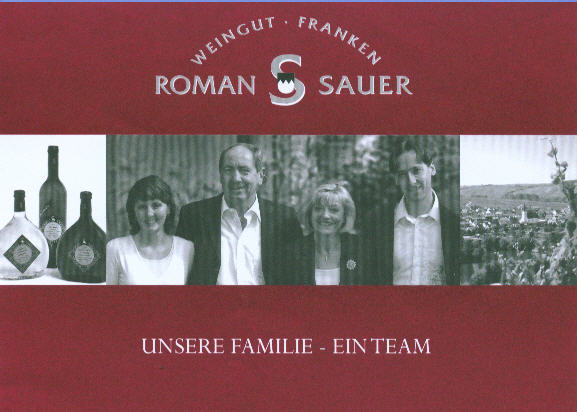
– Horst Sauer, Eschendorf
Horst Sauer also participated in the 2007 Canberra International Riesling Challenge and won a gold medal in the ‘current vintage 2006 sweet category’ for his “2006 Eschendorfer Lump Riesling TBA” and a bronze medal for “2006 Eschendorfer Lump Riesling dry”.
♦♦♦ (three stars)
– Juliusspital, Würzburg
– Fürst Löwenstein, Kreuzwertheim
– Hans Wirsching, Iphofen
– Brennfleck, Sulzfeld (significantly improved in 2006 and newly listed with three stars)
– Hofmann, Röttingen (as above)
♦♦ (two stars)
– Walter Erhard, Volkach (improved in 2006 and newly listed as two stars)
– Rudolf Max, Retzstadt (as above)
– Max Müller I, Volkach (as above)
– Trockene Schmitts, Randersacker (as above)
– Graf Schoenborn, Volkach (as above)
♦ (one star for discoveries of the year)
– Burrlein, Mainstockheim
– Felshof. Sommershausen
– Gebr. Geiger Jun., Thüngersheim
– Max Merkert, Eibelstadt
– Reiss, Würzburg
– Markus Schneider, Volkach
Unfortunately, I have only one bottle of Bocksbeutel left in my wine fridge. Empty bottles I have in abundance (for instance “2002 Würzburger Stein, Silvaner, Kabinett, dry” of Staatlicher Hofkeller which won a gold medal, “2003 Baccus, dry” of Schloss Castell and “2003 Würzburger Stein Sivaner, dry” of Juliusspital). The bottle to be enjoyed soon is a “2005 Kitzinger Hofrat, Silvaner, dry” of Bernhard Völker. What a pity that Franconian wines are not available in my local duty free shop in Jakarta.
The red wine “pope” of Franconia is Paul Fürst (Winery Rudolp Fürst in Bürgstadt. He won “German vintner of the year” award in 2003 and “best vintner of Franconia” in 2004. His webpage is very interesting too (www.weingut-rudolf-fuerst.de).
At the wine webpage www.finewinepress.com you will find an interesting interview with Paul Fürst in English. His “2003 Spätburgunder” (Pinot Noir) is a well acclaimed and award winning wine. I will introduce you to the winery at another time.
While in Würzburg we lunched at Juliusspital Restaurant which is what Germans call “gut bürgerliche Küche”, which I freely translate as “good quality, local food” (robust and harty in nature but also with delicate and fragrant elements). We drank from the open wine list (we had to drive home). My brother had a “2006 Juliusspital Schwarzriesling (Pinot meunier), dry” and I drank a “2006 Würzburger Abtsleite, Silvaner, Kabinett, dry”, both solid wines. It was unfortunate that we could not participate in any tasting since we had to get home the same day.
The design of the restaurant, by the way, is typical for historic German country inns. When I visited the restrooms I found to my great suprise wonderful cartoons on tiles. I had to take pictures, one of which you see below.

The texts freely translates as “Guess darling whom I am holding in my arm”.
Unfortunately, I do not have good photos of the family reunion. Needless to say that the three of us were overwhelmed by the hospitaly extende to us. Tables were bending under the food and wine on offer. We were talking and talking. It was so exciting that I forgot to take “intelligent” pictures with the result that I have some good ones of some of the participants but not of others. This is the reason why I will not show any of them because it would be unfair vis-a-vis the people whom I did not catch in a good enough pose. Since I have planned to take my wife and children there when we visit Germany next year, I promise to be more careful and present you with some good shots in the future.
The address of the restaurant cum wine bar is
Weinstuben Juliusspital
Familie Frank & Edith Kulinna
Juliuspromenade 19
97070 Würzburg
Tel.: 0931-54080
http://www.juliusspital.de




 Posted by themanfrommoselriver

 The Man from Mosel River