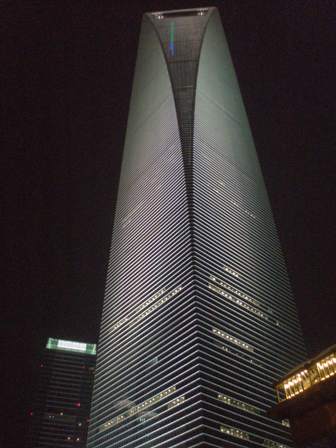
Shanghai by night

December 11, 2009

Shanghai World Financial Center

My friend Wolfgang took me around Shanghai by bight. After we had dinner with view of the Bund, we climed two of the hightes buildings, the Shanghai World Financial Center (492 m), also called “the bottle opener” and the Jin Mao Tower (421 m).

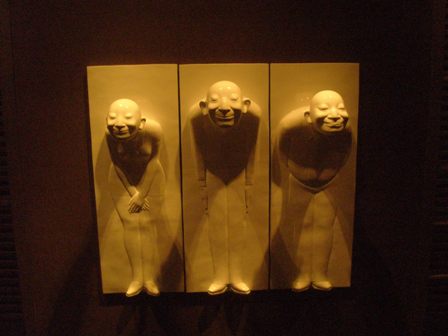
Three men welcoming us at the elevator

The entrance presents itself in a kind of minimalist Japanese style, resembling a bit an Egyptian tomb somehow. Very interesting feeling entering this building.

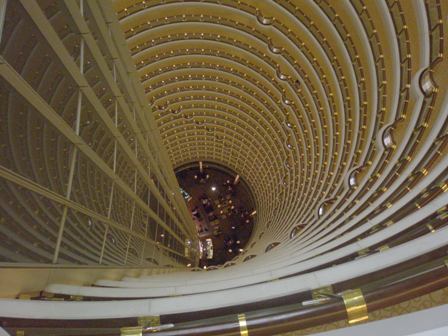
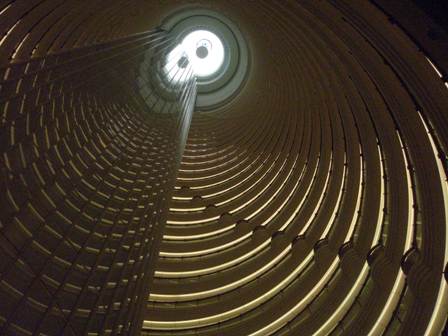
The top 30 odd floors are occupied by the Hyatt Hotel. The following two pictures show these floors. We did not go to the observations desk because it was just too late. Our walk led us to various restaurants and bars, all splendidly furnished.

Photo from the lobby upwards where a band was performing

Photo from above, 30 floors down is the dance floor where the band is playing

It was a breathtaking walk, a bit overwhelming though. More about Chinese food you will encounter in my next blog entry.


Beijing gray

December 9, 2009

Well, I am in Beijing by now and I am very surprised that I can enter my blog. When I wanted to add the picture in Shanghai the other day, the Great Fire Wall of China prevented me from doing so. The more my surprise that I can enter now.

It was a pleasant day despite the grey winter weather. Almost no visibility today. The people are nice as always in China and the food is excellent. I will report about some of my culinary excursions later.

I found Christmas music in every shopping mall; giant Christmas trees in all colours with flashing lights welcome the casual visitor. More new buildings, shops and shopping malls, restaurants and fashion outlets seem to open ever since my last visit in August.

The highlight of the day was my visit to Red Gate Gallery at Dongbianmen Watchtower. The current exhibition reflects the vibrancy of the young Chinese artists and their sense of humour. If in Beijing you should go and have a look. It’s well worth it.


Shanghai blue

December 8, 2009

I cannot believe it. I am blogging from China, from Shanghai to be precise. So far, whenever I traveled in China I could not access my blog and wordpress. Now the impossible has become possible. Incredible. Does that imply that the old censorship policy has been changed? or is it just Shanghai which is more open to the world?

I will add a picture to this entry later.

PS: I had to wait for the upload because the Great Firewall of China did not let me do it. Two days later in Beijing I manged to get into my blog again.

From the Pudong side, view of the Bund and the Huangpu river


Fifty five

October 24, 2009

55one

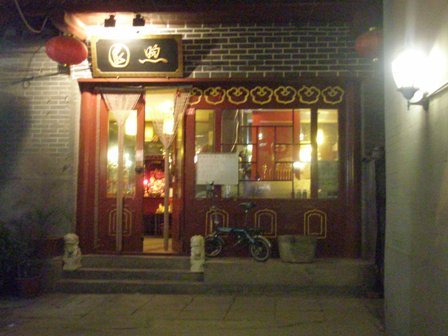
Back street near Houhai, Beijing

I was very luck to spend my 55th birthday with a good old friend in Beijing, China. He took me to a Hakka (“Kejiaren”) restaurant near Houhai where we had a jolly good meal and a jolly good time.

My Chinese name (Zhou Min-de) was given to me in 1983 by a Taiwanese farmer, Mr. Zhou, who was also Hakka (in Linlo Xian, near Pintung in Southern Taiwan).

We enjoyed the food and each others company. It was a mild August night, and the world seemed to be at peace. It was a double 5 festival for me, so to say. That must mean luck, prosperity and long, long life!

55two

After the feast

PS: We had beers, of course, what else? It just came naturally.


Blogging from a blogger’s desert

August 24, 2009

P8200037IAAE

The conference banner outside the BICC

Another week without a blog entry from me. There is a simple explanation for it. I attended an international conference in Beijing, China, which was a great success also for the host, the Chinese Academy of Agricultural Science (CAAS).

But whereas blogging from rural Australia was just an infrastructural challenge, this time the great firewall of China prevented me from communicating and reaching my blogging platform: wordpress.com.

It prevented me also from accessing my facebook and twitter accounts and various other sites of interest, for instance the Open Wine Consortium (which uses a NING platform format). Needless to say that youtube was also down.

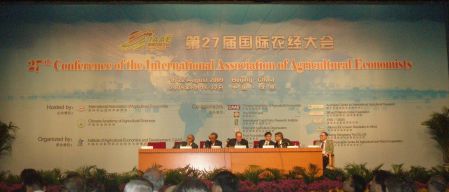
I am not a political blogger, just a wine and food enthusiast, and by training an agricultural economist which was the main reason why I attended the 27th International Conference of the Association of Agricultural Economists (16-22 August 2009) titled: “The new landscape of global agriculture”.
P8170001IAAE1

Experts on the dais

To say it from the outset, the conference was a full success. It was just great. I cannot but praise our Chinese host and the organizing committee as well as the Chinese agricultural organizations involved in its preparation and conduct.

The highest level of the Chinese government gave full support to the event and thereby to a field in public policy which had been largely neglected by the global financial institutions and many national governments alike during the last two decades. Vice premier Hui Lianyu, a native of Jilin province and a Chinese Muslim (Hui nationality), officially opened the event.

The great firewall of China, however, prevented me from publicly heaping praise on the Chinese government and the organizers, because I could not access the internet. Well, to be precise I could access some sites of the internet. We also had wlan-wifi connections during the duration of the event but the censorship exercised by the Chinese government did not allow for life reporting. A shame, good things could not enter the bloggosshere. There is a cost to such kind of censorship policy. China misses a chance to improve its public image.

Moreover, I wonder how many of the world’s top creative people would bother coming to a place where they are cut off from the world, their creative batteries, their inspiration and their audience for so long and from where the results of creative processes could not immediately find their way into the world wide web. This is another part of the costs incurred by the censorship policy.

We all know that the control of the internet by governments is a rat’s race. The whiz-kids, digital natives and techno freaks of this world, the Davids, to speak in biblical terms, are magically drawn to places like China in order to show and test their skills in beating Goliath: the Communist government. And therefore it is no surprise that there is ample support out there for trapped bloggers and others to circumvent the censors and jump over the great firewall of China by using proxy servers, and software designed to avert control. Alas, we are not alone in this tech-world of the 21st century.

Congratulations again to our Chinese partners for hosting such an important international event. May your government realize that it has more to gain than to fear from co-operation, sharing and the reciprocity through the inter connectivity of the world community and finally give up the censorship of the internet.

And then there is the saying of Mahatma Gandhi:

“When I despair, I remember that all through history the way of truth and love has always triumphed. There have been tyrants and autocrats, and for a time they seem to be invincible but in the end they always fail.”

It’s better to change when there is time for it. The communist party of China has shown wisdom in the past when it came to points of no return, for instance when they tolerated that farmers dissolved communes on their own accord and without prior sanctioning of the party. Let us hope they can draw on this wisdom also when considering the censorship policy.
Chinese Liquor

July 13, 2008

It is not just the grape wine bottles which we are drinking up before moving to Bangkok. I have a small collection of exquisite Chinese liquors given to me over the years by Chinese and Taiwanese friends.

The sorghum based spirits are wonderful though Western people often have difficulties appreciating the scent (some say it smells, well it does: of Sorghum of course). The Shandong liquor was smooth as silk. For ‘Gu Jing Gong Jiu’ you need to be in a youngish suicidal mode and not afraid of headaches.

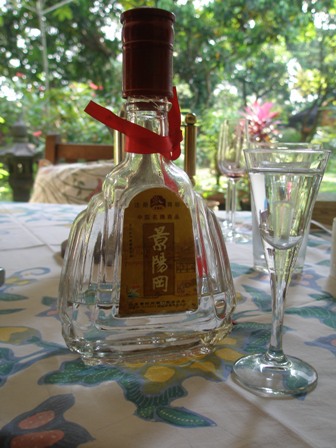
‘Maotai’, if it is the real stuff, is not only expensive, but a very nice drink. During my time in Beijing we drank a lot of rough ‘Er Gou Jiu’, but the bottle below is a ‘de luxe’ version.

Unfortunately, the bottles cannot come to Bangkok, so we enjoy them now. Soon our reserves will be gone and we can start anew to collect them. Thanks god that I have so many friends in Mainland China and Taiwan.

Shandong Bai Jiu, smooth like silk

Kweichow Maotai, 43% and Gu Jing Gong Jiu, 38%

Lao Beijing Ming Jiu (Er Gou Jiu), 45%


Red Wine Obsession in China

April 25, 2008

Recently when I was on a stop over in Singapore, I bought some portwine at one of the DSF duty free shops in the airport. The woman behind the counter was very friendly and we chatted along. I asked her which wines were her best sellers. She answered that they were grand cru wines from Bordeaux up 1000 S$ per bottle and that they were a much sought after commodity by tourist from Mainland China.

So it came as no surprise when I read the recent news about a sale of 27 bottles of French red wine by an anonymous Beijing based billionaire for the record price of about US$ 500.000 by the London based Antique Wine Company. The wines were various vintages of reds from Romanee Conti in Burgundy. According to the Antique Wine Company it was not bought for investment but to be drank. This sale is lauded for it’s indication that wine tastes in China are becoming more complex. The time of simply buying Bordeaux wines seems to be over. The broadening of wine education and appreciation is a good thing also for Australian wine producers. The recent large sale of Shiraz wines by Hanging Rock Winery is a good example for that.

A wine bar in a hotel in Beijing

During a recent trip to China I learned that red wine can be drank in new, “innovative” ways some might call it. Next time you are in China order “Red wine set menue” and you will be served with a good bottle of red Bordeaux wine, a large glass with ice and two cans of Sprite. You mix it together and you are right.

Many wine drinkers heart may sink at the prospects of being invited by a Chinese friend to this type of “blending” red wine. If the cheap mass wines are being mercerized by this technique that might be a good thing. For boutique wine producers like myself it is a rather shocking prospect that my elegant Two Hills Merlot could be treated that way.

“Gan bei” (cheers) as the Chinese say.


Grape production in China: Turfan – Oasis in the far West

June 7, 2007

Today I want to take my readers on a long trip to the Far East. China is our destination. That wine is produced in China, is “no news”. When we were living in Beijing in the early 1990s, we were very pleased to find Qingdao Huaguan Chardonnay, Great Wall and the Dragonseal reds. Today, shops in the big cities are well stoked with wines from all over the world. Wine consumption is increasing. The internet is full of news and analysis about Chinese wines and wines in China (www.wines-info.com). I found on the net a lovely 200 pages book manuscript of the late Pieter Eijkloff with the title: “Wine in China – Its history and contemporary development”. There is so much to read about wines in China, incredible.

In 2005 my wife Margit and I, visited the most Western part of China and we stayed a couple of days in Turfan. The main motive was sightseeing and to get to know this part of China which we had never visited before despite the fact that we resided almost six years there. Turfan is a very fertile oasis in the middle of the dessert along the Silk Road. it is located in a depression about 30 m below sea level and the Turfan basin extend to about 50,000 sqkm.

A mosque in Turfan

The pictures below give you an idea under what condition grapes are produced in this region with an extreme climate, very short, but hot summers (up to + 40 Celsius) and very long and ice cold winters (up to -20 Celsius). There is only minimal precipitation, on average about 20 mm per year. When we were there it “rained”. That’s what the local guide told us, otherwise we would not have notices. It was just a bit humid.

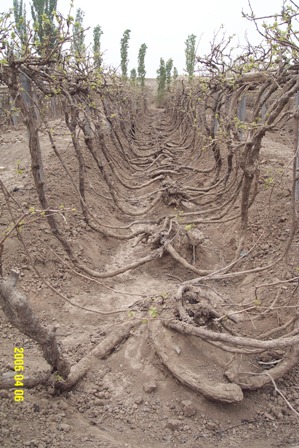
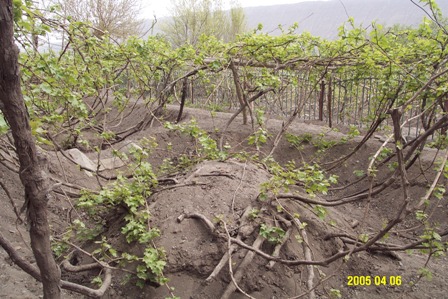
A typical vineyard near Turfan in spring

During the winter months the canes are buried in the ground to keep them alive. In spring they dug out and “hung” over various kinds of racks. Because wood is so scarce, we find all kinds of material where the vines are hung up. According to our guide there are many hundreds of different varieties. Unfortunately, our guide was not a grape expert.

Vines in the two-row system

Vines in the one-row system

However, we visited a family and could buy some of their produce. Traditionally they produce raisin not wine. Most Uigurs are Muslim therefore they do not drink alcohol. The grapes are dried in open barns.

A drying barn

Margit buying raisin in the market

In the local supermarkets of Turfan we could get a good overview on what wines were on offer. The sales prices drive tears into the eyes of an Australian primary producer. My vintners heart almost broke. What a pittance of a price for the producer will be left when all the costs of the agents are deducted!

The vines are irrigated with an age old irrigations system, called the Karez system. The water from the surrounding mountains, mostly from melting snow, is brought to Turfan through a sophisticated system of wells and deep channels dug by hand and lined with sheep skins. Thousands of kilometres of underground water channels can be found. From this precious resource mostly vegetables and fruit are grown.

Vines coming from a “central point and hung in squares”

Most meals we had included of some kind of mutton dish. We enjoyed the rustique but delicious cuisine of the Uigurs. After many beers and some “schnaps”, we also tried some of the reds. I do not remember the brands but we loved the drop. Traditional dances were presented and in one location the local invited us to dance to their music to which we joyful obliged. It was a very memorable visit to this most Western part of China and its friendly people in the bubbling markets. Needless to say that I brought back some of the traditional head gear and an lute like instrument.