Down under: Autumn time – harvest time

April 23, 2010

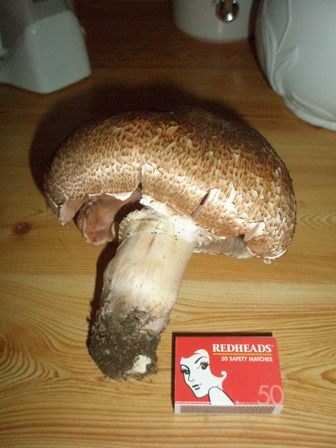
During long walks in the vineyard and around the paddocks we collected quite a few delicious mushrooms. The specimen above was particularly significant. Together with some other mushrooms it made a great pasta ai funghi porcini.

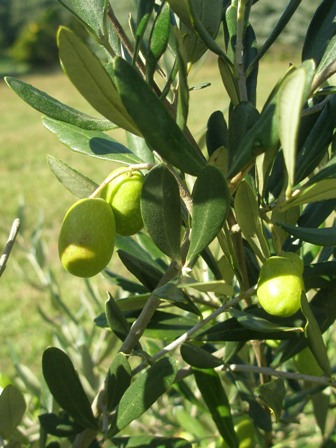
My olive grove was bady damaged during the bushfires last year. Only about 30 of my 100 olive trees escaped unharmed. Although there is lots of new growth from below, it will take years before the olive grove will take shape. However, there were still some beautiful olives to be harvested.

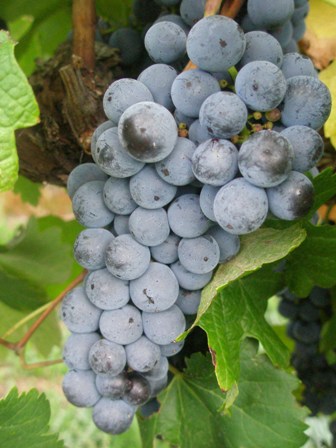
And of course, there were grapes, lots of them. Below a ripe Merlot bunch. It’s a pity that we could not sell all of our vintage this year. The grapes were very sweet and full of juice.

Autumn is a wonderful time in the cyle of the year. It was only the second time that we had the chance to experience it on our farm first hand. Happy days.


The good life on the farm

April 22, 2010

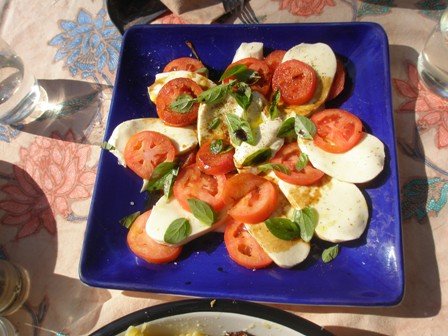
We have hearty good food when on the farm in Glenburn. The beautiful autumn weather allowed us to sit outside and enjoy pasta dishes, meats, salads and other rural food in the mid-day sun. And we all love Italian cuisine.

Zucchini pasta

Insalata caprese

We also have wine with the food. Often we just open a bottle of Two Hills Merlot. But more often than not, we are tasting wines made by our friends in the wine industry. The cucchini pasta we had for instance with a bottle of 2009 Sauvignon Blanc from Steve Sadlier’s vineyard, Nenagh Park, in Yarra Glen.

It has no label as yet, what Australians call “clean skins”, but it’s a ripper of a wine, not in the New Zealand style but rather the one of Sancerre, France. Epicurus would give an arm and a leg to be with us, for sure.

Steve’s Sauvignon Blanc


Backyard vintner

April 20, 2010

Pips Paddock, Springvale, Yarra Glen

The current overproduction of wine grapes is a great worry for many of the small, medium as well as large producers. Especially for fruit growers the outlook is bleak. Nobody wants to buy your grapes if the slightest deviation from “perfect” is detectable. They just walk away from you and let you sit on the fruit. It’s a buyers market.

However, there are options. One is to make your own wine. Not much equipment is required and space is usually available, even if it is on the back porch of the house.

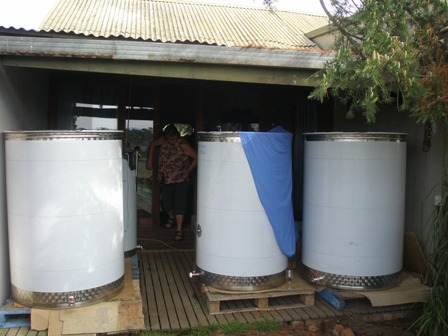
The new stainless steel tanks on the back porch

My friend Gayle Jewson from Springvale, Yarra Glen did exactly that. The grapes were hand picked and sorted, pressed, destemmed and dumped in new stainless steel vats for fermentation.

When we arrived I tasted the “brew” for the first time. Two weeks later I had a second tasting opportunity. What a difference two weeks can make? Amazing. I think Gayle’s Pinot Noir is on the right track and her Chardonnay is just lovely. Lock out for Pips Paddock Pinot and Chardonnay this year. There is only very limited supply. Visit Gayle on her farm and/or order by phone.

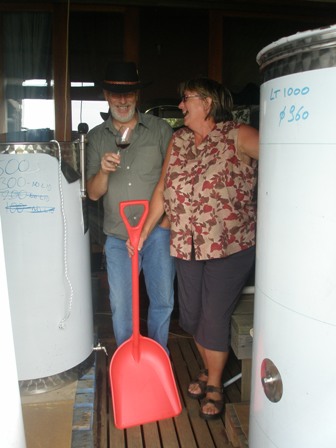
Tasting if fun

The backyard vintner in action


Good friends and good wines

April 12, 2010

Enjoying good wines together

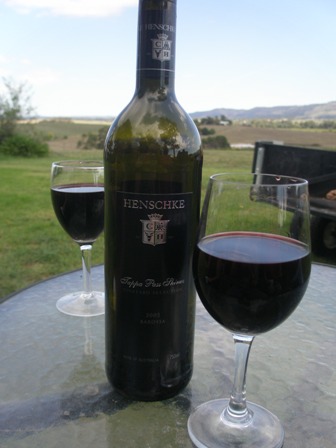
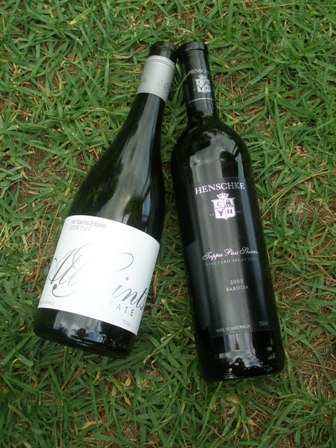
It is always a pleasure to visit Gayle and Phillip at their Spingvale farm just outside of Yarra Glen. They served us wonderful wines. A ‘2005 Tappa Pass Shiraz Vineyard Selection’ by Henschke from the Barossa Valley in South Australia and a ‘2008 All Saints Estate Durif’ from All Saints Winery in Rutherglen, Victoria. Both wines are wonderful, lush and full of flavor, the right stuff for a long chat on the lawn. Needless to say, we had a great time.

An afternoon with red wines

The 2005 Henschke Tappa Pass Shiraz

The 2008 All Saints Durif

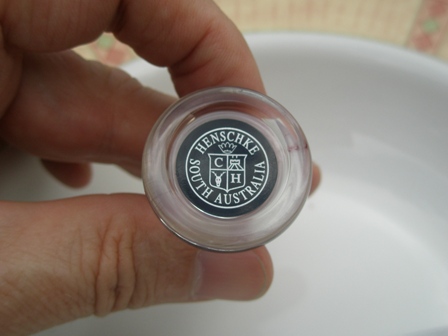
The Henschke Shiraz with a glass enclosure

When its over: bottles on the ground


Liz Mazurek Art Exhibition at Rocky Passes

April 11, 2010

Rocky Passes 2006 Syrah

One of our favorite “house wines” is Syrah from Rocky Passes, a winery about an hour north of Two Hills Vineyard. Rocky Passes Estate has received rocking reviews from James Halliday, one of the “popes of wine” from the Yarra Valley. The 2006 vintage received 92 points. Vitto Oles is a jolly good fellow, excellent wine maker and carpenter.

James Halliday wine reviews of Rocky Passes

Liz Mazurek painting

Today the newest art exhibition of Liz Mazurek starts at Rocky Passes. The theme is “The Persistence of Existence”. There is also a three course Spanish dinner available at the opening. If you have not reserved just go for some wine tasting and have a look at the colorful paintings of Liz. Rocky Passes Estate is worth a visit.

Address:
Vitto Oles & Candi Westney
Rocky Passes Estate
1590 Highlands Rd
Whiteheads Creek
Vic 3660
Australia
+61 3 5796 9366
www.rockypasses.com.au


Rural life – fishing in the dam

April 10, 2010

It took me a while to resume blogging. I did not keep my promise to post at least a photo a day. I am sorry about that. My first week of holidays on the farm was very eventful and I had a lot of things to do. But today it is raining and I have some time on my hands. Work can wait.

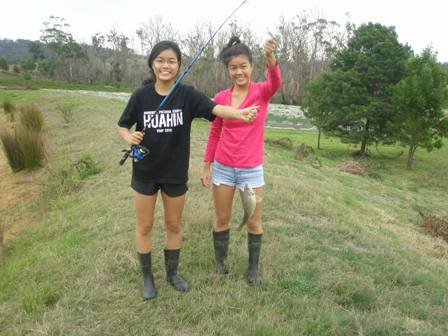
Yesterday was one of these beautiful autumn days. We decided to go fishing in the dam. Some years ago we had stocked the smaller dam with some silver perch. We took the fishing rods, got some scrubworms and off we went to check out if the cormorants left some fish for us humans.

To cut a long story short, Lucy was the first to catch a silver perch,then came Charlotte and finally Helen, all with their first ever fish. The fourth fish was thrown back into the water. Three beautiful fish should suffice for a hearty country meal. Later Margit pan-fried the perch with a few local herbs and butter. It looked beautiful, but came up a little bit muddy. This was possibly because of the rain and yabby activity. We threw in a couple of yabby nets, which should provide us with a nice lunch in a few days.

Lucy with her first ever fish

The silver perch

Lucy searching for a suitable worm

Charlotte and her first fish

Another silver perch – Lucy, Helen, Charlotte and Michael

Food and local wine at the dam

Of course, we tasted a lot of local wines. I chose a bottle of ‘2003 Kinloch Estate Pinot Meunier’ and a bottle of ‘2004 Two Hills Merlot’. I love the Pinot Meunier Malcolm Kinloch makes. A bottle of our own wine

The fishing party

Beautiful silver perch

Ready to be eaten

Needless to say that we had a wine with the fish. I selected a ‘2009 Sauvignon Blanc cleanskin’ from Steve Sadlier, our friend and vintner. which he had given to me the day before. That was a wonderful choice. The Loire style Sauvignon Blanc from the Yarra Valley complemented the flavour of the white fish perfectly.


Getting ready for the 2010 vintage

February 22, 2010

Two Hills Pinot Noir shortly before the nets went on

The nets are on now, and we are expecting a good harvest at Two Hills Vineyard for 2010. After the total loss of last year the prospects are not too bad.

Estimates are:

– Sauvignon Blanc: about 8 tonnes of fruit, and already sold
– Pinot Noir: about 5 tonnes of fruit and still looking for a home

The Merlot grapes look good too, but we are not making any wine this year. This will make the bird in the vicinity very happy, what a feast. That’s the price we have to pay for the grape glut. It’s sad but cannot be helped at this point in time.

Our new tractor will come into action for the vintage. This will make things easier, I hope.
Let us hope no unexpected disaster occurs before the grapes are in safely.

The plan for 2011 is to mothball the vineyard for a couple of years and see if the market recovers.


Wine of the day: Climbing Merlot by Cumulus Wines

February 20, 2010

Cumulus Climbing Merlot

I do not drink much wine from New South Wales, except maybe Semillon wines from the Hunter Valley. The other day some wines from Cumulus Wines, the largest producer (about 500 ha under vines, not a boutique producer), located in the Orange Region, appeared in our supermarket in Thonglor, Bangkok.

I bought a couple of bottles from the Climbing Series (Shiraz and Merlot). My children liked the label. The ‘2007 Climbing Merlot’ won gold, silver and plenty of bronze medals. It’s a cool climate (grown above 600 m), fruity wine, elegant with a good structure, a delight of a wine, even if one has to fork out about 20 Euro/30 A$ for the bottle here in Bangkok.


Wine of the day: 2008 Yering Chardonnay

February 18, 2010

After a hot day in the tropics nothing is better than a nice glass of white wine. We selected a ‘2008 Yering Station Chardonnay’ from the Yarra Valley. Yering Station is the oldest vineyard in Victoria. The winery is a must visit if you are touring the Yarra Valley. It’s located just outside Yarra Glen.

Only very recently had this wine arrived in our supermarket in Thonglor, Bangkok. It’s moderately priced for Thai conditions (less than 10 EURO or A$ 15) and a very lovely drink.

Wine on the terrace: 2008 Yering Station Chardonnay

Yering Station has still ‘grape growers with contracts’ and our friend Steve Sadlier is one of them. If we want to drink wine from his grapes, Yering Station is the winery to buy it from. Steve produces excellent cool climate fruit in the Yarra Valley.

We were a bit homesick and needed a reminder that Australia can be very near. Cheers folks


Who destroyed the Australian wine industry? …and the culprit is….

February 15, 2010

I have not been reading the Daily Wine News for a couple of days. After coming home last night, I browsed through the accumulated news. And, Eureka, I found for the first time someone who points his finger in the direction of the big corporate producers.

So far the tenor of most critics has been that there is just too much wine around (surplus of 20-40 million cases of wine each year) and that mostly greedy investors, money trusts and lifestyle (hobby) vintners, loaded with money made in construction or as medical doctors are the ones to blame. They are the ones who single handedly destroyed the wine sector; they produced the “wine lake”, and planted unsustainable hectares of new vineyards. The remedy was also clear: the small ones have to go. Instead wine production had better be left to the professionals (i.e. the corporates).

In comes Brian Croser, the founder and former owner of Adelaide Hills based Petaluma winery, with his view of the problem. He believes that the 2,000-odd Australian vintners are the originators of first-class Australian wine and have been the creators of the outstanding international image of their produce. The large companies, the corporates, have benefited from this positive image and “sailed on it”. However they mainly produce commodity wines of inferior quality which they dump on world markets, thereby destroying the reputation of fine Australian wines.

Whether this is true or not is certainly debatable. Everyone who extended their plantings in the hope of a larger marketshare is somehow to blame. However, finally we can hear another tune, not heard before and the public conversation has not only become more colourful but also more pluralistic, which is good for everyone.

If we have to pull out 40,000 ha of grape vines, they should come from various sources. If one of the four big companies would go and leave the sector, a lot could be gained for the remaining producers. Alternatively, small producers could pull out. What would be better for the country? this is a question not easily answered.

We will see small, medium as well as big companies leaving the industry. Many small family businesses will have their niche and will thrive regardless of the downturn of the sector. Others will close down, especially fruit producers who are at the end of the value chain (actually they are at the start of it). Also some of the investor and dividend driven schemes will come to an end. Vineyards and wineries will be hard to sell for some time to come. The big corporates will clean up their portfolios, they might de-invest in wine production and move into other segments of the beverage industry. Lower average profits in wine making will make other investments relatively more profitable. The wine sector will remain unattactive for young professionals for a while until the pendulum swings back, and the cycle of boom and bust will start all over again.

We at Two Hills Vineyard came too late to the party, and were caught out, so to say. I guess, we will go into hibernation and see what the prospects are in a couple of years time. I hope we can afford this strategy and that it will pay off some day when we can reduce costs and better market our produce. I remain optimistic and we will hang in there. Cheers to Two Hills wines!
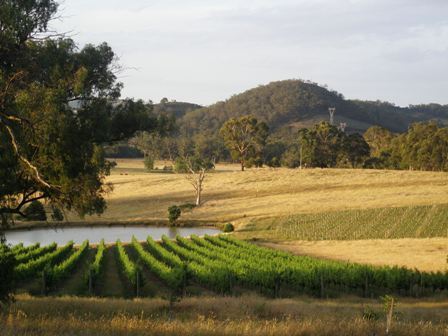
Two Hills Vineyard, Glenburn