Today, after all these Mosel meals, I want to take you back to Australia and write about the wine region in which our vineyard is located: the Upper Goulburn Wine Region. I also would like to inform you a little bit about the activities of the Upper Goulburn Winegrowers Association (UGWA; www.uppergoulburnwine.org.au).
The Upper Goulburn is located in central Victoria. The region derives its name from the Goulburn River which is one of the main features of the area. It is a cool-climate grape growing area setting it apart from most other parts of Victorian. The region has only recently been classified in the geographic indication system. Grapes, however, have been grown in this part of Victoria for almost 40 years. In comparison to the Mosel this is indeed a very young wine region.
The Geographic Indications Committee of the Australian Wine and Brandy Corporation (AWBC; www.awbc.com.au) determines wine zones, regions, sub-regions and their boundaries. The system was introduced after lengthy negotiations with the European Union which did not accept Australian wines unless it complied with European regulations. The Australian Wine and Brandy Corporation Act of 1980 was amended in 1993 to accommodate those requirements.
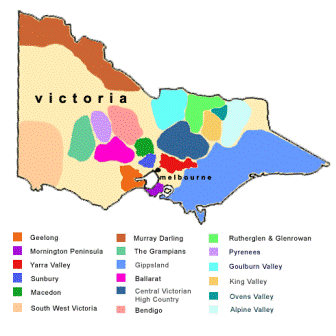
Wine Regions of Victoria Map Dark blue formerly Central Victorian High Country and now divided in Strathbogie Ranges and Upper Goulburn Wine Region (www.wineaustralia.com/australia
The region is very diverse in terms of altitude, climate, temperature, rainfall, and soils. Site selection is of ultimate importance. Rainfall varies from 700 to 1400 mm. Some vineyards even rise to the snowline at 800 m. Many locations are ideally suited for sparkling wine production consisting of Chardonnay and Pinot Noir grapes. Aromatic varieties such as Riesling, Gewuerztraminer and Sauvignon Blanc can be found but also Cabernet Sauvignon, Merlot, Malbec and Shiraz. (www.greatwinecapitals.com/melbourne/mel_reg_centralvictorianhighcountry.html)
The Upper Goulburn is very picturesque and one of the gems of Victoria. It extends from Tallarook in the west to Mansfield, Lake Eildon and further north Lake Nillacootie. Regional centres like Yea, Alexandra and Eildon are located in the region. Mount Buller and its skiing slopes, the lakes, the small rivers and the high planes are a premium destination for national and international tourism.

Mount Buller with snow cap
Two Hills Vineyard can be found at the most southern edge of the region on the way to Yarra Glen. Today there are about 25 wine labels and more than 30 vineyards in the region. Recently a branding workshop has identified the key characteristics of the region which include:
● high diversity of vineyards and wines
● climate very suitable for premium cool climate grapes and wines
● aromatic whites/sparkling wines and elegant reds
● hand picked and hand crafted grapes/wines
● family owned businesses
● environmentally aware producers
● low environmental footprint
● shared experience between producers and customers
● good infrastructure
● unknown – Victoria’s secret
From these few words it is clear where you have to spend your next holidays: in Central Victoria. See you there (www.visitvictoria.com/wineries).

Two Hills Vineyard


 Posted by themanfrommoselriver

 The Man from Mosel River