Food and wine pairing: vegetable soup and Riesling?

September 28, 2012

Our vegetable soup

As you probably know summer days in Germany can be chilly. This is not a big deal because the appropriate food is easy to find. How about a real vegetable soup? Not one out of a tin but with real veggies, cut into small pieces and cooked with just the best stock. And how about some home made bread as well?

Sounds yum. I tell you.

But what about a wine? Should it be red? Should it be white?

Well, my choice was a young and fresh Riesling from the Rheingau. From my recent visit of Schloss Johannisberg, Rheingau I had brought a bottle of ‘2011 Schloss JOhannisberg dry Riesling’ from the “Gelblack” series.

I got the bottle from the cellar door for 13.70 Euro/bottle. The alcohol content is 12.5%, residual sugar is 7.9 g/l, and total acidity is 7.5 g/l. The colour is a beautiful straw yellow. It shows lush aromas of green apple and tropical fruit. The acidity is charmingly fresh and zesty.

We gave the wine no chance to age and show it’s long-term potential. The young fragrant Riesling complemented the creamy soup with its carrots, cellery and other fresh garden-vegetables very well.

Cheers and enjoy!


Big summer wine tasting at Weingut Karthäuserhof, Eitelsbach II

September 26, 2012

Wine tasting

Let us come back to the Karthäuserhof estate tasting on August 11, 2012. It was a splendid summer’s day with blue sky and ample sunshine when we walked into the estate.

We paid our entrance fee of 15 Euro/person. It was all very confusing for a first time visitor. Many of the other guests, it seemed, knew their way around. Lot’s of people had showed up.

The wine tasting was conducted in two seperate locations. The first was a rather crammed barn with four tasting stations. I can only recall three of the wineries represented. The barn was packed with people, pushing and shoving along.

The vintners behind their tables were equally, let’s call it – stressed. I immediately felt some regret. Why did I give up a perfectly spacious table elsewhere and a bottle of wine in a quite atmoshere, I aske myself.

The tasting station of Knipser Estate

The three wineries were:

Weingut Knipser (Knipser Estate), Laumersheim, Pfalz
My first wine from Knipser I had tasted in Beijing, China, about 24 years ago, when my friend Norbert who is a native of the Pfalz, presented me with some dry Riesling from this estate. The family tradition of wine production in the Pfalz goes back to 1615 (an incredible long time in an Australian context).

Weingut Meyer-Näkel (Meyer-Näkel Estate), Dernau, Ahr
The Meyer-Näkel family, now in the fifth generation, has about 15 ha under vines, 75% of which are Pinot Noir, 12% early Pinot Noir, 5% Pinot Blanc, 5% Riesling and 3% others. One of the two daughters presented the wines when we were there. The Ahr is the northernmost (and the smallest) wine region of Germany and produces some stunning Pinot Noir wines.

Weingut Koehler-Ruprecht or The Vintage Vineyard as it is called on the webpage, Kallstadt, Pfalz
The vineyard is about 10.5 ha in size. The mainly white varieties (Riesling, Pinot Blanc, Chardonnay, Muscat, Scheurebe and Pinot Gris) are planted on a calcerous soil in four locations in Kallstadt (Saumagen, Annaberg, Steinacker, Kreidkeller).

The first two wineries I know quite well. I have tasted wines from these producers at various occasions. The Koehler-Ruprecht estate was new to me. I admit that I do not know the village of Kallstadt near Bad Dürkheim. The webpage of Koehler-Ruprecht, however, is presenting the estate in five languages (German, English, Chinese, Norwegian and French)!

The Meyer-Näkel tasting table

And now the bad news: the crowded conditions did not lend themselves to note taking. Anyway, I was not in the mood while being pushed and shoved to think about anything, except: let’s get our of here as quick as possible.

But then I also thought, Rainer, you should taste some of the wines. Which I did. I remember nothing, except that the grand cru Meyer-Näkel Pinot Noir was wonderful, and that the daughter behind the counter was very kind and friendly.

We went to search for the second wine tasting station thereby recovering a bit from our claustrophobia.

More about this later.
Stay tuned.


Big summer wine tasting at Weingut Karthäuserhof, Eitelsbach

September 23, 2012

Karthäuserhof Estate, main gate

A winery I always wanted to visit is the Weingut Karthäuserhof in Eitelsbach, a small hamlet which is part of Ruwer, a suburb of Trier, just a couple of kilometres away from my home in the city centre.

The wine estate Karthäuserhof is a member of the elite club of German wine estates, the VDP. It is a prime producer of outstanding Riesling wines. The estate if farmed by the sixth generation of the Tyrell family. The vintner Christoph Tyrell is well known in the region and beyond.

Every year on the second weekend in August, Karthäuserhof is hosting a wine tasting conducted in co-operation with about a dozen other top German wineries from various wine regions. The 2012 tasting was a very special occasion since it marked the 200 anniversary and jubilee vintage of the Tyrell family.

The 11 August 2012 was a special day indeed; it was our last full day in Germany before our departure to Bangkok. My wife Margit and I, we were looking forward to the event despite the fact that we knew we could not buy a lot since our suitcases were already full with various bottles of wine which we had already purchased.

Our view from the bathroom window

Since we stayed with friends right across from the estate, we had a great view of the location “Karthäuserhofberg”, one of the ‘grand cru terroir’ of Karthäuserhof.

The vineyard has an inclination of about 50%. The soil is Devon grey and blue slate. It is situated right next to the winery and exclusively in the ownership of the Tyrell family. The total area under vines in one plots (very unusual for Germany, I would say) is about 19 ha, 17.7 of which are under Riesling, the rest under Pinot Blanc grapes.

I hope I have wetted your appetite. My next blog entry will deal with the wine tasting, the various wineries represented and their wines. Stay tuned.

Address:
Weingut Karthäuserhof
Karthäuser Straße,
54292 Trier,
Germany
Tel.: +49-651-5121
http://www.karthaeuserhof.com


Food and wine pairing: spicy prawns with off-dry Riesling from the Mosel river

September 21, 2012

Spicy prawns sizzling in the pan

I love spicy food, especially seafood. I find it also easy to identify an appropriate wine for such occasion. During a casual stroll through one of the local super markets here in Bangkok, I found a small selection of wines from my beloved Mosel river.

I could not believe muy luck.

‘2010 Brauneberger Juffer Riesling Kabinett’ by Weingut Max Ferdinand Richter

I selected a bottle of ‘2010 Brauneberger Juffer, Riesling Kabinett’ by Weingut Max Ferdinand Richter, in Muehlheim, Mosel.

The name of this vineyard (31 ha, opposite the villages of Brauneberg and Muehlheim) is intriguing, Braunenberger Juffer. “Brauneberg” stands for ‘the browninsh colour of oxidized devon slate’ and “Juffer” means ‘un-married young woman’/vestal-virgin. There is a story about a young woman who rather tended the vines in this prime vineyard location instead of getting married.

Well!

‘Braunberger Juffer’ is is one of the top terroirs along the lower Mosel. I was so mesmerized when I read ‘Brauneberger Juffer’ on the label, that I did not pay attention to the “attribute”, ‘Kabinett’ which suggests an off-dry type of wine. Not my favourite usually. 50 or so odd grams of residual sugar at 7 to 8 g./l. acidity, is just too much for me.

Fortunately, such information is not mentioned on the label. I would not have bought it. But after all, the sweetness of the wine balanced the spiciness of the prawns exceptionally well, and I was reconciled with my choice of wine.

I guess a dry Riesling would also have been a good choice, but maybe next time.

I love the label: Braunberger JUffer Riesling Kabinett

This wine is full and round, mellow, almost oily. The dominant aroma is peach with some hint of honeysuckle. On the palate the sweetness of bee honey is dominant. However, the wine is light and fresh. The acids are well balanced. The fine texture is tangible and the long finish is rewarding.

Address:
Weingut Max Ferd. Richter
Owner: Dr. Dirk M. F. Richter
Hauptstrasse 85
54486 Mülheim/Mosel
Germany
Tel.: +49-6534-933003
e-mail: drichter@maxferdrichter.com


Riesling from the Ruwer river: Maximin Grünhaus

September 14, 2012

2011 Maximin Grünhäuser Riesling trocken

One of the nicest dry Mosel Riesling wine I tasted during our summer vacation in Trier was a ‘2011 Maximin Grünhäuser Riesling trocken’ by Schlosskellerei Maximin Grünhaus C. von Schubert in Mertesdorf, Ruwer.

It was at Weinsinnig, one of my favourite wine bars in Trier, that we sampled this wine with its romantic and old fashioned label. The wine has character. Although just from their “ordinary” dry Riesling class, you get value for money (9.90 EURO/0.75 l. bottle).

2011 Maximin Grünhäuser Riesling trocken

It has the zest, the exuberance, the fine balance of acids, the opulent aromas, the structure and long finish one longs for in a Mosel Riesling. Although I had driven past the winery many times before, I had never tasted a wine from this first class producer in the Ruwer valley.

The MUNDUS VINI award for the best dry white wine in Germany 2011 and the “Big Gold Medal” were bestowed on the ‘2009 Maximin Grünhäuser Abtsberg Riesling Qualitätswein old vines’, of the estate. I wonder what this wine would taste like.

But I tell you, I will return, and include some more of their wines when I visit the Mosel next time.

Address:
Dr. Carl von Schubert
Hauptstr. 1
54318 Mertesdorf

Tel.: +49 (651) 5111
Fax : +49 (651) 52122
info@vonschubert.de

Maximin Grünhaus


Assmannshausen Hoellenberg Spaetlese – Best Pinot Noir of my summer holidays

August 28, 2012

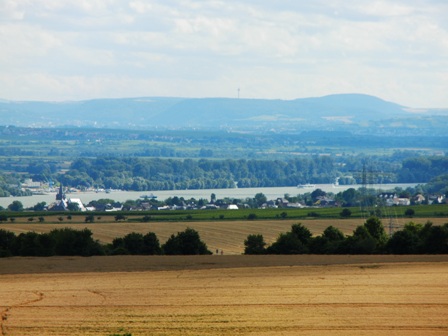
View of the Rhine from Bingen looking downstream

Well, if you could just see around the bend in the river, you could see Assmannshausen and its steep vineyards. The vineyards you see in the distance on the other side of the Rhine river here in the photo above are in fact the ones of Ruedesheim. However, you will get a good idea how steep these terroirs are and what a hell of a lot of work it is to cultivate the grapes on these steep slopes.

‘Hoellenberg’is the name of the location (terroir) which means in English (freely translated) ‘mountain of hell’, a quite common name for steep slopes in the Rheingau wine region.

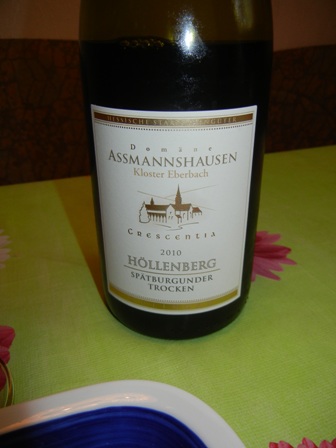
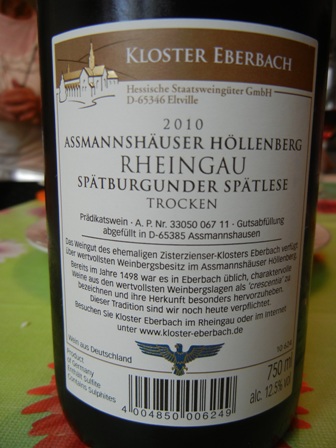
In short, the best Pinot Noir (spaetlese, late harvest) I tasted during my five weeks in Germany was a ‘2010 Hoellenberg Pinot Noir Spaetlese’ from Assmannshausen produced by Kloster Eberbach in the Rheingau.

2010 Assmannshausen Hoellenberg Spaetlese – Pinot Noir

I bought the bottle in the wine shop at Kloster Eberbach for about 17-18 Euro, I think and it turned out to be a treasure. Pinot Noir of the finest kind. Pinot Noir the way I like it, full of flavours but well balanced, earthy with a vibrant acidity, a good body, structure and a long finish. A wine with character.

At 12.5. % alcohol, this wine is not overpowering but elegant, regal I would even say. I immediately regretted that I had not bought more bottles. I was to fast, as always, impatient. At the time I did not want to stand in line for the tasting on this busy Sunday afternoon when we had dropped in the cellar door at the monastery in Eberbach.

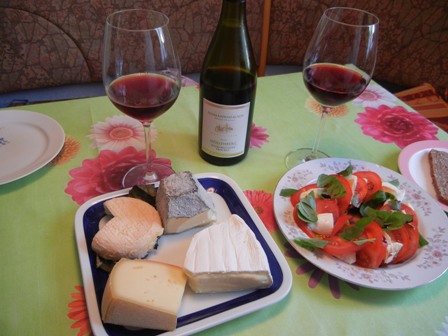
A selection of cheeses and salads

We had the wine in a very casual way with some summer dishes, salads and typical German dinner cold cuts and an insalata caprese. The wine would have matched almost any food except some spicy Asian dishes. but it is worth being enjoyed as stand alone drink.

My rating: four and a half out of five stars, 19 of 20 points, 90 Parker points. I could not be more subjective, I guess. In hindsight and given my memory lapses, I consider this the best wine I drank during my summer vacation.

The only one exception maybe was the wine tasting at Karthaeuserhof in Eitelsbach which I attended at the last day of the holiday, but then we merely tasted (small amounts of excellent wines in big glasses and without food) and did not drink a bottle of wine.

More about this event, another time. Stay tuned to the Man from Mosel River.


Von Othegraven Winery in Kanzem, Saar

August 25, 2012

Regular readers of my blog will have noticed that I usually abstain from writing negative comments about any wine experience. Today I will break with this tradition making a slight dent in my otherwise immaculate positivism.

Summertime in Germany is also the time of wine festivals and the time of visiting wineries and cellar doors. And keeping in the spirit of things, my family and I, we set out on a beautiful day in July to pay a visit to one of the wineries along the Saar river.

I needed a birthday gift for a dear friend of mine and I intended to honor him with a first class bottle of wine from a first class winery. Since my friend lives in the Ruwer valley, a location with excellent Riesling terroir, I wanted to contrast the Ruwer wines with a specimen from the Saar, the other tributary of the Mosel where excellent Riesling wines are produced.

My choice was the Von Othegraven winery in Kanzem, a small hamlet on the banks of the Saar river. This winery is quite well known in Germany because Guenther Jauch, a celebrity TV moderator and talk show host, is the owner of the place.

I could not have been more wrong in my choice.

We rocked up without an appointment (which we would regret), drove into the courtyard of the estate at the outskirts of Kanzem at the bottom of the steep vineyards of the Kanzemer Altenberg, the grand cru vineyard of the area.

We innocently rang the bell of the manor house but where greeted by a very grumpy vintner (it was the manager, not the wine-maker), who let us know immediately and in a very impolite way that we were not welcome, and should “buzz” off.

Uff, we were mentally not prepared for such a rude reception, and deeply regretted that we had bothered to come in the first place.

So my recommendation to the casual wine tourist is not to visit Von Othegraven. It is a waste of time. If you are still interested in their wines, go to my favourite wine bar, Weinsinnig in Trier, and buy a bottle of the outstanding Altenberg Riesling.


Kloster Eberbach, Rheingau

August 7, 2012

The Rheingau wine region

Because of a flight delay we had a couple of hours on our hands with nothing to do. This provided us with an unexpected but welcome opportunity to visit the Rheingau wine region. So where to go and what to do?

Some years ago I had been to Eltville, one of the many small and pretty settlements with extensive wine culture and history. Last year in November I met a couple of professors from the famous wine institute in Geisenheim, Rheingau at the 3rd International Symposium on Tropical Wine in Chiang Mai, which further nurtured my curiosity in the Rheingau wine region.

So I typed “Kloster Eberbach” into the navigation system of the hired car and off we went to this place near Eltville which I had always wanted to visit. We were looking for some mix of culture and wine. In no time we were cruising the country roads of the Rheingau.

Vineyards and farm buildings

The region on the right side of the Rhein river between Wiesbaden and Assmannshausen is like a Garden Eden of the modern world. The slopes of prime vineyard land descend gently towards the Rhein river. The land is very fertile and the climate very suitable for the production of first class wines, mainly Riesling.

The top of the mountain ridges of the southern Taunus are crowned with deep forests. Many of the villages and settlements are very beautiful. Every year millions of tourist flock to places like Ruedesheim, Geisenheim, Erbach and Eltville.

The Eberbach monastery

Our destination, the Eberbach Monastery, formerly a Cistercian Abbey, is a kind of museum today. We had a look at the old church, the cloister and the various rooms used by its monks from the 12th century until the French revolution and the secularization of church property under Napoleon.

Fortunately, the grape-growing and wine-making tradition of the monks has been preserved. Today the state of Hessia is the owner of the vineyards and winery “Kloster Eberbach”. The monastery offers a range of programs related to wine, special tastings for instance in the historic wine cellar, and has a “vinothek”, a kind of cellar door or wine shop.

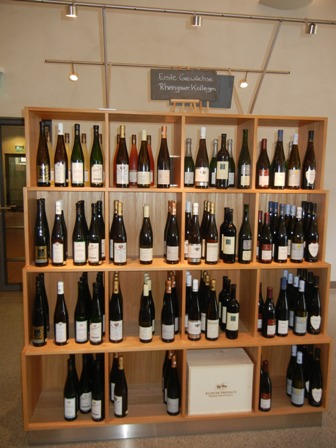
The wine shop of Kloster Eberbach

The “vinothek” wine shop does not only offer the wines of Kloster Eberbach but also of vintners and wineries of the surrounding villages and terroirs. The shop was packed with buyers on this Sunday afternoon. I browsed through the various shelves with wines from different locations and of different quality categories. I tried to stick to a certain budget which did not allow for grand cru wines.

My selection

In the end I settled for three wines only, one Riesling and two Pinot Noir wines. The Riesling came from the most famous and oldest terroir called “Steinberg” (stone mountain) right behind the monastery. The Pinot Noir Spaetlese from Assmannshausen was a bit pricier (17.40 EURO). It should turn out to be the best Pinot Noir I drank while holidaying in good old Germany.

Address:
Kloster Eberbach Winery
65346 Eltville am Rhein
Tel.: +49-6723-6046-0
www.kloster-eberbach.de

PS: When I studied agricultural economics at Bonn University, my master thesis was (among others) also dealing with the farming activities of the Cistercian monasteries and how they influenced land markets. I had visited Himmerod Abbey, a Cistercian monastery near Trier, but had never visited the equally famous Eberbach Abbey.


“Weinsinnig” – wine bar in Trier

August 4, 2012

One of my favourite wine bars in my home town Trier is “Weinsinnig”, located right in the center of town.

The name of the bar is a kind of word play on “Wahnsinnig” (in English “mad” or “crazy”), and composed of two parts, a nomen, “Wahn” or “mania” (in English) and an adjective “sinnig” which can be translated as “plausible”, “make sense”, “evident”, “sensible” or “witted”. In the combination with “Wein”/”wine” it becomes something new, a compound with a new meaning which could be translated as “in the mood to enjoy wine”, “wine is sensible” or “crazy for wine”.

Weinsinnig is also a kind of cellar door for wineries from the Mosel. Moreover, it offers selected culinary delights, for instance “Flammkuchen”, a tarte flambe. And last but not least, Weinsinnig offers various activities related to wine and the people making it.

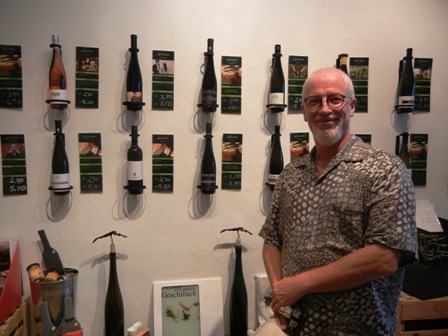
In front of the ‘walk along wine list’

It was a rainy summer’s evening when we visited and therefore we sat inside. Weinsinnig offers also a couple of chairs and tables outside. One sits on the pavement on a narrow street. Fortunately, warm blankets are on offer.

My choice: a dry Riesling from the Ruwer

I love their selection of local wines, many of them produced by young and innovative vintners. I chose a ‘2011 Maximin Gruenhaeuser dry Riesling’ by one of the top producers from the Ruwer valley, von Schubert’sche Gutsverwaltung. I also bought some more of this wine and will only say that this is a Riesling to die for.

2011 Maximin Gruenhaeuser dry Riesling

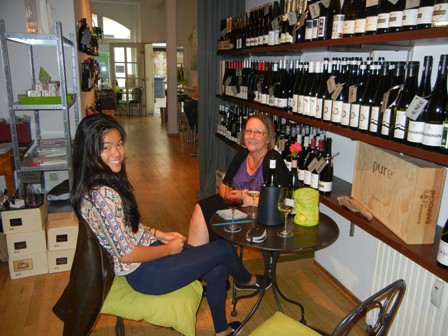
Inside

By the way TripAdvisor rated it 4 of 5 on 16 Jun 2012 and ranked Weinsinnig as 69 out of 182 restaurants in Trier. In my view Weinsinnig belongs to the “must visit” category in Trier. Check it out.

Address:
Weinsinnig
Palaststraße 12
54290 Trier, Germany
Tel.: +49-651 9790156


The Nahe wine region: Schaefer-Froehlich Winery in Bockenau, Nahe

August 1, 2012

A vineyard in Bockenau, Nahe

Every year when we visit Germany in summer, we start our family vacation with a hearty breakfast in Bad Sobernheim, Nahe. We drive to this picturesque little town on the banks of the Nahe river right from Frankfurt airport.

After we have fortified ourselves, we usually pay a visit to one of the wineries in the vicinity. This year’s choice was the family winery of Schaefer-Froehlich in Bockenau, Nahe.

Regular readers of my blog know how fond I am of the Nahe wine region. Family tradition and my own history somehow tie me to this very diverse grape growing region. I nurture these emotional links through the enjoyment of the region’s excellent Riesling wines.

The Schaefer-Froehlich winery is highly decorated and its outstanding wines regularly win awards in national and international wine events. In 2010 Tim Froehlich was selected by Gault Millau as the wine-maker of the year. And Eichelmann awarded it the winery-of-the-year award in 2011.

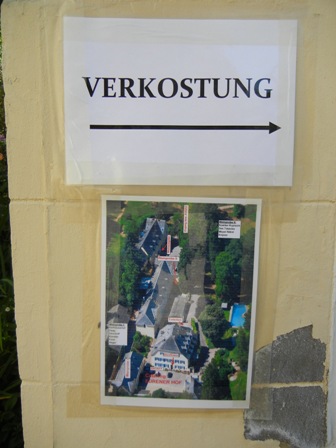
The entrance to the vintner’s house

I called the winery to make sure that someone was there to receive us. Very often I just go and take my chances. It was good that I called, the voice on the other side told me that they were very busy with the bottling of the last vintage, and that it was not a good time to visit. But I was able to convince the person to welcome us since we came from far away and because we would not stay long.

Bottling in full swing at Schaefer-Froehlich winery

We were received by Nicole Froehlich. She led us to the cosy tasting room up on the first floor, where we started right away with serious business. Wine tasting so early in the morning has its challenges.

Nicole Froehlich introducing the wines

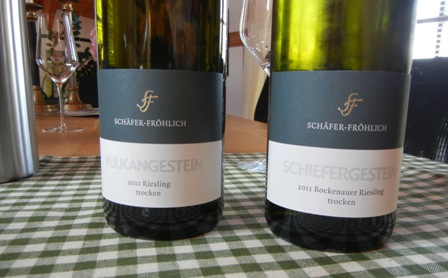
I did not want to waste the host’s time and overstay our welcome. Therefore I restricted the tasting to two wines only, both dry Riesling wines, one grown on volcanic soil, the other one on slate. Both are excellent wines, young and exhilarating with aging potential and great character. This is Riesling as I like it.

The two dry Riesling wines by Schaefer-Froehlich

Interestingly enough the volcanic one appealed to me more than the Riesling grown on slate, despite its greater complexity and finesse. My wife preferred the “slate Riesling”.

I wonder what the grand-cru wines are like when the “ordinary wines” of Schaefer-Froehlich are such delicacies. Guess what” I will tell you after my next visit to this wonderful place.

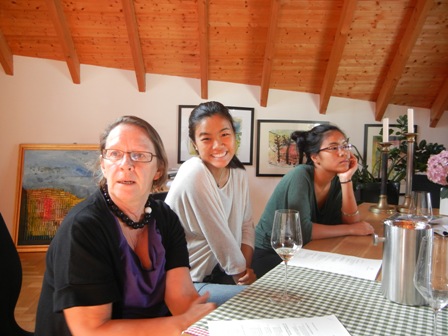
The wine tasting crew from down under

I highly recommend this winery, it’s wines are outstanding and service is just great. Please call them before you rock up.

Address:
Weingut Schäfer-Fröhlich
Schulstraße 6,
55595 Bockenau, Nahe
Tel.: +49 6758 6521
Fax: +49 6758 8794
www.weingut-schaefer-froehlich.de