Vineyards of Thailand Part 1: Holiday Park

January 10, 2010

This blog entry if the first of three looking at various vineyards in Thailand. During the Christmas vacation, we went on a winery tour, visiting three Thai vineyards; Holiday Park, Gran Monte and PB Valley, except Holiday Park, all in the Khao Yai area.

Holiday Park, about two hours north of Bangkok, is a complex undertaking, more a holiday home cum entertainment facility than a vineyard cum winery. However, they do produce grapes, as it seems mostly table grapes for direct consumption. When we arrived in the place, vineyard workers were busy “cleaning” the grapes, which was thinning individual bunches of smaller berries so that the remaining ones could grow bigger. The table grapes we saw were very healthy.

Vineyard workers thinning bunches under the trellis system

Table grapes at Holiday Park

Small tractors were converted into small “locomotives” with wagons so that visitors can be driven around the property including a holiday housing park, a lake, an activity centre, the vineyards and a play ground.

The locomotive

The undertaking is obviously targeting domestic tourists and visitors. The staff at the tasting counter did not speak English. But nonetheless there were wines and juices to be tasted. It was my first ever experience with small plastic cups for a tasting.

Plastic cups for wine tasting at Holiday Park

I assume the wine made is just a by-product of the table grape business. The grapes which cannot be used as table grapes and/or are left over are made into wine. The price of the bottle was THB 250 (about 5 EURO or A$ 7.50). We did not buy any wine.

Holiday Park red

If you have small children, Holiday Park is still worth visiting. I suggest you go there early in the morning when it is not too hot. From there on you drive to Khai Yai to visit other wineries or the national park.

I could not find any address for Holiday Park on the internet in English. Sorry folks.


Wine from Slovenia

December 15, 2009

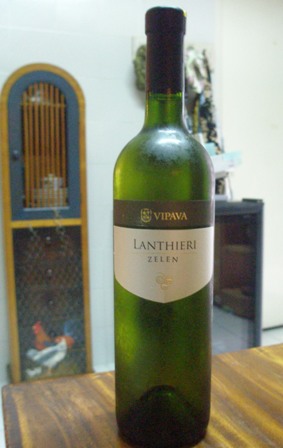
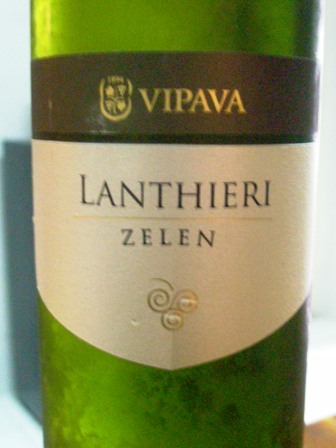
The 2008 Lanthieri Zelen

It’s already some time ago that our firneds Lucia and Giuseppe brought us the above bottle of Slovenian wine. They said, “put it back fro a special occasion”, which we did. But this splendid Sunday warranted a special treat.

To say it from the outset, the ‘2008 Lanthieri Zelen’ by Agroind Vipava 1894, a wine co-operative in the Vipava valley, is a wonderful wine. It was our first wine from Slovenia ever, a complete novelty to us.

Zelen is an autochthonous grape variety from the Upper Vipava Valley in Slovenia. The Lanthieri brand is reminiscent of the Lanthieri family, noblemen in the region, valley and town of Vipava, also called the Slovene Venice.

The Vipava wine road is going through the valley where viticulture is the main rural business. About 3,000 acres are under vines. The region is home to some very old, indigenous varieties which cannot be found elsewhere, for instance Zelen, Pinela, Klarnica and Pikolit.

The history of wine-making in the Vipava valley is interesting. It reminds me a bit of our own history in my home town Trier. Also in the Vipava valley, the Celts and Illyrian tribes cultivated grapes long before the Romans arrived. This is also true for my own tribe, the Treverer, in the Mosel river valley.

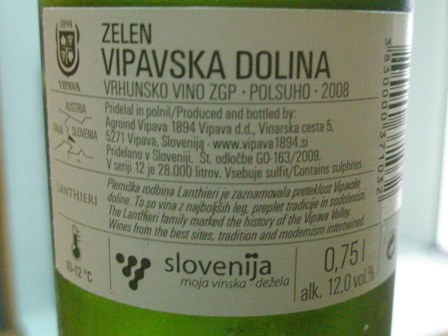
The back label in Slovenian

The wine has a light-yellow colour and seems to be an aromatic type of wine. Floral notes of mediterranean herbs such as lavender and rosemary can be detected. Very dominant, however, is the dried-apricot taste, very lovely and very unusual, I found. The wine has structure and is well balanced, fresh and zippy.

Spicy clam pasta

We enjoyed it with a spicy, clam pasta. The wine was “strong” enough to not “go down” with the red peppers, but, instead, held itself very well. I am sure we will not find any wine from Slovenia in Bangkok wine shops. I guess we have to visit Slovenia and detect its treasures during our next trip to Europe.

Thank you Lucia and Giuseppe for giving us this wonderful gift. We apprecite your generosity and we know how heavy wine bottles are.

I think Slovenia might have the potential to become the “wine Mekka” of tomorrow.


2008 Loch Riesling

October 10, 2009

Loch0

When I opened the first bottle produced by Weinhof Herrenberg, a ‘2008 Loch Riesling’, a was quite surprised when I found a it to be closed with a metal cap.

Loch00

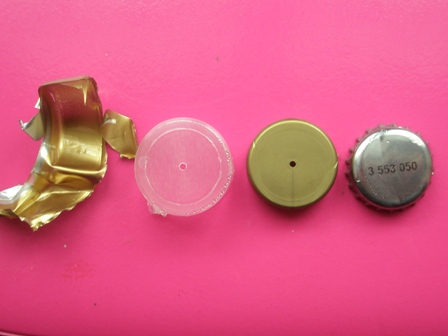
This was the first time in my life that I was confronted with such a kind of enclosure. In the process of getting to the wine unwrapping some of the plastic, I first thought it would be a glass stopper. But then I discovered the metal cap. Whow, all my traditional gear, my corkscrews, were useless and could be pushed aside and I searched for a beer bottle opener.

Loch000

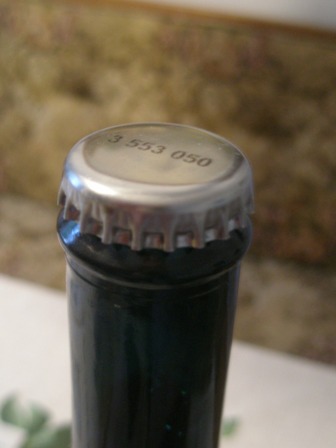
The above picture shows all the elements of the metal cap including the plastic covering it.

The Loch Riesling is a clean wine typical for the Saar. Aromas of tropical fruit, fully ripened, were displayed. The wine was fresh, a little spicy, with good structure and a medium finish. I had it without food, just like that, on a beautiful autumn afternoon. The golden colour of the wine reflecting the golden autumn sun. I recommend you try it.

Address:
Claudia and Manfred Loch
Weinhof Herrenberg
D-54441 Schoden/Saar
Tel.: +49-6581-1258
Fax: +49-6581-995438
info@lochriesling.de
www.lochriesling.de


Weinhof Herrenberg – Loch Riesling, Schoden, Saar

October 8, 2009

My friend Heinz was kind enough to help me out. He dropped by the Weinhof Herrenberg in Schoden, Saar, on his way back from the hunt and bought three bottles of Loch Riesling. I had planned to visit the Loch family winery for some time but never managed to get there. There was always something else when visiting Trier, my hometown nearby, a birthday, a visit, a train to catch etc.

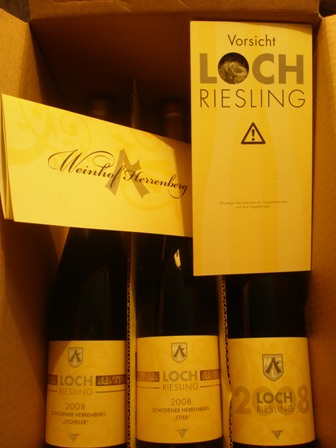
Heinz brought back the box shown below and three different Loch Riesling wines, all of the 2008 vintage. Regular visitors of my blog know that I am a Riesling lover, especially if they were grown along the Saar, my favorite provenance of German Riesling wines.

LochRiesling2

The treasures from Weinhof Herrenberg and the two brochures

The three wines were a ‘2008 LochRiesling’ (8.90 Euro/bottle), a blend of Riesling grapes from various vineyards, a ‘2008 Schodener Herrenberg “Stier”‘ (12.90) and a ‘2008 Schodener Herrenberg “Stoveler”‘ (13.90), both wines from my favorite ‘terroir’, a very steep vineyard called “Herrenberg” bordering a forest and enticing large groups of wild pigs and deer to visit and taste the sweet grapes during vintage time. I had walked the vineyard and heard about the Loch wines but never tried a single drop. It was high time to change that.

LochRiesling3

2008 Loch Riesling wines from Schoden, Saar

I also love the brochure with the “whole” (the “Loch” in German) explaining the philosophy of Claudia and Manfred Loch, the proprietors and vintners of the boutique winery “Weinhof Herrenberg”, which is the basis for their wine-making. In short, the Loch’s aim for authenticity, uniqueness, they reject designer wines but quest for a unique character and truthfulness.

The brochure is a very unusual one, telling people why to keep their hands off LochRiesling wines and what the weaknesses of the wines are: for instance that their wines are unknown, consumer hostile, old fashioned, egoistic, lawless, dangerous and limited (in numbers of bottles!). I like this brochure.

LochRiesling5

The “Loch” brochure with a whole in it

The wine list also includes wines from locations in Ockfen and Wiltingen, two famous Saar wine villages. The “Beerenauslese” wines are not available any longer. The Loch’s also produce a dry, sparkling wine. All wines are reasonably priced.

LochRiesling4

The current wine list

You might wonder what they taste like? Well, I will tell you more about this at a later blog entry. But if you are near Schoden or in the vicinity of the Saar, please visit the Loch family vineyard at Weinhof Herrenberg. If you cannot visit in person, visit the website which is very informative.

Address:
Claudia and Manfred Loch
Weinhof Herrenberg
D-54441 Schoden/Saar
Tel.: +49-6581-1258
Fax: +49-6581-995438
info@lochriesling.de
www.lochriesling.de


German wine regions: the Nahe

September 17, 2009

Nahe2

The Nahe wine region has a great significance for me and my family. It was here that I got first into contact with vine cultivation and wine appreciation at a rather tender age.

Why you might ask? Were you not from Trier, Mosel?
Well, my maternal grandfather, Hans Heinrich Schüssler, a native of Reichenberg, a village near Würzburg, used to live in Martinstein. Being from Franconia, another famous German wine region, he was the only wine drinker in the immediate family (my father preferred beer). He used to be the station master in Martinstein (today 322 inhabitants), a hamlet along the left bank of the Nahe river. The village was founded in the middle ages at a ford crossing the Nahe river. In 1340 it got a castle and even market (city) rights.

My brother and I, we used to spend the long summer holidays (and many other holidays) at my grandparents house in Martinstein. My grandfather used to take us on long walks in the forest and villages nearby. During these walks we always found a country inn where we could refresh ourselves, enjoy a drink or a “Brotzeit” (a typical German snack). He would drink a “Schoppen” (0.25 litre glass) of the local Nahe wine. He loved dry white wines. We would have a lemonade.

He was associated with a “hiking brotherhood” (called “Hunsrückhöhenverein”) whose members would walk in large groups on weekends to various destinations. Usually a country inn was the designated object of the hikers. Here the group converged for a hearty meal and some drinks. Shortly after vintage, “Federweisser” (freshly made but still half-fermented wine) was a popular drink.

But boys being boys, we would sip at his glass from time to time. He being deeply involved in conversation with fellow hikers, did not notice. Neither did we. The sweetness of the fresh wine veiled its dangers. To cut a long story short, we had the experience of a first inebriation of our young lives and could hardly walk strait on our long way home.

After my grandfathers retirement he moved out of the train station into a newly built home right in the middle of vineyards at the outskirts of the village towards the east. Vineyards stretched right to the door. Just a short walk up the hill and endless vineyards lay at your footsteps. Occasionally we would help during vintage time (more play than serious helping). But we would often taste fully ripened grapes and enjoy the fruit. I treasure these wonderful memories of my youth at my grandfathers house in Martinstein.

Map Nahe wine region

The Nahe wine region (photo source: wikipedia)

As you can see from the above map, the Nahe wine region stretches from Martinstein to the West along the river eastward, later north towards the estuary at Bingen where it flows into the Rhine river. The largest city in the region is Bad Kreuznach, a small town of about 45,000 inhabitants.

Nahe1

With about 4,200 ha under vines, the Nahe region is one of the smaller wine growing areas in Germany. It is still larger than, for instance the Yarra Valley in Victoria (with about 3,800 ha, about 2% of Australia’s total). The Nahe region is dominated by white grape varieties (about 74% of the total area under vines). The main variety is Riesling (26%) followed by Mueller-Thurgau (14%) and Dornfelder (13%).

Fifty years ago the variety distribution was very different. Silvaner used to be the most planted variety with about 50% of the total area but has ever since been replaced by the Burgundy varieties (Pinot White, Gris and Noir) as well as by Riesling, Dornfelder, Blauer Portugieser and Müller-Thurgau plantings.

The Nahe is divided into seven collective sites (Grosslagen) and 328 individual sites (Einzellagen). Due to its volcanic origins, the soils of the nahe show a great diversity. The wines reflect this. Only in 1971, the German wine law defined the nahe region. before that time, its wines were sold as “Rhine wines”. However, some of the best Riesling wines of germany originate from the Nahe and today Nahe wine can rival the best from Mosel and Rheingau or any other German wine region.
Nahe3

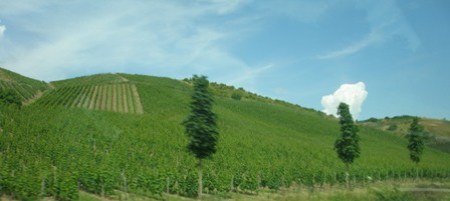
The Nahe can be divided into the upper (west) and lower (north-east) Nahe and the region around Bad Kreuznach. In Martinstein and the neighbouring village of Monzingen (first mentioned in 778) the oldest vineyards of the Upper Nahe are to be found. The soils of the Nahe range from sandstone to quartzite and slate. The region shows a temperate climate and some of the southern slopes enjoy a micro climate comparable to the Mediterranean. Elevations range from 100 to 300 meters altitude.

Nahe4

Who are the top producers of the Nahe wine region?

Well, the name Herrmann Doenhoff comes to mind. He is the leading vintner of the Nahe and his wines are ranked among the top Rieslings in Germany. Herrmann Dönnhoff has about 20 ha under vines and produces about 140,000 bottles a year. His winery is located in Oberhausen/Nahe. The 2007 vintage produced outstanding wines; the 2008 Riesling wines did not quite reach that quality level during recent tastings. But his ‘2008 Niederhäuser Hermannshöhle Riesling Gran Cru’ earned 93 Parker points.

Other top producers are Emrich-Schönleber in Monzingen (about 15 ha under vines, yearly production about 110,000 bottles), Schlossgut Diel (17.5 ha and 120,000 bottles) in Rümmelsheim and Schäfer-Fröhlich (14 ha under vines and 75,000 bottles annually) in Bockenau.

Wines and vintners I like very much are Sascha Montigny in Laubenheim and Weingut Edelberg at Gonratherhof 3 in Weiler just on the other side of Martinstein. The former I like because of the high quality of his red wines, especially the 2006 vintage; the latter produces solid country wines which remind me of my youth in Martinstein and the long hikes with my grandfather. The country inn at Gonratherhof was often our destination when the three of us set out from our little house in the vineyards.


The South Pack: Young Australian winemakers on a mission

August 15, 2009

The wine glut in Australia makes wine marketing a true challenge. Many vignerons and wineries have to knock on endless doors of wine outlets, restaurants and retail shops. You get sick of it. Among others, that’s one of the reaosns why eight young independent winemakers from Victoria have created “their own thing”. They call themselves “The South Pack”.

SouthPack1

Three years ago they started their own roadshow to Melbourne and Sydney. Instead of going out and selling wine, they decided that people should come to them. They look for a suitable location, a restaurant, a hotel or any other suitable facility and invite the top trades and restaurant people to come for a tasting: meet the maker and his wines. Usually it’s accompanyied by food and music and great fun.

SouthPack2web

The eight young winemakers (actually they are nine people) knew each other through the wine business and are friends and mates. This year the roadshow will be conducted for the third time. Last year, also Brisbane was included. Attendence is by invitation only but numbers at the shows have multiplied every year. This year will be no different. There is a great interest to meet the originators, the magicans, the winemakers and have them talk about their products: hand carfted artisan fine wines of ourstanding qualities. These wines are not like the industrial liquids, technically well made wines but a bit ordinary, normal, faceless.

SouthPack3

Meet the unusual. I only know one of the eight personally, Timo Mayer, a longtime friend. Timo is the winemaker of Gembrook Hills in the Yarra Valley and has his own vineyard and label. He made our award winning ‘2002 Two Hills Sauvignon Blanc’. He told me all about South Pack. I was exited to learn about this initiative and its immediate success.

Even if you have not been invited, just pick up some of their wines. Most of them you can buy online. Here is where to find and contact them:

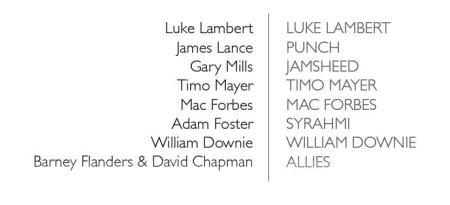
Luke Lambert: mainly Syrah from St. Andrews, Yarra Valley and Nebbiolo from Heathcote.
www.lukelambertwines.com.au

James Lance – Punch: The winery in the Yarra Valley was severely affected by the bushfires, produces Chardonnay, Pinot Noir and Cabernet Sauvignon
www.punched.com.au

Gary Mills – Jamsheed (named after a famous Persian king): Shiraz and Gewuerztraminer
www.jamsheed.com.au

Timo Mayer: Bloddy Hill he calls his vineyard on the top of a windy peak overlooking the Yarra Valley, most of his 2.5 ha are under Pinot Noir, some Chardonnay and some Shiraz
www.timomayer.com.au

Mac Forbes: wines come from the Yarra Valley (lots of Pinot Noir and Chardonnay) but also the Strathboogie Ranges (Riesling). The so called “alternative wines” are made from fruit from other wine regions in Victoria. Here you’ll find varieties such as Barbera, Gruener Veltliner, and Blaufraenkisch
www.macforbes.com.au

Adam Foster -Syrahmi: another winery from Heathcote with beautiful Shiraz wines
I could only find references ot his wines but not a proper website.

William Downie: solely Pinot Noir wines are made by William, the fruit comes from the yarra Valley, Mornington Peninsula and Gippsland
www.williamdownie.com.au

Barney Flanders and David Chapman – Allies: Allies is a collaboration between Barney and David. They produce a variety of wines (one label is called “Garagiste”, implying garage wines of made of excellent fruit; there must be a lot of French influence!?). Their Pinot and Chardonnay wines come from the Mornington Peninsula, the Shiraz comes from Heathcote (no surprise).
www.allies.com.au


The best German vintners and wine makers

June 1, 2009

Threewinegods

The wine gods (photo taken from a building in Berlin)

Its certainly a great honour to be called “vintner of the year”. Since 1994 Gault Millau, Germany’s wine guide and major authority regarding wine, wine business and the wine sector, is awarding the “vintner of the year” award.

Today the total number of vintners of the year is 16, seven of which come from the Mosel wine region. The current one, however, comes from the Pfalz (Knipser brothers).

But in the years 2007 (Theo Haart, Mosel), 2005 (Kartaeuserhof, Ruwer), 2001 (Loosen, Mosel), 1998 (Mueller-Scharzhof, Saar), 1996 (Joh. Jos. Pruem, Mosel), 1995 (von Schubert, Ruwer) and 1994 (Fritz Haag, Mosel) the vintner of the year came from my home, the Mosel river and its tributaries.

(Remark: the Mosel wine region was originally called: Mosel-Saar-Ruwer)

No other German wine region has provided that many “champions”. So far the Nahe and Pfalz wine regions had two vintners of the year; and Rheinhessen, Rheingau, Frankonia, Ahr and Baden had one each (for the names of the vintners of the year: Gault Millau).

I came about this fact only by accident while researching a story, I was going to write. I have to find more Mosel wines here in Bangkok, I guess. Wish me luck.


Trivento – Wine from Argentina

February 9, 2008

You might remember that the other day in Kuala Lumpur I could not taste the wine on the menu, a ‘2005 Trivento Golden Reserve Malbec’ of the Maredo Restaurant because it was sold out.

Guess what? I found the brand in Vin +, a small wine shop in Kemang, Jakarta. I bought one bottle only to try it out.

trivento-malbec.jpg

The Trivento 2005 Golden Reserve Malbec

You might wonder about the results?

Today I went again and bought a whole case of it. It is a most delicious wine and retails for about 235,000 Indonesian Rupiah which is equivalent to about 17 € or 28 A$.

It is a deep, red, ruby wine with a wonderful nose displaying aromas of mint, cherries and chocolate. The wine was matured in new French oak for a year and was aged for another year in the bottle before its release. Its a pity that Malbec has this short, dry finish but the aromas compensate you for that. However, for non-Malbec lovers there are Syrah and Cabernet Sauvignon wines on offer as well.

Moreover, I also bought from the Trivento product range a ‘2006 Reserve Chardonnay’, a ‘2006 Tribu Torrontes’ and a ‘2005 Reserve Malbec’. More about these wines later.

Trivento Bodegas Y Vinedos (www.banfivintners.com) was founded in 1996 and is located in Mendoza, Argentina. Most of its vineyards are to be found on high altitude in the best zones of Mendoza (up to 1100 meters above sea level). Trivento Vineyards possess a modern winery with a capaity of about 27 million litres of wine. It has all the modern equipment used nowadays to make wine. The winery is surrounded by about 10 ha of vineyards.

Tomas Larrain holding a degree in agricultural economics from the Catholic University of Chile is the general manager and Federico Galdeano, a native of Mendoza with extensive experience in the Napa Valley/California and Tuscany/Italy, is the wine maker.

By the way I now found out that the rumour – that the Argentineans drink their best wines themselves and export only the rest – is false. They do export some of their good wines!


Mama’s kitchen: tender bighorn fillet with mushrooms

May 11, 2007

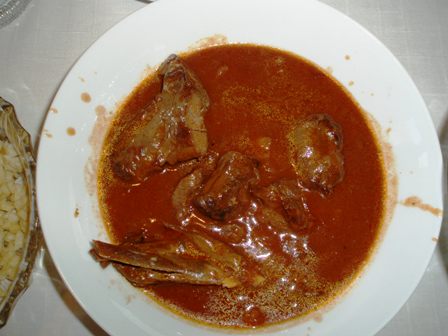
Because I am from a hunter’s family, we have from time to time dished with meat from wild animals at home. During my recent visit to Trier, my mother prepared a tender fillet of a young bighorn sheep (Mufflon in German). The young Mufflon was shot in Schoden at the Saar river by my friend Heinz. She served it with freshly collected wild mushrooms (Steinpilze also from Schoden), a cabbage salad and spaetzle (literally translated: little sparrow), a kind of tiny noodles or dumplings made with flour, eggs, water or milk, salt and sometimes nutmeg mainly used in the South German (my mother comes from Franconia), Austrian, Alsace and Swiss cuisine. I took some photos of the delicacies so that one gets a better idea. It was such a wonderful meal.

p5020662web.jpg

The bighorn fillet

p5020661web.jpg

The mushrooms

p5020664web.jpg

The old folks

When I raided my mother’s wine cellar, I found a bottle with the picture of Karl Marx, one of the most famous sons of my home town Trier. Agreed, the application (or the interpretation hereof) of his ideas has brought much misery to the world. However, now mankind knows for sure that planning economies do not work, but that market based economic co-ordination systems are much better for us all.

p5020656web.jpg

This bottle was given to me for my 50th birthday a couple of years ago. It contained a 2002 Eitelsbacher Marienholz Pinot Noir (Spaetburgunder) from the von Beulwitz Estate (www.von-Beulwitz.de), now owned by the Weis family in Mertesdorf, one of the villages at the Ruwer river, a small tributary to the Mosel (and part of the Mosel-Saar-Ruwer denomination). The Ruwer terroir has about 300 ha under vines in various locations (Ruwer/Eitelsbach, Mertesdorf, Kasel, among others). Some of the best German Riesling is grow here since Roma time. In fact the earliest findings of vine cultivation date back to the 2nd century. A stone relief called “The vintner in his wokshop” is the one of the oldest historical relicts (the other one is the wine ship of Neumagen).

p5010602web.jpg

Ruwer vineyards

The von Beulwitz estate goes back about 140 years and produces mainly Riesling wines, many of which have won international awards and trophies. The most recent one is the “Trophée d’excellence” “Riesling du monde”/Strassbourg for it’s 2003er Kasler Nies’chen, Riesling Auslese, “Alte Reben” (old vines). The 2005 Riesling Spaetlese from this location gained 97 points.

The estate grows vines on about 5 ha, mainly in steep locations in Kasel and Eitelsbach. Yields are kept low in order to produce wines of great elegance and finesse. Unfortunately, the Pinot Noir of 2002 did not fall into this superb category, it was a rather ordinary wine. But despite this, we enjoyed the meal and the wine and had a good time at home. I promised myself to try some of the award wines next time.