Augusta Treverorum – home at last

July 24, 2008

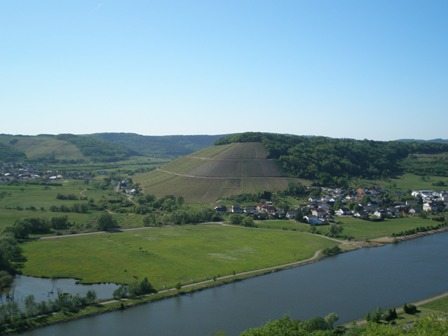
My hometown of Trier (lat.: Augusta Treverorum) from the ‘Kockelsberg’

Alas, we made it. Grandparents were very happy to see us. Blue sky and summer sunshine greeted us. A splendid holiday awaited us. In short, Germany at its best. We are so lucky.

The Mosel river

Margit and I, we went to check out our favourite “watering whole”: the wine bar of Reichsgraf von Kesselstatt opposite the cathedral and the church of “Liebfrauen”.

The ‘garden’ of the wine bar

Riesling was our choice. We had a ‘2007 Kaseler Riesling dry’ (subregion: Ruwer) and a ‘2007 Wiltinger Riesling dry’ (subregion: Saar). Both wines were young and fresh, which make them a delicious drink in a hot summers day. We both preferred the wine from Wiltingen, Saar.

Cheers, and “zum Wohl” as the Germans say.

PS: I am loading this up from a small flat in Madrid which we rented. The internet connection is weak and blogging difficult. Please bear with me.


German Wine Regions: The Saar

June 28, 2008

One of the premium Riesling producing wine regions in Germany is the Saar, which is part of the Mosel region (the English usually call it Moselle, using the French word for the river). In fact the Mosel Wine Region used to be called (until 2007) “Mosel-Saar-Ruwer”, the latter two being small tributaries to the larger Mosel river. Along the three rivers about 13,400 ha are under vines these days, most of the vineyards are to be found on steep slopes, offering breathtaking views.

The village of Wiltingen, home to many famous wine producers along the Saar

Along the river Saar vine cultivation goes back a long long time, roughly 2,000 years only. Until Napoleon conquered this part of the various German lands, most wineries were in possession of the catholic church, monasteries, and other clerical institutions. Napoleon secularized the administration and with it most vineyards and wineries came into private hands.

The area between Serrig and Konz is the main production base of the Saar. Further upriver only small and singular plots are planted with vines. The most renown wine producing villages along the Saar are
Serrig, Saarburg, Irsch, Ockfen, Ayl, Schoden, Wiltingen, Kanzem, and Wawern. Moreover we find vineyards along one of the smaller side valley’s Filzen, Koehnen, Nieder- and Obermennig, Krettnach and Oberemmel.

Ayler Kupp, one of the prime ‘terroirs’ of the Saar

The dominant variety is, of course, Riesling. The total area under vines is about 1,500 ha, mostly on steep slopes with gradients of up to 55 per cent. Other but minor varieties are Pinot Noir, Dornfelder, Pinot Gris, Rivaner, Kerner and Pinot Blanc. The soil consist mainly of blue Devon slate soils. The alcohol content of the wines is usually low (between 8 and 12 %), but the acidity of the wines shows excellent structures and compositions and this is why the wines can be cellared for long periods of time.

Steep vineyards in Ockfen
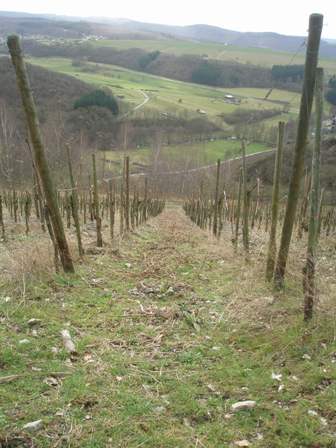
The vineyards are ready for spring to come

The two photos above were taken in Ockfen, showing vineyards in the location ‘Ockfener Bockstein’, one of the prime ‘terroirs’ in that village.

Springtime and lots of work to do to make the season a success. Lime is distributed by hand in the vineyards, here in Schoden.

There are many prime wine producers along the Saar. The top estate is probably Weingut Egon Mueller (also called the godfather of Saar Riesling) – Scharzhof in Wiltingen. Among the highest rated Riesling wines in Germany (on www.riesling.de) Egon Mueller has three of the top eight wines.

But there are many other prime producers. I can only mention a few. For instance Weingut Fortsmeister Geltz-Zilliken in Saarburg, or Schloss Saarstein in Serrig. Then there is the rising star, Roman Niewodniczanski and his team at Van Volxem in Wiltingen. His wine maker, Dominik Voelk, is young and ambitious, and by the way is a native of Franconia, a wine region with long traditions in excellence. When I visited the estate in March, he had completely sold out all his wines. I am now waiting for the release of the newest vintage in September (grand cru only). Then there is Weingut Dr. Siemens in Serrig and Weingut Peter Lauer in Ayl.

Also other producers are worth mentioning. Weingut Reichsgraf von Kesselstatt, which operates a wine bar just across the cathedral in Trier (Trierer Dom), possess vineyards in Wiltingen. Four star ratings were awarded to Weingut von Orthegraven in Kanzem and Weingut von Hoevel in Konz-Oberemmel but there are many others who produce excellent Saar wines.

I love the Saar Rieslings with their well balanced, “filigree like” acid compositions. I love them for their explosiveness, zest, intensive aromas; they have structure and balance, are low in alcohol and usually impress with a long finish, lingering on your tongue’s taste buds like ballerinas which you can still see before your inner eye long after they left the stage.

I encourage you to visit the Saar and sample as many wines as you can, it’s worth it, definitely. This time of the year should be perfect, as the pictures below demonstrate. I hope they can entice you to give it a go and lure you to the Saar.

Explore the beauty of my home region, do not forget to visit Trier, its just around the corner.

Vineyards in Schoden
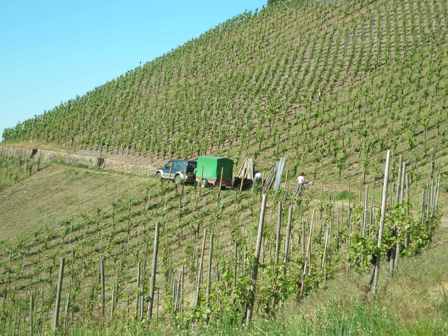
The ‘terroir’/location ‘Herrenberg’ in Schoden

Near Schoden the Saar is most picturesque. The hills, the forests, the river and the small villages offering local food and wines make the Saar a prime destination for tourism.


Vintage Celebration 2008 – Upper Goulburn Wine Region

May 9, 2008

I missed this year’s vintage celebration of our wine growers association – the Upper Goulburn Wine Region (www.uppergoulburnwine.org). The last weekend of April saw wine ethusiasts, vintners, and other local folks descend on the picturesque rural town of mansfield at the foot of Mount Buller where soon the ski and other winter tourists are going to converge for joyful days in the snow.

For the time being it’s still autumn, all grapes have been harvested and the juices of young wines are working hard to become as excellent a wine as in this part of the world we are able to produce. Thanks to our clean natural sorroundings, the hills and northerly slopes, the terroir and our cool climate, the Upper Goulburn Wine region produces outstanding wines.

This year the vintage celebration weekend (25-27th April) consisted of three major events.

1. Cocktails on the Deck on High – an evening reception at this new venue – normally offering Thai cuisine as well as tapas, with a stylish piano bar and an “oriental room” (whatever that means) – in the High Country with cocktail canapes and the best of Upper Goulburn wines matching these delicious finger foods. The guests were entertained by a string duo from Melbourne named “Take Two”.

2. A Day on High – starting at 11 am until 5 pm and covering the main street of mansfield where regional food, wines and other produce are displayed and cwhere all kinds of culinary delights can be tasted. You just purchase a glass for A$ 5 and off you go to taste the new releases of the regions superior wines. This time the entertainment consisted of “Derek Guille and his Ugly Uncles”, a performance band in blues, folk and jazz (more than the usual country stuff of Country and Western).

3. Long Lunch – the lunch took place in the gardens at Highton Manor , a restaurant in a 1896 historic country house right in town. The lunch does not come cheap but with Mount Buller as a backdrop, the selected four course meal prepared by local chefs and served with the best wines from our region, was a true delight.

The 2008 vintage has been very erratic in Australia. In many places, South Australia for instance, it started very early (one month earlier than normal) with many varieties ripening in unpredictable and abnormal order. Various heat waves partially destroyed the crops, gain an example from South Australia where about 100.000 tonnes of grapes were left on the vines. Wineries had to cope with a mass arrival of fruit concentrated in a very short time band.

But in other regions, Gisborn or McLaren Vale for instance, 2008 produced a great vintage. I have not heard too much from neighbours and other members of our association.

We at Two Hills Vineyard had a good year. We did not overcrop, kept yields low for a maximum of flavour and intensity. Our fruit enjoyed great demand. Finally word has spread around that our fruit is of excellent quality and as a consequence we have more interested buyers than we can satisfy.

A small portion of our Merlot fruit will be made into wine, as always at Yering Farm, by Alan Johns and we are looking forward to another excellent Two Hills Merlot wine.


Country Inns in Germany – Klostermühle, Ockfen, Saar

May 5, 2008

When I am visiting my hometown Trier I always try to arrange an outing to the Saar, my most favourite tributary of the Mosel (the other one I love very much, is the river Ruwer).

One day in March my mother, my friend Heinz and I, we went for lunch in the countryside. It was March. Spring was waiting in the wings, but could not get through as yet. However, it was a beautiful day. We choose the Klostermühle in Ockfen, Saar, as our destination, a winery cum hotel and restaurant (www.bockstein.de).

Winery-Hotel-Restaurat Klostermühle in Ockfen, Saar

Pork tenderloin with Spaetzle, a German type of noodle dumplings

The food was delicious, typical country inn style, rustique, big portions, in short: value for money type of food. I had one of their Rieslings with my food. Ockfener Bockstein is the name of the most famous location (terroir) in this neck of the wood. It was a very typical Saar Riesling, low in alcohol but zippy and fruity, with complex acids, a good structure and a long and intense finish.

After lunch we drove though the vineyards of Ockfen. On our way to Schoden where Heinz together with some friends is renting a hunting ground, we passed by the “Bockstein” which you can see in the picture below (where the tree line on the hill in the background is ending).

Ockfener Bockstein, one of the most famous “terroirs” of the Saar

The Saar is a very picturesque wine region and tourist destination in southwestern Germany and certainly worth a visit. Do it regularly as I do. The Riesling wines are among the best of Germany.

Address
Weingut – Hotel – Restaurant Klostermühle
Fam. Minn
54441 Ockfen, Saar
+49-6581-9293-0


Chain of Ponds, Adelaide Hills, Australia

April 26, 2008

I found another treasure in our local duty free shop a Chain of Ponds ‘1999 Grave’s Gate Shiraz’, from McLaren Vale in South Australia. The homepage of Chain of Ponds (www.chainofponds.com.au), located in the Adelaide Hills, claims that they are “Australia’s “most highly awarded boutique vineyard”. After studying the page I have the feeling that for my taste, they are already much too big to qualify for such a label, but I am easy on that.

Of course their origins (in 1985) were small but they have grown over the years in a sizable business.
I just managed to get the bottle in the last year of the drinking time frame: best drinking 2003 to 2008, it says somewhere.

The wine background is given as follows:

Frost at the commencement of the 1999 growing season wiped out Chain of Ponds estate plantings of Shiraz, hence the sourcing of fruit from McLaren Vale for this wine.

In 2001 James Halliday gave a rating of 90 out of 100 point. The wine comes from the River Series, sold for A$ 18 per bottle. I payed US $ 18.20 for it, which seems to be quite reasonable. The wine could be described as follows:

<“Deep, bright red-purple; clean, fresh juicy/berry fruit on the bouquet is followed by luscious and sweet berry fruit on the palate. Neither the oak, nor the extract, nor the alcohol (13.5°) have been overdone”.

The winemaker is Neville Falkenberg. The 1999 wine must have been made by his predecessor since Neville has been with Chain of Ponds for only the last five years. The Adelaide Hills is a premier cool climate region of South Australia, only about a 20 minutes drive from the capital Adelaide. I love Adelaide not just because my wife originates from there, and recommend it for any visit to Australia. It’s a must, seriously.

Apart from this series, Chains of Ponds has a Premium Range segment. It also produces wines from Kangaroo Island grapes. Its Italian Varietals come from the Adelaide Hills (Nebbiolo, Sangiovese and Pinot Grigio). The low cost segment is called Novello Range (A$ 14/bottle). I have not been to the place but the homepage shows beautiful pictures. Another place to check out.


Homecoming – Trier, Mosel

April 8, 2008

Vineyards in Trier

Vineyards on left side of the Mosel near Trier

I listened to Keith Urban’s “Once in a lifetime” on my i-pod when riding into Trier on the train from Koblenz. It was the first day of April.

“But you’ve never been this loved (mm hmm)”, says the forth line of the first stanza and it seemed to summarise my feelings.

I was very happy to have reached the place where I grew up.

Spring greeted me and the sun bathed the hills surrounding the old Roman city. What a perfect day, I thought; how lucky I was. And it turned out later that it should be the only ‘spring day’ during my short visit. Snow and ice should clebrate a comeback a couple of days later.

Behind me lay a wonderful train trip through the charming settlements and small towns of the Mosel river valley: Winningen, Kobern-Gondorf, Alken, Moselkern, Treis-Karden, Cochem (a long tunnel ride depriving me of any view of my beloved Mosel), Ediger-Eller (crossing the river into yet another tunnel) and into Bullay. More tunnels were to follow and we crossed into the Eifel hills leaving the river behind us. The next vineyards would re-emerge in Schweich, near Trier.

It was a glorious morning ride on the train. The Mosel river valley showed its best side and the train trip from Winningen to Bullay is the most enjoyable part. I was listening to music from Sting “Songs from the labyrinth”, a collection of songs from the 16th century. What perfect music for such an historic ride along the shores of the Mosel river.

I followed it up by listening to Alan Stivel and his Celtic Music collection and in my inner eye I could see the original settlers of the area, the Celtic Treverer working the valley and the steep vineyard slopes. This was the perfect music for a homecoming. Here and there castles and ruins thereof greeted us from the hilltops.

Spring had just arrived. Fruit trees were in flowers, apples, pears and cherries in white or a soft pinkish white, peach trees in dark pink. Nature is ready to rock; just a few more warm days and everything will be covered in soft green colours. The willow trees pushed already their sprouts. All other trees, the birches, beech and oak trees on the hills were bare.

The train went along the river through meadows and paddocks, fields and forests. Thousands of years the Mosel flowed through this landscape. River barges made their way down or uphill through the brownish water. White swans working on their nests. The sun blinded me while riding along in the train. Who would have know that these hills would mean so much to me one day?

The vineyards were well tended, immaculate, only some belated vintners were busy binding the canes to the wires or the stakes; soon the buds of the leaves would burst.

Only the dirty train windows prevented me from taking pictures.

At my mothers house a delicious lunch would wait for me (and some Two Hills Merlot of course). Homecoming, it was the second time for 2008, that I had the opportunity to come back to the town I was born in. What a joy.

Noodles and Two Hills Merlot


Wiltingen Saar – the best of Riesling wines in Germany

March 31, 2008

The little village of Wiltingen, Saar , about 9 km southwest of Trier, is one of the most famous “terroirs” for Saar Wine. It has about 1400 inhabitants and is the heart of Riesling production. The area under vines is 160 ha only and rather small one might say but these vineyards produce excellent wines.

The location (terroir) ‘Scharzhofberg’, for instance, produces outstanding Rieslings which are world renown and regularly win international awards as best wines.

Wiltingen is home to many famous wineries. I cannot name them all. There is for instance the “Riesling pope” Egon Müller who has his family business there, so has Roman Niewodniczanski’s winery Van Volxem, and many others.

wiltingen2.jpg

Wiltingen at the Saar river in March, photo taken from the Schoden side

wiltingenschild.jpg

Wiltingen is a jewel also for tourism

It was a rainy day when we visited Wiltingen. However, we wanted to pay a visit to Van Volxem and maybe purchase a couple of bottles of the finest Saar Riesling. Well, we met the winemaker, a very friendly young man from Franconia, as I could identify from his accent, and he invited us in, mentioning in passing that if we came to buy wines, we would have to come again, because they sold out completely. Nonetheless, he made us sit down, served us a very good cup of coffee and told us the story of the Van Volxem wines.

Spring is a busy time in the vineyards. We were told that Van Volxem has about 30 ha under vines and that they are in the process of planting another 6 ha in prime locations, usually on very steep slopes along the Saar river.

Also Ms. Niewodniczanski showed up and took her time fro a friendly chat; she urged us to come again later in the year when they new vintage would be released. She promised she would show us around, not only to the cellars but also the vineyards could be part of our visiting program. We left our addresses and promised to come again. Who could resist such friendliness, a treatment so warm, only expected to be extended to family members.

vanvolxem.jpg

Van Volxem, entry to the cellar door

vanvolxem2.jpg

In the historic tasting room

Postscript: A couple of days later, I sat in the Weinhaus, one of my favorite wine bars in Trier, and witnessed the sale and hand over of two 6-bottle boxes of Van Volxem Riesling wines to customers.

Well, I thought, I cannot complain since I still have some bottles in my “cellar” in Jakarta, and the next vintage will certainly make a wonderful buy.

Address
Weingut Van Volxem
Roman Niewodniczanski
Dehnstrasse 2
54459 Wiltingen, Saar
Ph.: +49-6501-16510
e-mail: vanvolxem@t-online.de

The estate is member of the VDP (Verband deutscher Praedikats- und Qualitaetsweingueter), the association of German prime wine estates (www.vdp.de). Today the Association has 200 members and covers about 3% of the German viticultural area.


German Vineyards in March

March 18, 2008

March is a great time of the year in the Northern hemisphere. Nature is ready to go, buds are almost bursting, waiting for the right temperature, the hours of sunshine which make the difference, warm the soil and the plants. As every year another miracle is in the making.

The vineyards are neatly pruned and ready to go shortly before the new growing season begins. The following pictures from the Saar Wine Region might give you an idea.

vineyardin-march.jpg

The colour scheme is still dominated by greys and dark winter colours but here and there we can see greenish spots, and soon spring will have driven winter away.

The slopes are steep and every vine has its own post. This one is very well tended, not a single stem or blade of grass can be detected.

pruned3.jpg

The pruning is of a special kind too. In Australia we hardly see this kind of binding the canes.

pruned1.jpg

It is not easy to spread organic manure in the vineyards at these steep slopes.

menure1.jpg

A metal sledge is used to bring the manure to the vines.

pruned2.jpg

Apart from the well tended vineyards (as above in Ockfen, Saar) we also find here and there a neglected one or one in a rather ‘chaotic stage’ but they are the exception rather than the rule.

chaoticvineyard.jpg

The neglected vine garden


Shakespeare in the Vines – Sevenhill Cellars

February 22, 2008

Ever since my friend Neville Rowe became general manager of Sevenhill Cellars in the Clare Valley I have followed this interesting enterprise though the internet.

The Clare Valley is one of Australia’s oldest and most famous wine regions, about 120 km north of Adelaide, South Australia. Sevenhill Cellars is located south of the small country town of Clare which gave the valley its name (along the B 82).

The vineyards and the cellar are owned by the Jesuits (Society of Jesus) (www.sevenhillcellars.com.au) who migrated to Australia (from Austria) in 1848 so seek a more peaceful life. In 1851 they established Sevenhill Cellars. It is the oldest winery in the Clare Valley and the largest producer of sacramental wine in Australia. Watch out for the ‘St. Aloysius Riesling 2005’ , their flagship wine (ranked 34th in the “Top 100 Rieslings” of the 2005 Sydney Royal Wine Show) but also try some of their fortified wines – Liqueur Tokay, Verdelho and Frontignac or the ‘Jesuit Fine Old Tawny’. Hope this is enticing enough for Riesling lovers to check it out.

Originally the place was called “Open ranges” but the Jesuit settlers called it “Sevenhill” reminiscent of the seven hills of Rome. The intention was to make the place a centre of Catholicism in this part of Australia and to produce sacramental wines. Today, they also produce table wines for the laicist consumers.

shakeaspeare1.jpg

Every year a Shakespeare play is put on at Sevenhill, called “Shakespeare in the Vines”. If you are around today, you are lucky because the romantic comedy “Twelfth Night” is shown on Friday 22 and Saturday 23, February. The ticket costs 35 A$ only. I am sure you will have a stunning night and the opportunity to choose from a variety of excellent wines.

The play is divided into five acts. It is actually quite complicated for me to give you a short account. I would like to refer you to http://absoluteshakespeare.com where you can read details about the story line and the characters.

I only want to mention that one of the most beautiful songs Shakespeare ever wrote can be found in this play. It goes as follows:

Come away, come away, death,
And in sad cypress let me be laid;
Fly away, fly away, breath;
I am slain by a fair cruel maid.
My shroud of white, stuck all with yew,
O prepare it;
My part of death no one so true
Did share it.
Not a flower, not a flower sweet,
On my black coffin let there be strown;
Not a friend, not a friend greet
My poor corpse, where my bones shall be thrown:
A thousand thousand sighs to save,
Lay me, O, where
Sad true lover never find my grave,
To weep there!”

Thumbs up for Sevenhill Cellars

neville2.jpg

Neville Rowe, general manager, Sevenhill Cellars

Address:
Sevenhill Cellars
Box 13 Sevenhill SA 5453
Ph.: (08) 8843 4222
e-mail: info@sevenhillcellars.com.au


Torrontés – white grapes from Argentina

February 17, 2008

The other day when I decided to buy a dozen bottles from Trivento (Concha y Toro), I did not only pick up the Grand Reserva Malbec and other Malbecs, but also some whites, a chardonnay and a grape variety I had never heard of, Torrentés.

Through my encounter in Kuala Lumpur the other day, I was stimulated to venture into new territory. So I started to discover the wines of Latin America. Since I do not command any knowledge whatsoever about wines from this part of the earth, I am like a “clean slate” to write (or better to drink) on. Frankly, I am in the process to educate myself and to learn more about wines from Argentina.

There are of course many different wine regions but more about them later. My friend Max Sandelowsky from Salta province may forgive me that I delay writing about his wonderful region to a later date.

So, when I held this bottle from Trivento in my hand and read Torrontés on the label, I had no clue what this wine would taste like. Now I know.

Torrontés is a very typical white wine of Argentina. The grape variety comes in three variations,

– Torrontés Riojano,
– Torrontés Sanjuanino
– Torrontés Mendocino

It is said that Torrontés is the most distinctive wine of Argentina, grown nowhere else in the world.

Tasting notes vary. It’s often describes as earthy, fine aromatic reminiscent of Muscatel (wines made from Muscat grapes). Some say its strikingly similar to Viognier with hints of peach, flowers and orange citrus fruit. It has structure and fine acidity. Its delicate flavours entice you to have another sip/ That was true in our case, we had another bottle the next day with a seafood pasta. I can only recommend it to you. Try it, its a great experience.

torrontes.jpg

Source: http://www.torrontes.com