And the winner is ? – 2007 Canberra International Riesling Challenge

November 4, 2007

whitegrapes1.jpg

You might remember that I wrote about the 2007 Canberra International Riesling Challenge? The 8th Challenge has seen a new record of 486 entries (wines) from 249 wineries and six countries. What I have not done yet is to also inform you about the outcome of the event. This is the more enjoyable since the overall winner comes from a German winery which I visted recently in Würzburg, Franconia. The newly added category trophy of ‘Best in the World’ was won by “Weingut Juliusspital Iphofer Julius-Echter-Berger Riesling Beerenauslese 2006”.

As last year the ‘Challenge Winner’ came from Australia. The 2006 winner was a “Tim Adams 2006 Riesling” and the 2007 award was won by “Orlando Wines St. Helga Eden Valley Riesling 2002”.

The history of the event is a success story of new world wine, in this case Riesling wine, promotion. Under www.rieslingchallenge.com you can find the full story and the long list of entries and winners. Although I cannot do justice to all the many award winners from the different countries, I would like to selectively take out and refer to some of the participating wineries and their wines.

It came as no surprise that the German Riesling winner of the ‘Best in the World’ came from Franconia, one of the wine regions famous for its ‘Bocksbeutel’, wine filled in ellipsoid shaped bottles. Franconia (area under wines in 2007: 6072 ha) had a ripper of a vintage in 2006, ranked by the German wine magazine ‘Weinwelt’ as 4 to 5 star quality, the best since 1997.

Because of the cool August of 2006, the wines show high acidity which together with the excellent extraction values provides a high storage potential. The growing period, however, ended after a beautifully warm (almost hot) September, in a very wet October (50 to 140 liter precipitation) and for many vintners this meant a run against the clock to avoid the fruit rotting on the vines.

Weingut Juliusspital is one of the top German wineries. Horst Kolesch, the head of the winery (which is one of the three big wineries in Wuerzburg), can be very happy with the outcome of the event. Apart from winning the main trophy, his wines did very well in the competition and won various other medals. Another of the top Franconian wine producers, Horst Sauer Winery, won among others a gold medal in the ‘current vintage 2006 sweet category’ for his “2006 Eschendorfer Lump Riesling TBA” and a bronze medal for “2006 Eschendorfer Lump Riesling trocken”.

From the vicinity of my hometown Trier, the ‘Bischoefliche Weingueter’ won a silver medal for their “2006 Kaseler Nies’chen Spaetlese” (sweet category), a famous terroir from the Ruwer river. The “2006 Scharzhofberg Spaetlese” won a bronze medal in the ‘current vintage dry category’. The location of the vineyard is the prime terroir for Riesling wines in Wiltingen, a small village at the Saar river. From the Mosel vineyards of the Bischoefliche Weingueter the “2006 Dhroner Hofberg Spaetlese” won a bronze medal in the ‘semi-dry category’.

Let me turn to some of the Australian wineries. From the Yarra Valley the Long Gully Winery (the owners are of German origin)won a gold medal for their “2007 Long Gully Estate Riesling” (current vintage dry category).

From our own region, the Upper Goulburn Wine Region, only Delatite Winery (www.delatitewinery.com.au) had (three) entries. The “2006 Barwite Riesling” and the “2005 Delatite Riesling” won bronze medals each. The “2006 Delatite Riesling” won a silver medal. These awards are a great success and a further addition to the many national and international awards Riesling wines from Delatite have won recently.

The 2007 Judges were:
– Louisa Rose (Chairman of Judges), Chief Winemaker, Yalumba
– John Belsham, Foxes Island, Marlborough, New Zealand
– Ken Gargett, Wine Writer, Queensland
– Alexander Kohnen, Director of the German Wine School
– David O’Leary, Director/Winemaker, O’Leary Walker Wines
– Sally Harper, The Bathers Pavillion/Sommerlier, Sydney

PS: It was interesting to learn that Sevenhill Cellars from Southern Australia won a bronze medal for their “2007 Sevenhill Riesling” and a gold medal in the ‘museum class 2004 and prior vintages’ category for their “2001 Sevenhill Riesling”. My friend Neville Rowe has recently taken up the general managers position at this winery which is the oldest in the Clare Valley.


Wine production in the capital city of Berlin

October 18, 2007

I spent the second month of my stay in Germany in Berlin, the capital city of the Federal Republic. Berlin is not located in the centre of the country but rather to the east, only about 70 kilometers from the border with Poland. It’s far away from my own homeland, the Mosel banks. I always joke, my hometown Trier is closer to Paris than to Berlin. In history the Treverer and the Mosel where they settled belonged to both countries or to put it the other way: we were ruled by both.

p4190267.JPG

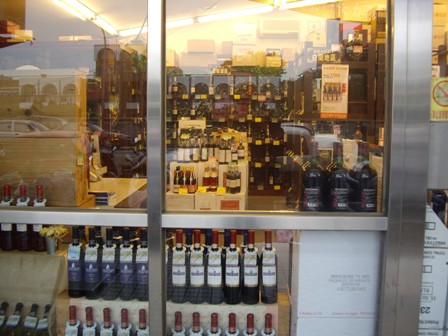
Wine shop in Berlin where wine consumption is ‘en vogue’ (in Lichterfelde)

But can you imagine that grapes are also grown on the soils of the national capital? A curiosity, one might think; indeed so it is. Recently I learned from local newspaper articles that today vines are grown in five city districts (for instance Wilmersdorf, Prenzlauer Berg, Wedding, Kreuzberg-Friedrichshain). Because the region is not certified as a wine producing area, the wines produced from the local grapes are not allowed to be sold commercially.

This is not neceassarily an impediment to wine being ,though in small, in fact very small, quantities. The district councils use the bottled local wines as gifts for public anniversaries and award ceremonies. In some cases citizens can obtain these wines against a small fee. Usually the grapes are transported to a proper winery in a wine region where the wines are made. Many of the grapes are turned into sparkling wines. Apart from Riesling red varieties are also grown. Depending on the weather and disease conditions, between 200 and 400 bottles are produced in each of the districts. For us ‘normal’ wine consumers a tasting might be out of the question but it is good for the promotion of the divine drink.

p4190268.JPG

Advertisement for wine and invitation for wine appreciation classes


2007 Canberra International Riesling Challenge

October 16, 2007

I would love to be in Canberra right now. The 2007 Canberra International Riesling Challenge is going to start tomorrow at the Hyatt Hotel. Now, that my tastebuds have been extensively exposed to German and especially Mosel Rieslings during the last two months travelling in Germany it would be extremely interesting to compare the different wines and styles on offer from the Old and the New World.

d1000319riesling1.JPG

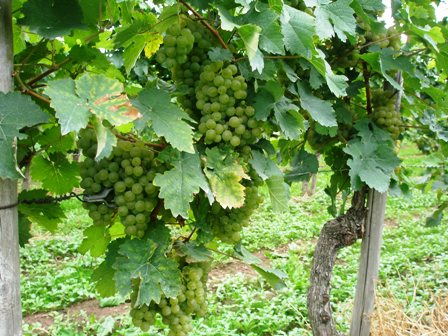
German Riesling grapes, fall 2007

The event is the biggest Riesling competition in the southern hemisphere. This year a record number of wines were registered, 482 wines in comparison to 458 last year and 328 in 2005. The bulk of the wines comes from Australia (293), 73 are from Germany, 58 from New Zealand and 45 from the USA but only three from France.

For more information please visit the website especially created for the event (www.rieslingchallenge.com).

As we know Riesling is all the vogue. Dr. Ernst Loosen from Bernkastel/Mosel (www.drloosen.com), one of the prime producers of Mosel Riesling was very modest and polite when he suggested earlier this year during the “Riesling Rendezvous” at Chateau Ste Michelle estate in Washington State (24-26 June) that “it is up to the New World to help raise the reputation of Riesling and create a Riesling renaissance”. In fact the wine consumers have done it all alone and the world is witnessing a boom in Riesling demand.

Talking Riesling is very important. Australia is a leading Riesling producer. Ever since the Pewsey Vale Riesling from the Eden Valley won a gold medal in London in 1854 Australia has been on the international Riesling map. Many wine regions in the Old World,with the exception of the Mosel of course, where elector Clemens Wenzeslaus had instructed its administrators in 1768 to grow only “white riesling”, did not grow much Riesling in those days.

I hope the event can also contribute to a better understanding of the confusing labelling of German Rieslings. Here more needs to be done to educate international consumers.

Rieslings from our own wine region, the Upper Goulburn Wine Region, have done well in Australian wine shows in recent years. At the 2005 Small Vignerons Awards a 2004 Barwite Riesling won the trophy for best Riesling and in 2006 this trophy was won by the 2005 Delatite Riesling. At the recent Alexandra Food and Wine Expo (please see my earlier blog entry) I had the opportunity to taste the 2005 Barwite Riesling, which showed beautiful floral characters and was a citrus bomb in my mouth. Of course I am curious how the UGWA member wineries will do at the event.


Freedom from protectionism – the EU wine market in the 21st century

June 22, 2007

It sounds strange to the ears of an Australian vintner that the wine industry (because of its complexities) would need the protection of the government. I think we in the Australian wine industry enjoy a maximum of freedom from government intervention. European vintners are not that lucky. But is seems that finally they might be getting some more freedom, if the European Commission carries through with its proposal to reform the heavily subsidised and regulated wine market.

However, if one expected a hearty welcome and praise for this effort, one would be utterly mistaken. There is some fierce criticism from some of the EU member countries which object to this “too much” of freedom. Doomsday scenarios are then usually invoked to scare reform minded policy makers. “The end is near”, “our culture and traditions are dying” and other similar slogans are shouted out by lobbyist of various persuasion. Of course consumers would ultimately benefit from deregulation and liberalisation. In the non-wine producing countries, there seems to be no problems but in the wine belts of the EU a storm is being stirred.

According to the Economist of June 16th, 2007, the EU wine budget amounts to € 1.3 billion a year. Some wine is produced more or less exclusively for destruction. The reform plan includes the pulling of about 200,000 ha of vines (about 6% of the total area) and transfer payments to vintners who cannot sell their produce so that they can leave the sector and find some new employment. The restrictions on new planting are scheduled to be lifted from 2014 onwards so that successful wineries can expand. Especially French and Luxembourgian officials oppose these moves and invoke the fears of inundation by cheap, mass-produced, “industrial technique” dominated wines from the new world. Both countries are rather successful in making money from wine production. Their vintners earn more than others in Europe, says the Economist. Ever since the debate of the Corn Laws in Britain in the House of Commons in 1813 and the enactment of the importation act in 1815, mercantilism has raised its ugly head from time to time, always with the ever same line of argumentation (foreign grown products would be dangerous to rely on, prices and wages would be diminished and producers and manufacturers would lose out). Empirical evidence is overwhelmingly just to the contrary. Europe would not be that prosperous without free trade and the healthy competition it bring with it.

On a more personal note, I believe there is another aspect usually overlooked: the dignity of a producer who can survive in the market without government handouts. Isn’t it a beautiful feeling if your wine flies out of the farm into shelves of supermarkets and grocery stores, and you don’t have to beg government officials for charity? I hardly make any money with Two Hills Vineyard at the moment, but so far I survived as a free but responsible man. If I should be forced to pack up and sell, I can say that I at least tried. No government to blame, I have only myself to blame which is neat.

I wish my European colleagues well in their efforts to become more independent and sucessful.


Wine Industry in Crisis

May 17, 2007

Today I received information from the Upper Goulburn Wine Growers Association, of whichTwo Hills Vineyard is also a member, about the current problems in the North-East Victorian wine industry. As you all know, the 2007 vintage was volumewise much smaller than earlier vintages. In fact the crushed tonnage was 65% less than average. Because of the adverse conditions (late frosts among them) in 2007, the tonnage projections for the 2008 vintage are about 50% of normal times. This has a far reaching impact on the region, the councils, growers, wineries, consumers, tourists and the people in rural Victoria’s North-East. The livelihood of many producers, wine grape growers as well as wine processors, is threatened.

The Victorian Wine Industry Association has come up with a hands-on training program for those affected. This modular program looks at four main areas:

1. Vineyard Management
2. Business Sustainability
3. Market Development
4. Winery Tourism

For a boutique vineyard such as Two Hills all of these are very important. I am particularly interested in the possibility of future wine grape sales online. As an absentee owner, I appreciate more information about potential sales, demand and prices. Of course this year we had no problem in selling our fruit. Just that we did not have enough of them, and that’s made 2007 a bad year so far, the volume was just no there. It was good news for the receiving wineries, they got first class fruit from Two Hills. The online sales mechanism is most likely to be housed atwww.winesofvictoria.com.au

I also expect that I will have good use for the planned benchmarking guide for small wine businesses and the standardised Gross Margin Calculator. Though we are already exporting some wine, I hope to benefit from the country specific export market guide kit. If anybody of my readers knows any reliable importer, for instance in Germany but also elsewhere, please let me know. Our volumes at Two Hills Vineyard are small. Our single site vineyard does not allow blending with other fruit, which makes the special character of our products. Moreover, ‘exciting to drink a wine every year, for instance Merlot, from the same location and it always tastes different: one tastes the specific year, its climate, the soil….

I am an unlikely beneficiary of the training itself. Have I told you that we have booked our flights to Australia and that we will be in Glenburn from 11 July till 15 August? Come and visit us and have a glass of Two Hills wine.

picture-384web.jpg

Lunching together with family and friends


My hometown: Augusta Treverorum – a short visit to Trier

May 5, 2007

It was four busy days in Trier, running from appointment to appointment. Spring this year in Germany is most beautiful. Temperatures almost like in summer, sunshine, blue skies and very dry, no rains (bad for all the farmers and vintners). The four days included among others a family gathering with brother Wolf and my old folks, visits of old friends, meals in country pubs and at home, long walks in Trier, barbecues, afternoon coffee and cake, a Riesling wine tasting with the winemaker, a hunting trip in the forests of the Saar river, and a birthday party of my niece Adriane who turned 24!. When I finally had my train ticket to Frankfurt in my hands, I knew the time had come to say good bye. I payed a short visit to my favourite wine bar, Kesselstatt, opposite the cathedral (Trierer Dom) and had a last drink, a fine and dry 2005 Wiltinger Riesling. Then I went to an internet cafe near the train station but could not enter this text into my blog so I had to defer it to later. “Good byes” as always in the hope that you meet again and off I went on the train to catch my plane in Frankfurt for Jakarta.

Weinstube Kesselstatt

Weinstube Kesselstatt in Trier

The train trip makes the farewell easier. Along the Mosel river to Koblenz I could enjoy the beautiful Mosel valley with its steep vineyards, old castles, small settlements, and lovely countryside. After a change of trains follows the middle Rhine river valley with magnificent castles, stepp slopes covered in vines, the narrow valley, and the beautiful and winding river. When I had passed Bingen and entered Mainz, the long farewell had almost come to an end. From the familiar to the unfamiliar, the known to the unknown; the ancient, rural, pituresque and wine producing land gave way to industrial landscapes, big cities and finally the airport. My time in Germany had come to an end. So long, farewell, Auf Wiedersehen, good bye and the promise to return in September with more time on my hands for family and friends and the tasting of fine wines from the Mosel-Saar-Ruwer.

Trierer Dom

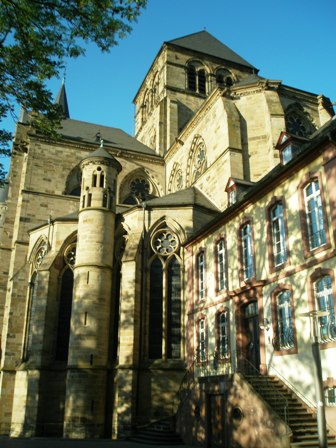
Trierer Dom and Liebfrauenkirche


Land and wine

April 13, 2007

It’s always good to be back in Taiwan. It is here that I started my professional career about 23 years ago at the former Land Reform Training Institute in Taoyuan, now renamed, the Center for Land Policy Studies and Training (www.iclpst.gov.tw). The class I am teaching (on good governance, decentralization, democracy and citizens participation in land administration) is very exceptional, 24 professionals from 22 countries from all over the world. They make it easy and interesting for me. This year’s group is very active, interested and discussion hungry. As always the staff of the Center is very friendly and I have the chance to catch up with many old and new friends.

On Sunday it started with a wonderful lunch in Taibei. At the “Wei Fu Lo” Restaurant we had Beijing Duck and many wonderful local Taiwanese dishes to complement the North Chinese delicacy. I later learned about a special chicken dish, called “Gu-ken chicken” which is grilled in coffee powder. We drank green tea with our meal, no wine.

wine-store-with-door-small.jpg

But across the street from the Center is a wine and spirits shop which I used to patronize in the past. I paid it a visit and browsed through its stock. These include mainly whiskeys, brandies and cognacs as well as other spirits, but also a selection of fine wines from France (lots of Bordeaux’s, among them a Barville, Sancerre, Cordier/Saint Emilion, Baron de Rothschild, Chateauneuf du Pape, Mouton Cadet), Italy (Nero D’Avolo from Sicily, wines from Umbria and Melini from Tuscany but also a Barolo), Chile (Philippe de Rothschild), Spain, Australia (Lindemans, but also Amberly from Margret River and Goudrey from Western Australia ) and a large stock of various Blue Nun (Made in Australia) bottles. The selection included also some sparkling and desert wines (Ice wine).

wine-store-small.jpg

My friend Jim bought a bottle of 2004 “Les Cloîtres” (Hautes-Côtes de Nuits) of Bouchard Aìné & Fils, Beaune, Bourgogne, France for the equivalent of about 17 EURO (!) which we drank together. After the bottle got some air, the wine was silky and smooth with lots of red fruit flavour, a good texture and an impressive finish. A week is not long and before I could settle in I was back on a plane heading home to Jakarta.


Up North

April 8, 2007

I travelled north, from Jakarta to Taoyuan, Taiwan where I am going to teach for a week at the International Center for Land Policy Studies and Training (ICLPST). The flight was very comfortable in the business class of China Airlines. The menu I chose was all seafood. Boiled baby prawns with tomato and lettuce leaves as entrée and fish and prawn satay in ginger light soya sauce with Shanghai noodles as main course. On top of the wine list I found to my surprise a German Riesling from the Mosel-Saar-Ruwer, my home region in Germany where also Trier, my hometown, is located (www.trier.de). Home sweet home, and out of this melancholy, I asked for it.

menu-taiwan-small.jpg

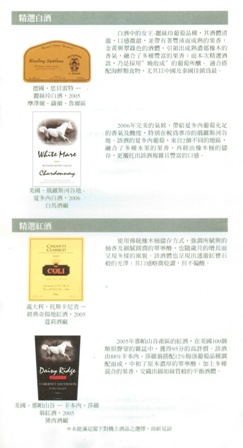
It said: 2005 Spaetlese, but I could not resist! The description claimed the wine is “rich, buttery layered with flavours of orange zest, Asian pears and golden delicious apples, with a subtle, smoky back note”. I could not taste any of this. For me it was “sugary” and the steward was so kind to let me have the second white wine on the menue: a Chardonnay from the US. 2006 White Mare Russian River Valley (Sonoma County), depicting a white horse on the label, not my type of label but what could I do. I did not know the winery. There was also a red (Cabernet Sauvignon), 2005 Daisy Ridge with the same white horse label.

The second red wine was from Italy, a Chianti Classico 2005 from Coli in Tuscany. After a couple of glasses of the Chardonnay, which I quite liked, I moved on to the Italian wine and stayed with it for the rest of the flight. By the way, the service was great at this flight, so many nice stewards and stewardesses, unbelievable. I can only recommend China Airlines. The wine list, though, could be changed. OK, I did not try the champagne, a Drappier Brut which got 89 point from the wine spectator. There are much better Rieslings from the Mosel or the Saar to choose from. I would also replace one of the US wines with an Australian Shiraz maybe or a Merlot.

I watched a movie, read in my Tim Winton book (The Turning) and arrived in Taoyuan in no time, well rested, fed and happy.

temple-small.jpg


Hail St.Patrick’s in Jakarta

March 19, 2007

St. Patrick’s Ball invitation

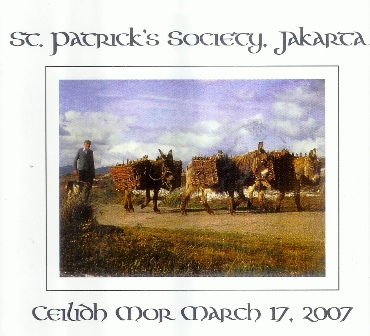
Oh boy, what a splendid celebration this was, the annual St. Patrick’s Ball in Jakarta (www.stpatricksjakarta.org). My friend Uli from Germany came with me to enjoy the fun. We sat with some of my Australian friends on table No. 39, four couples and we two Germans, almost as last year just that my wife fell sick and I was, so to speak, with a male companion only. For Uli it was the first St. Patrick’s Ball ever. But being a country boy himself, he adjusted quickly and felt at home in no time. I met quite a few friends and acquaintances and we all had a good time.

The dancers were spectacular, the speeches boring, the food very good, the people in a jolly good mood, all dressed up and in their best outfits, a pleasure for the eyes and senses. There was white wine from Spain, and red wine from Western Australia.

Gun cuireadh do
Chupa thairis le
Slainte agus sonas

May your cup
Overflow with
Health and Happiness

I was sure that I would remember the brands until the next day. But something must have gone wrong. I danced at my hearts content until about three thirty in the morning with some charming and beautiful lassies from all over the world. When I hit the hay at home, I had already forgotten all about the wine, but boy, we had a jolly good time….

st-patricks-societyw.JPG

The German “contingent”, two old friends!


Wine made in India

March 16, 2007

When I openend my morning newspaper today – for insiders it’s the International Herald Tribune, (IHT) delivered at about 6-6:30 h every morning to my home in Jakarta so that I can read it while having breakfast and after my children have left for school – I was quite surprised to find on page 2 an article with the headline: “Days of wine and roses, sobered by high tariffs” desribing the situation of the infant wine industry and increasing wine consumption in India.

Jaipur

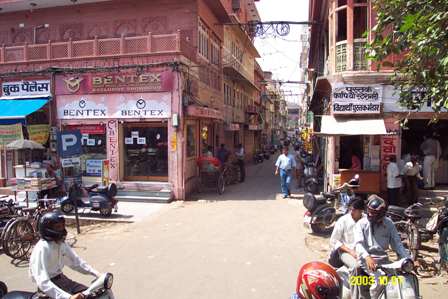
Jaipur street in 2003

It reminded me of our two years in New Delhi, almost 10 years ago. It was hard to get access to wine, any wine. We needed a personal reference from a friend so that a wine dealer would accept us as his new clients. This took quite some time. Only white and/or red where the choices available to us. The stuff was delivered after nightfall. A van drove into our driveway with turned off headlights. Then the bottles were delivered in secret, tucked into inconspicuous boxes. When we openend them the very first time, we found to our surprise the cheapest of French white wines, which might have costs a dollar or two in France but for which we had to surrender about 15 US$ of our hard earned money to our mysterious benefactor. I remember how happy we were. Over time and with the approprite consumption level, the quality of the wine and the choices available to us would improve. However, we never quite made it to get our true choice of wine delivered. But better ordininary wine with a delicious meal than no wine at all, became our daily and pragmatic attitude.

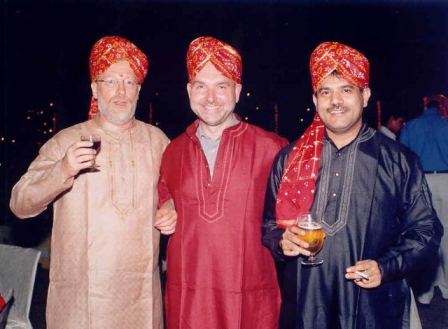
Ten years later, not much seems to have changed in New Delhi. The article in the IHT calls our mysterious benefactor a “bootlegger” which he certainly might have been. And despite a surge in domestic demand, wine cunsumption seems to be still hampered by a series of religious, cultural and bureaucratic hindrances. When I attended an international seminar in Jaipur in 2003 we had some very delicious Indian reds. Unfortunately, I did not take a photo of the bottle at the time but the three “dancing derwishes” are proof that we had great fun at the event. If you want to learn more about wines made in India please visit www.sommelierindia.com.

Derwishes

With my friends

In the long run, I feel, prospects for Australian wine in India should be good. My two daughters, if they should take over the family vineyard after I have “transcended” my earthly existance, might be the beneficiaries of this. 30% growth of wine sales as we can observe today will have subsided but the total bottles sold will go into the millions. When I think of the values, I become dizzy: total wine exports value of the US to India stands at only 1 Million US$ today. With an ever increasing number of consumers and average income increasing even faster, a small family vineyard as Two Hills should have a chance to sell to a few boutique wine shops in Mumbai, Delhi, Kolkata and Chennai. How I love the future.

Jaipur 2