Long Row Cabernet Sauvignon, Angove Family, Winemakers from South Australia

June 17, 2010

2007 Long Row Cabernet Sauvignon

The Angove family is one of the oldest wine making families in South Australia. Five generations of wine-making tradition, that’s a lot given the youth of Australia as a country. Founded in 1886 in Adelaide, the Angove Family Company is one of the largest private wine producers in the country.

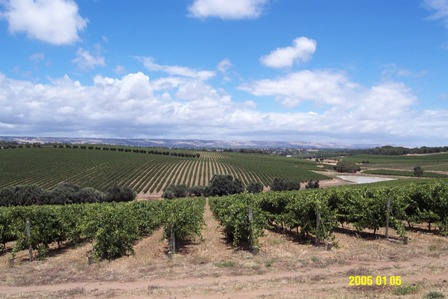
With a total area under vines of about 480 ha, Angove is not a small operation. It’s Nanya vineyard is located in the flats of Riverland, in South Australia. Endless rows of vines dominate the view. Some of them are 5 km in length, a frightening thought for a German like me. It must be tiresome to work in these vineyards. The grapes are, of course, machine harvested.

The 2007 Long Row Cabernet Sauvignon is a blend, made of fruit sourced from across various wine regions in South Australia. The Long Row brand was established in 2003. This wine was classified by the Australian wine critic Jeremy Oliver in “The Australian Wine Annual” as a wine of “Top Ten Bargain Range”.

In fact it is a very nice drink, fruity, solid with structure and a good finish. In Australia you can have it for about A$ 10 per bottle, in Thailand you have to pay three times that amount.

I like the colour. Since I do not drink much Cabernet Sauvignon, the experience with this Angove Family Long Row wine, was pleasantly surprising. I will have to find out if our supermarket carries it as well or I will ask my wine merchant to locate a couple of bottles for me.

If you are in South Australia you might visit the two cellar door facilities operated by Angove, one at the Renmark Winery, the second at the original winery at Tea Tree Gully. Please visit their website for instructions how to get there.


Good friends and good wines

April 12, 2010

Enjoying good wines together

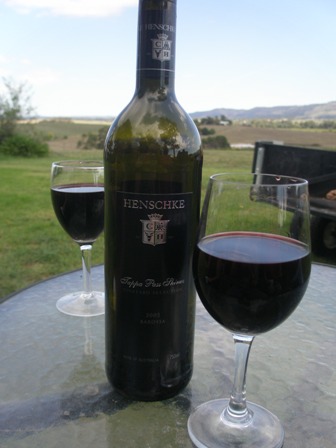
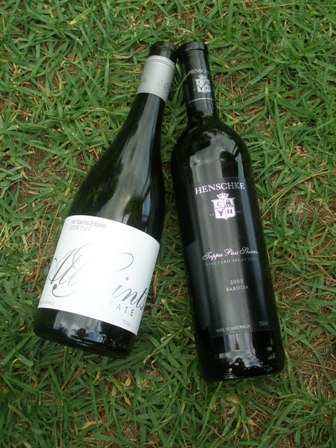
It is always a pleasure to visit Gayle and Phillip at their Spingvale farm just outside of Yarra Glen. They served us wonderful wines. A ‘2005 Tappa Pass Shiraz Vineyard Selection’ by Henschke from the Barossa Valley in South Australia and a ‘2008 All Saints Estate Durif’ from All Saints Winery in Rutherglen, Victoria. Both wines are wonderful, lush and full of flavor, the right stuff for a long chat on the lawn. Needless to say, we had a great time.

An afternoon with red wines

The 2005 Henschke Tappa Pass Shiraz

The 2008 All Saints Durif

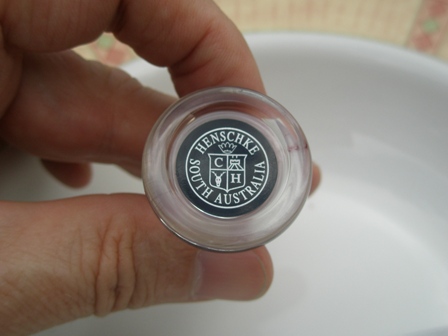
The Henschke Shiraz with a glass enclosure

When its over: bottles on the ground


The “good” Lehmann and not the Lehmann brothers

May 23, 2009

While we were working on Thursday, May 21st. in Bangkok, our German colleagues were celebrating Ascension Day, also known as “Fathers Day” in my native Germany. “Father’s Day” is usually celebrated in the following way: young fathers, some older ones among them, and many other men, usually the ones who have not fathered any child they are aware of but eager to celebrate whatever comes their way, gather in the morning around a handcart loaded with all kinds of drinks and food. Then they set out and walk into the surrounding countryside to drink with their mates and have a jolly good, all-male time. Sometime they have a specific destination or they walk around a circuit. I will refrain from describing the usual end of these walks.

In short, the occasion warrants a special treat.

On this Father’s Day in Bangkok, I had the great pleasure of enjoying some hearty Italian meals, delicious pastas and insalata caprese and other delicacies. The rather colder nights in Bangkok, due to the beginning of the rainy season somehow incited in me the desire for some good reds; Australian was the natural choice.

Swirling College Wine

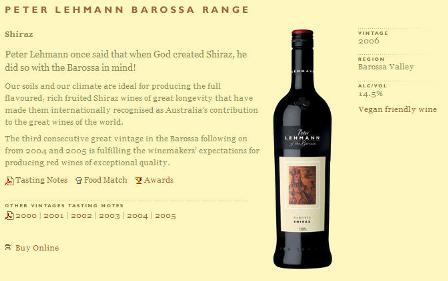
Peter Lehmann and his Shiraz wines seemed to be just the right stuff. Since wine prices are dear in Thailand we have to be careful with our choices.

Peter Lehmann is one of the few Australian vintners who became a legend in his own lifetime. Today, Peter Lehmann Wines in the Barossa Valley, South Australia is part of the Hess Family Estates with wineries in the Napa Valley, South Africa and Argentina.

Peter Lehmann Wines was established in 1979 as a response to the serious grape overproduction at the time (sounds terribly familiar in 2009 too). Most of the grapes come from about 185 contract growers. Only about 3% of the total wine output is derived from the self-owned vineyard (73 ha which is not small for a boutique vintner like me).

The Shiraz wines are the flagships of Peter Lehmann which assured me that nothing could go wrong.

We bought the following wines:

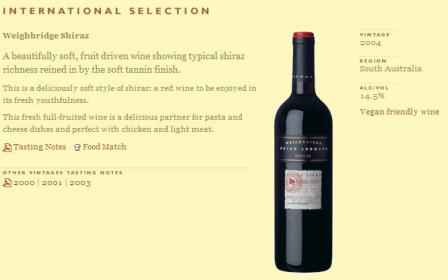
1. A ‘2006 Peter Lehmann Weighbridge Shiraz’
Peter Lehmann 2006 web

2. A ‘2005 Peter Lehmann Barossa Shiraz’
Peter Lehmann 2005 web

Both were “reasonably” priced for Thai conditions. The price for the bottle of Weighbridge Shiraz was about 700 Thai Bath (US$ 20 or € 14.6) and for the Barossa Shiraz about 1,000 Thai Bath (US$ 29 or € 20.8). Retail prices in Europe range from € 8-12 resp. € 15-17 or £ 6.50 and £ 7.50 in the UK. Interesting these price differentials. That’s the price of protectionism. Long live free trade.

Both wines went well with the Italian food. They had a beautiful dark red colour, were spicy and full of black fruit, plum in the case of the Weighbridge Shiraz. The 2005 Barossa Shiraz was “heavier” with lots of chalky tannins, a wine to be chewed so to say. We started with the 2006er bottle and went on to the older, in my view better, wine, which was absolutely the right choice.

I have not visited the Peter Lehmann winery in South Australia myself. The website is beautiful, informative and very enticing. I conclude: one should visit the place.

It takes about one to one and a half hours to drive to the winery from Adelaide Airport.

Address:
Peter Lehmann Wines LTD
off Para Road
Tanunda SA 5352
South Australia


Restaurant review: Elbow Room, Jakarta

April 11, 2009

By default I had some time for myself. I took the opportunity and strolled through Kemang, the area in Jakarta where my hotel, the Grand Flora, was located. The other day, I had briefly met friends at the “Elbow Room”, a brand new place to hang out in Jakarta but we only had a couple of beers.

I was impressed by the shiny new décor of solid wood panels and the copies of paintings by classical and modern artists. Also the high ceilings appealed to me, so did the non-smoking ban which provides the air of freedom in a world which more and more subdues private lives to the wisdom of a certain kind of political correctness. I consider myself a non-smoker despite my occasional cigar burning rituals I perform with great gusto.

Last night I went there again, this time for tea, as we say in Australia, which translates for non-Australian as “dinner”. Apart from the wood beams and wood panels, the bar contains also some type of ship-features, in golden metal colours. At first sight the large round window on the first floor gives the impression of a porthole. The smaller inner-circle is more reminiscent of an eyeball though which you can look through and out to the street. The toilets are done in ship-style too.

I choose a table on the first floor near the window and sat in the big and solid country-style leather chair, I like so much. I was not very hungry. Actually, a glass of wine would have done it for me. From the earlier visit I knew that you can only order whole bottles. The waiters are extremely friendly and helpful (great service). The jazz music gives the place a flair of intellectual sophistication. The lights are subdued, in fact the place is rather dark.

elbow-room

My little digital camera could not cope with the general darkness of the place. This is why I cannot show you pictures of the interior and of the food I consumed. I ordered bruscetta and fried zucchini, both quite tasty snacks. The Australian Shiraz (Penfolds) was out, so I settled for a bottle of ‘2004 Geoff Merrill Cabernet Merlot’, from South Australia, the only other red wine on offer.

I had not heard of this wine and this producer before. The Cabernet Merlot blend is a medium bodied wine with a wonderful dark red colour (14.5 % Vol). The black fruit aroma was quite nice, and the wine tasted also like black fruit. The mid-palate weight was very remarkable, the finish was OK but nothing spectacular, in short a solid wine. When researching the wine, I did not find it on the Geoff Merrill website (there is no cuvée of this type). But the wines are reasonable priced (16 to 30 A$). The Elbow Room charged INR 469,000.-, about € 30 for the bottle which I find to be a bit on the dear side.

I asked the waiter if I could take the bottle home in case I could not finish it and he kindly agreed (otherwise I would have left the place). I smoked some kretek cigarettes and had a jolly good time.

If you want to know what the interior of this bar-cum-restaurant looks like, you have to go yourself and find out. I personally prefer to eat in more lit up places. The prices for the snacks mentioned above were very reasonable. I recommend to the Elbow Room management to consider introducing a wine-by-the-glass policy. Check the place out if next time in Jakarta, it’s worth visiting. I will definitely visit again.

Address:
Elbow Room Restaurant
Jl. Kemang Raya No. 24 A
Jakarta, Indonesia
Te.: +62-21-7194274


Phylloxera in the Yarra Valley

January 8, 2009

On December 23 another outbreak of phylloxera in the Yarra Valley was confirmed. This is the third infection since 1. December 2006. Phylloxera is a small aphid that lives on the roots of grape vines. Despite almost a century of research no remedy has been found so far. An infection will inevitable lead to the death of the vine. Grape growers, vintners, wine makers and winery owners are concerned that the spread of the disease cannot be contained.

A new “Phylloxera Infested Zone” called the Maroondah PIZ has been declared around the known infested sites, with the boundary set at a minimum of 5km from all known phylloxera affected properties, and taking into account physical features including roads and rivers.

phylloxera-zone-yv-web

The Maroondah PIZ

One can see the affected vineyard from St Hubert’s road, near Punt Road Winery. It has obviously been treated. The dead vines are without any leaves.

The four photos below show some of the symptoms we look out for. All four photos come from a brochure called “Inspecting Vineyards for Phylloxera” on vine desease from South Australia.

phyll1

phyll3

phyll4

phyll2

Early signs of phylloxera

We at Two Hills Vineyard are very concerned too. Our wine is made in a winery in the Yarra Valley (Yering Farm Wines) and some of our contractors and vineyard workers are also working on vineyards there.

In order to not contract the vine disease we are attempting a certification with a protocol in place which will prevent our vines from being affected sometime in the future. It’s quite fortunate that we have no visitors in the vineyard and do not participate in the wine tourist trade. However, all people working in the vineyard and their equipment need to take proper precautions. We hope it will work.


Grape grower of the year in McLaren Vale

October 3, 2008

The Daily Wine News, an e-newsletter from the Australian Wine Industry Portal of Winetitles, carried the other day a summary of the McLaren Vale Annual Wine Industry Awards. One of the award winners (in the category ‘Grape grower of the Year Award’) was a vintner names Joch Bosworth of Edgehill Vineyards.

I went straight on to google the man and found a very interesting website (www.edgehill-vineyards.com.au). Joch’s wine label – the Battle of Bosworth -is named after a famous battle in England in 1485. The Bosworth family has grown grapes in the McLaren Vale region since the 1840’s. The Edgehill vineyard is located in Willunga, and was established by Peter and Anthea Bosworth, the parents of Joch, in the early 1970’s.

Needless to say that Edgehill Vineyard was converted to organic viticultural practices (in 1995) and today is a certified A-grade organic farm (certified by ACO www.australianorganic.com.au). It has some 50 acres under vines, planted to Shiraz (some more than 20 years old), Cabernet Sauvignon, Chardonnay, Viognier, Sauvignon Blanc and Mourvèdre.

What I find remarkable too is the fact that the rows between the vines are left to a “vicious” weed, the Soursob, the picture of it featuring on the wine label. The Soursob produces a very pretty yellow flower. The life cycle of the Soursob complements the cycle of the grape vines in so far as it dies off in spring and flowers and uses water in winter when the vines are dormant. Would love to know wht his neighbours say to that system.

I present you a video which is posted on Joch’s website. I do this for two reasons:

1. It is interesting to watch and informative
2. It shows the relaxed atmosphere and vine growers culture of my adopted home Australia which I treasure so much.

Enjoy watching it.

I have visited the McLaren Vale wine region only once and enjoyed the triop tremendously, but next time I will look out for Edgehill Vineyards in Willunga.

Address:
Battle of Bosworth Wines
PO Box 11 McLaren Vale
South Australia 5171
(Ganney Road, Willunga, SA)
Tel.: +61-885562441
http://www.edgehill-vineyards.com.au


What we were drinking: South Australia

March 23, 2007

David, the son of our mutual friend John, from Sydney brought two wonderful bottles of wine over the other day. We had them with a beautiful meal for Saturday lunch. With the spicy clam pasta we enjoyed a bottle of 2006 Sauvignon Blanc from Shaw and Smith from the Adelaide Hills (www.shawandsmith.com), a cool climate region in South Australia where my wife comes from. Grapes where planted there as early as 1839 and today there are about 60 wine labels with over 3,000 ha of vineyards planted. This young Sauvignon Blanc is a wine to my taste: fruity (with passionfruit and guava flavours), grassy-herbaceous, flinty and well rounded with a long finish. The wine is unwooded and James Halliday gave it 94 points. Very enjoyable in a tropical climate such as Jakarta.

McLaren vale1

McLaren Vale with vineyards, sea view in the distance

The second bottle we drank with the main dish, a vegetable stew, came from Mitolo Wines (www.mitolowines.com.au), a family owned winery situated in the most southern tip of the McLaren Vale region. I will write more about McLaren Vale in one of the next entries, because we visited the region in 2005 and had a wonderful time visiting some of its vineyards. We drank a 2004 Jester Shriaz. The wine had a deep purple colour. The nose showed intense blackberry, plum and chocolate aromas of rich black fruit. The wine has a good structure, is well rounded and has a long finish. Of course it should have been cellared for 4-5 more years but we could not wait. Both wines made our day which we spent sitting on the terrace and discussing the pleasures of life in general and life in Indonesia in particular. Come and visit us one day.

McLaren Vale 2

Vineyard view in McLaren Vale