Crazy bridges – how to destroy the Mosel

May 15, 2010

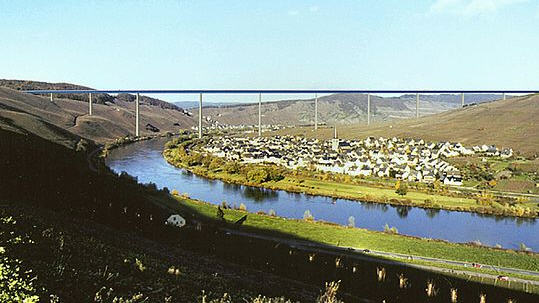
Planned bridge near Uerzig, Mosel

Two days ago the deadline for the petition ended. I confess that I did not make it in time. But I have joined the facebook group called “Stop the new B 50 and save the Mosel vineyards from devastating damage” opposing the building of this bridge.

The planned bridge is massive. It is about 160 meters high and 1.7 km long. It will probably cost about 270 million EURO which is equivalent to about US $ 400 million. On the facebook site above you can find more photos and animations showing you what the bridge will do to the Mosel valley.

The issue made it even into the New York Times which carried an article about it contrasting pro and contra views. Because the cost and benefits of such a massive undertaking are not clear cut. If you asked me to which camp I would belong, well, I asked myself two simple question: 1. would I give up my vineyard land for the venture? and 2. Would I like to look at this bridge from my window when I wake up in the morning?

My recent Australian experience with the North-South pipeline suggests that there is very little hope that such mega projects can be stopped by citizens protest. The Plug the Pipe campaign could not stop the project but it surely raised the political costs to Victorian the labour government. And election time is near.

Topher analyses the political economy of the North-South Pipeline. Unfortunately, there are no elections in my home state of Rheinland-Pfalz this year. So we are less lucky than the Victorians. The only thing which might save us is the empty state coffers.


Restaurant review: Weinhaus Spielberg, Randersacker/Franconia

May 13, 2010

Randersacker

The settlement of Randersacker, Franconia

One of my favourite wine regions in Germany is Franconia. My maternal grandparents came from this part of the country. My grandfather, Hans Heinrich Schuessler, was the man who introduce me to the pleasures and the mystery of grape wine. He was a native of Reichenberg, a small hamlet just south of the city Wuerzburg, the capital of the region. Randersacker is situated at the opposite side (from Reichenberg) of the Main river. We visited the place while touring Germany some time ago.

Spielberg1

The inscription on the Bocksbeutel bottle reads: In vino veritas

The market town of Randersacker was first mentioned in a historical record in 779 AC. The historical centre of the town, though small, is quite nice and worth visiting. We were on our way back to Wuerzburg but wanted to have dinner at Weinhaus Spielberg.

Franconia produces outstanding wines, mostly Sylvaner/Silvaner but I like also the Riesling wines. It’s speciality is the Bocksbeutel, a wine bottle in the form of an ellipsoid. This is what we came for when we selected Weinhaus Spielberg as our target.

Spielberg2

A coaster of Weinhaus Spielberg

Weinhaus Spielberg is a traditional country inn where solid German food and good local wines are served. We ordered some local specialities, especially typical Franconian dishes. The two pictures below might give you an idea what food I have in mind. We had the house wine with the food, a very refreshing, young and delicious Silvaner.

Spielberg4

Spielberg3

The service is very efficient, the waiters are friendly and very helpful. At times the Weinhaus is very busy. However, there is no need to fret, you will highly satisfied with what you will get. My credo: visit the place yourself, and see with your own eyes, taste with your own taste buds and have fun in Franconia.

Address:
Weinhaus Spielberg
Stefanie Sokoll
Lurzengasse 3
97236 Randersacker

Tel.: +49-931 / 708391
Fax: +49-931 / 709957
E-Mail: Spielberg-AS@t-online.de
www.weinhaus-zum-spielberg.de

Opening hours:
Monday – Sunday: 11 – 24 h
Friday: open from 17.00 h
closed: Thursday


Pierre Sparr Riesling, Alsace

May 8, 2010

Pomfret con alceitunas y alcaparras

We had fish for dinner. Following a Spanish recipe, we had “Bonito con Aceitunas y Alcaparras” (tuna with olives and capers) from the “Culinaria Spain – Spanish Specialities” cookery book by Koenemann, 1998, Cologne, which is a wonderful book. It has not only breathtaking recipes but great pictures, stories about the food and the people, the various regions of Spain and, of course on Spanish wines.

We deviated from the original recipe by replacing the tuna fillets by whole pomfret fish but used all the other ingredients for the preparation of the dish. Needless to say, it was delicious. The recipe worked also with pomfret, one of my favourite fishes here in Asia.

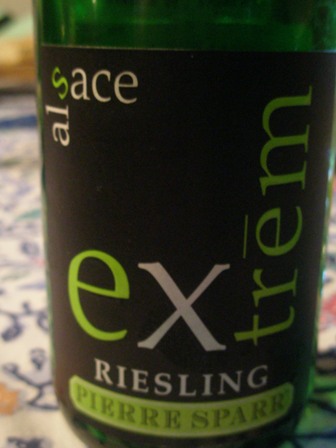
2008 Pierre Sparr Riesling, extreme, Alsace

I had no Spanish wine in my wine fridge, but a Riesling from Alsace which I had bought a couple of days earlier because of its funky modern label. Pierre Sparr is the name of the estate. The 2008 vintage Riesling is still young and exuberant, just the right stuff for pairing it with the strong taste of the olives and the capers. The acidity made all the difference.

Pierre Sparr Riesling extreme

2008 Pierre Sparr Riesling, extreme, Alsace

I tried to find the same label on the Pierre Sparr website but could not. It must have been a special label for the export market. Back home in Alsace the same wines have more traditional wine labels. The Sparr family winery goes back to 1680. Pierre Sparr is representing the ninth (!!!) generation of Sparr family wine-makers and vignerons. The winery is located in Sigolsheim at the heart of the Alsace region. The family owns and operates 34 ha under vines and contracts fruit from about another 150 ha, usually small growers.

I love this wine region and have visited many times, especially during my student days. Alsace has a outstanding gastronomy, spread over the most picturesque region, right at the foot of the Vosges mountains down to the Rhine river. Vines have been cultivated since Roman times.

Pierre Sparr offers a wide range of wines (and also grappa). I guess the wine we had belongs to the lowest quality segment which you can buy in France for about 8.25-9.50 EURO/bottle. I paid much more for it here in Bangkok. It displays rose petal aromas, citrus, peach and honey. The wine is sprizzy and has zest, a good structure and a long finish. Its’ perfectly made and will last for some more years (12% alc/vol).

I hope we have the chance to visit Alsace again this year. And meanwhile I look out for Pierre Sparr wines here in Bangkok.


Restaurant review: Gasthaus Bidinger, Schoden

May 5, 2010

Bidinger00

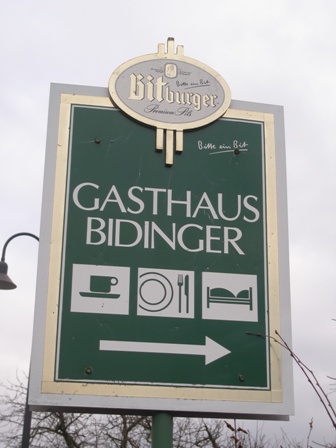
Show me the way

It’s a public holiday in Thailand today (coronation day), and this might be the reason why I am in a reminiscing mood, the dominant “mood of old people”. But Gasthaus Bidinger (Gasthaus/Gasthof = inn) in the hamlet of Schoden, Saar would be a nice place to visit today. Lunch at Bidinger is one of my favourites when with my mother in Trier, Mosel. The food is traditional German country tucker, solid and substantial, and very enjoyable.

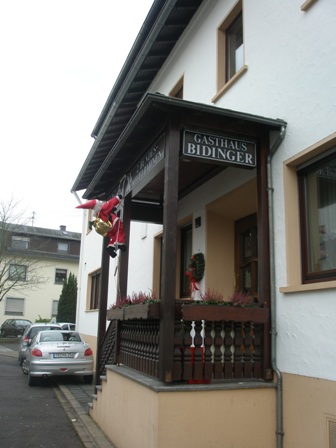
Bidinger0

Gasthaus Bidinger, front entrance

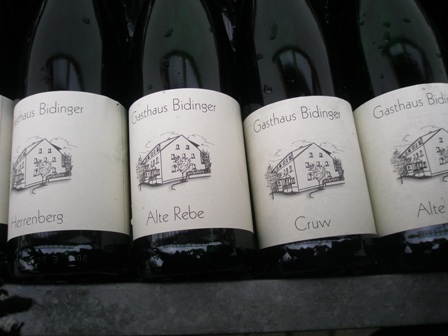
Apart from rustique rural food, Gashof Bidinger offers also a nice selection of traditional drinks, for instance Bitburger Pils beer and the local apple-pear cider, called “Viez”. Viez is usually a quite sour, low alcohol drink widely consumed by the local peasantry. Mixed together with some sparkling water it is very refreshing in summer. Moreover, Bidinger also bottles his own local wines. The Saar produces some of the best Riesling wines in Germany, and is one of my favourite wine regions.

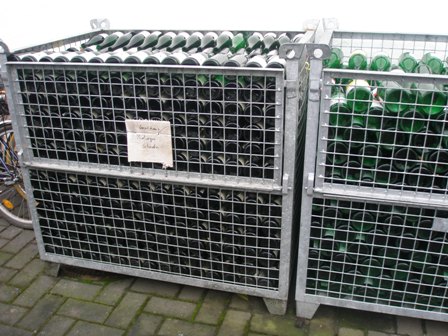
Bidinger2

Many empty bottles

Bidinger3

“Moselaner” apple cider, locally called: Viez

Bidinger1

Wines from the Saar

I would love to be at the Saar today. If you have the chance to visit, do so. It’s a jewel, hidden away somewhat but still easily accessible. A visit to the Saar can be combined with a trip to see Trier, the oldest German city and Luxembourg, just next door.

Address:
Gasthaus Bidinger,
Klosterstr. 30,
54441 Schoden
Tel: +49-(0)-6581/99260
Fax: 06581/99261
e-mail: Gasthaus-Bidinger@t-online.de
www.gasthaus-bidinger.de


Vietnamese delight – lazy Saturday

April 25, 2010

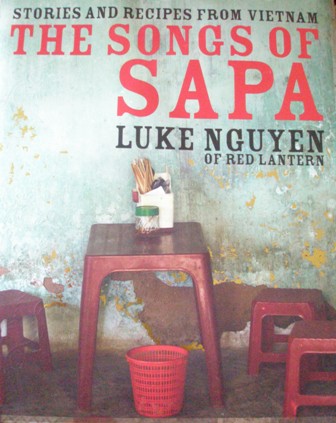
Bubbly to start a wonderful weekend. In the background Luke Nguyen’s beautiful cookery book about Vietnam

Finally, we had some rain on Saturday morning which might be an indication that a season’s change is in the making. Anyway, it was cooler than normal which needed to be celebrated with a Prosecco. That’s how it started. In the background there was music from the Skyehooks, a Melbourne cult band from the 1970ies. All four of us we were very relaxed, did’nt have to be anywhere, did’nt have to go anywhere, in short quality time.

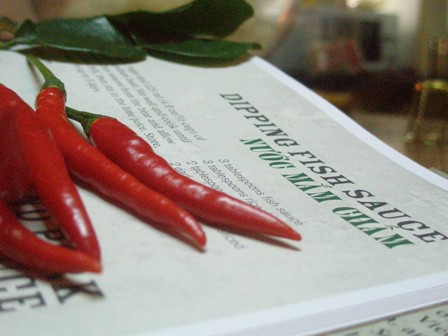
The cooking started with us making our first fish sauce. We followed Luke Nguyen’s recipe. I will not provie it here but instead encourage you to buy the book yourself. It is called: “The Songs of Sapa” and is the most fascinating cookery book I have seen in a long time.

The fish sauce recipe of Luke Nguyen

This is what it looks like: The home made fish sauce

After that the fish cakes were made, also a recipe from the above book by Luke who has become a kind of celebrity chef in Sydney. Together with his sister Pauline and Mark Jensen he has his own restaurant called Red Lantern.

Fish cakes sizzling in the pan…..

…….and on the plate

Rice vermicelli

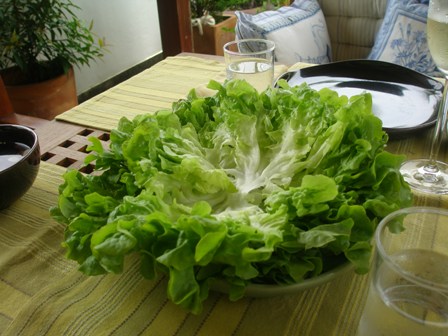
Fresh salad leaves

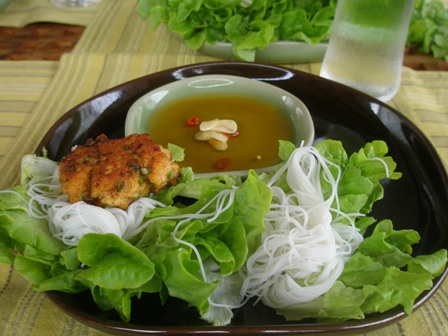
Voila: this is what it looks like on a plate

You do not need cutlery or chop sticks, no, just use your hand. get some vermicelli on the salad leave, take some fish cake and dipp it in the fish sauce: hmm. You will not believe me but this is the most delicious “finger food”. What we forgot in all our enthusiasm was the plate of mint leaves. We will try this next time.

My go at it

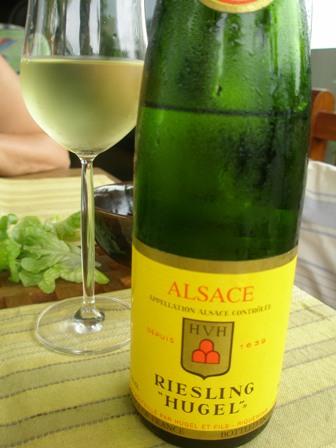
The last question: what about the wine? Well, I hose my favourite Riesling from Alsace, a simple ‘2007 Hugel Riesling’, a wine with zest and character, young and vibrant, a citrus bomb for the taste buds.

Hugel, one of my favourite Riesling wines from Alsace

If you have the chance to get your hands on Luke’s book, please do so. It is worth it. The recipes he has collected are wonderful. Vietnames cusine is light but at the same time filling. After this wonderful lunch we were not hungry until late in the evening.

And this is what the cookery book looks like:


The last sip – a Delatite Riesling

April 18, 2010

Leaving Two Hills Vineyard in Glenburn is always a sad affair. The evening before departure we bid farewell to our old friend Steve and our family, Michael and Helen. On Sunday morning we said good bye to our neighbours, Hillary and Ken. Then we drove to Yarra Glen where we left the car at Gayle’s farm. We had a morning tea, moved the luggage into her car and off we went to Melbourne Airport. Gayle dropped us there and we did the usual stuff.

Fortunately, there was a nice bar called “Plonk”, right next to gate No. 4 from which we were to depart for Bangkok. We went through their wine list and chose a wine from our wine region (the Upper Goulburn Wine Region), a ‘2008 Delatite Riesling’. What a delight this wine was, fresh and fruity with citrus and passion-fruit aromas, a good structure and a long finish. The waiter was particularly charming. Here we said our final good bye. Reminiscing about the past is an old man’s vice, but the memories we took with us are treasures of a very special kind.


The top German Vintners or the VIP club of German wineries: VDP

March 1, 2010

The logo of the VDP

VDP stands for “Verband Deutscher Praedikatsweingueter”. The German can be freely translated as “Association of German Wineries of Excellence”. The VDP is a club-like organisation with 196 member wineries.

It was founded in 1910 and celebrates this year its 100th anniversary. According to its website, VDP is the oldest association of the top quality wine estates. membership requirement is to adhere to the standards of the association which includes among others the strict limitation of yields. There is an inspection and certification process in place which members must submit to in oder to not loose the membership status. It is supposed to uphold the high quality of the produce.

The sign of quality are the eagle (no surprise for Germans who have made it part of their national insignia) and the cluster of grapes, usually embossed on the bottles of their “Erstes Gewaechs” comparable to France’s “premier cru”, wine made from grapes from the best terroir or locations.

The members of the association sell about 35 million bottles per year, for an average price of about 9 Euro /bottle. 80% of their production is sold on the domestic market, 20% is exported. Almost half of the bottles are sold directly to consumers.

The members come from all German wine regions. More than half of them (acounting for about 6% of all Riesling plantings worldwide) produce the finest Riesling wines Germany has to offer. In 1990 it had 161 members. Since then 73 wineries have left and 108 have joined the association.

According to www.riesling.de it’s newest three members are:

Klaus Zimmerling, Saxonia
Konrad Schloer, Taubertal
Thomas Seeger, Baden

Some of my favourite producers are members of the association, for instance Van Volxem Wine Estate in Wiltingen at the Saar.


Sunday walk in the vineyard – a wish

February 21, 2010

“Bildstock” near Nittel, Upper Mosel

Today, I would love to walk through a vineyard with my mother, preferably along the Mosel or the Saar. It is her 80th birthday today. I salute you mum and wish you many more years on this earth.

We could have lunch in one of the many country inns and enjoy a local Riesling wine.

But instead I am far away from the action, in Bangkok, in the tropics. This is one of the downsides if one works in far away places. As consolation I will open a bottle of Saar Riesling later with lunch.


The Old Man with the Beard

February 9, 2010

Famous last words

As a native of Trier, I treasure the most famous son of our city, Karl Marx, though he left rather early and spent most of his time in exile in London. He used to love wine, especially Riesling from the Ruwer where the Marx family used to own a vineyard and of course my beloved Mosel.

I like the poster above (this is why I took a shot through the window to get a glimpse of it), but unfortunately these were not his last words. he did not say: “Sorry folks, it was just an idea.” Only later generations could come to that conclusion. As family gathered around the dying Marx awaiting his final utterance. It is reported that he barked at them and said: “Go on, get out! Last words are for fools.”


Sweet breakfast

January 31, 2010

Yummy waffles with strawberries

Our daughters Lucy and Charlotte surprised us today with waffles for breakfast. They had to try out the new waffle machine which we acquired yesterday. The sweet waffles cried out for a wine. Well, why not, I thought, starting this Sunday in style.

2008 Hardy’s Riesling Gewuerztraminer’, medium dry

We had this bottle of ‘2008 Hardy’s Riesling Gewuerztraminer’ (11.5% vol. alcohol.), an unusual blend for my taste buds, left over from last night. With the sweet breakfast it went much better than with the spicy bean soup. The strong lemon aroma of the wine is quite nice but its also oily like petrol (or good Alsatian and Australian Riesling). However, medium dry is “too sweet” for me somehow.

Great colour in the glass

I asked myself why one would blend these two varieties which stand on their own perfectly well? I rather enjoy them as single varieties, I must say. I only know of Australian blends of these two grape varieties.
If the purpose of a blend made of different grape varieties is to add more complexity to the flavour and texture of a wine, I am not sure if the Hardy winemakers succeeded.

But as Shakespeare has Hamlet say:

“There are more things in heaven and earth, Horatio, than are dreamt of in your philosophy”.
(Hamlet Act 1, Scene 5, 159–167)