Restaurant review: Schlosshotel Cecilienhof, Potsdam

October 1, 2009

cecilienhof

Schlosshotel Cecilienhof

I had the great pleasure to participate in a formal dinner at Schlosshotel Cecilienhof in Potsdam. This hotel is part of a historic castle of great significance: it was the site for the Potsdam Conference which brought peace to Europe at the end of World War II. It was in this building that Truman, Churchill and Stalin (among others) negotiated the fate of Germany in 1945. But I will not bore you with too much history today.

The dinner was a very enjoyable affair: I had great company, the food was excellent, the wines were very, very drinkable and the service was eminently suitable. I went for the seafood choice below: first a salmon starter followed by a “Zander” (pike perch) fillet.

Zander0

The starter made of salmon

Zander

“Zander”/pike perch fillet for main course

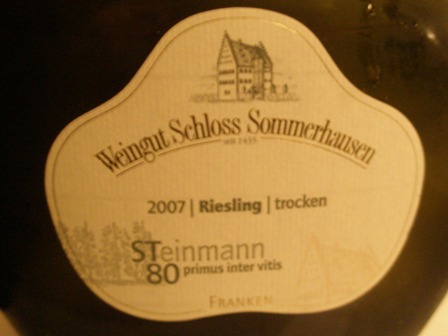
I also tried both wines on offer. The choice for white consisted of a ‘2007 Weingut Schloss Sommerhausen Riesling dry’ from Frankonia in Germany and was an excellent pairing with the starter. Schloss Sommerhausen is located between Ochsenfurt and Wuerzburg, the home of my maternal grandfather who introduced me to the wines from Frankonia.

I just love Riesling and Silvaner wines from Frankonia, but they also produce excellent Spaetburgunder and many other wines. The shape of the Frankonian wine bottles is unique (only the sweet Meteus wines from Portugal can also be found in such bottles), they are called “Bocksbeutel”.

Sommerhausen Riesling

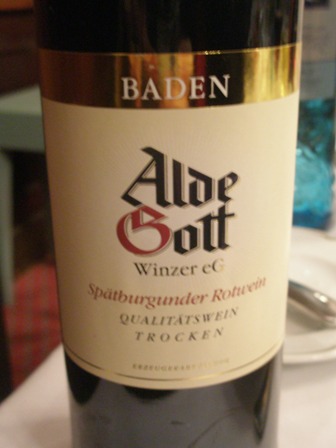
But I also wanted to taste the Pinot Noir, a young wine from 2008, ‘Alde Gott Spaetburgunder dry’ from Baden. This was my second Pinot Noir from Baden since I arrived in Germany and I must say, both wines (the other one was from Affental) were excellent.

Both are produced by wine co-operatives. “Alde Gott” is located in Sasbachwalden, a village near the cities of Buehl and Baden-Baden were also the wine co-operative of Affental can be found.

AldeGott

Addresses:
Weingut Schloss Sommerhausen
Familie Steinmann
Ochsenfurter Straße 17–19
97286 Sommerhausen
Tel. 0 93 33/2 60
Fax 0 93 33/14 88

Wine sales at Schloss Sommerhausen
Steinmann family
Hauptstraße 25
97286 Sommerhausen
Tel. +49 – 93 33/2 60
Fax +49 – 93 33/14 88

Opening hours:
Mo. – Fr. von 9.00 – 18.00 Uhr
Sa. von 10.00 – 16.00 Uhr
Public holidays 10.00 – 14.00 Uhr

Wine Co-operative Sasbachwalden
Talstraße 2
D-77887 Sasbachwalden
Tel.: +49-07841 – 20 29 – 0
Fax: +49-7841 – 20 29 18
E-Mail: info@aldegott.de


A Sunday at Bloody Hill

September 21, 2009

TimoM0

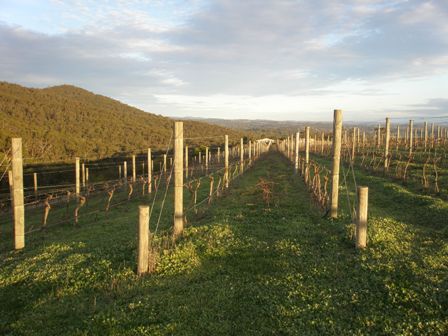
Great Yarra Valley views from the Mayer Vineyard (left to the dam)

On a beautiful Sunday in early August, we were in for a surprise visit to the Mayer’s. We bought some “nibblies” (Australian for cold meats, sausages, cheeses, condiments, etc.) and some wine in Healesville and drove up the steep drive to Bloody Hill on top of which their beautiful house (rammed earth) is situated. Alas, they were in and happy to welcome their unannounced intruders.

TimoM00

The vineyard at the crest of the hill is very neat

TimoM1

Some of the wines on “offer” (f.l.t.r.: a Silvaner from Franconia, Dr. Buerklin-Wolf, a Riesling from the Pfalz and a Dr. Mayer Pinot Noir from the Yarra Valley)

We came at the right time. A shipment of Riesling wine (about 60 cases) which Timo had made on a visit to Germany last year had just arrived and was ready for tasting. Moreover, as a member of the South Pack, Timo was in the preparation of a wine tasting tour to three Australian cities (Melbourne, Sydney and Brisbane). The South Pack is a group of eight innovative young Australian wine-makers who have raised the bar for the selling of premium and super-premium wines in sluggish markets.

TimoM3

The German Brotzeit

A quick “Brotzeit” was thrown up and the wine tasting could start. We did not drink in any kind of order but rather according to gusto and enthusiasm. First cap of the rank was the German Riesling Timo had made, Dr. Mayer Riesling of which I have no picture which speaks for itself. This was not a time for tasting notes but for joy and nourishment of body and soul, for Australian and Swabian story telling and song.

TimoM2

Bloody Hill Pinot Noir

Timo is a native of a small hamlet, called “Grossheppach” (about 4,500 inhabitants), today part of the small town called Weinstadt (translated: wine city) in the Rems valley (the Rems is a small river), Wuerttemberg, about 15 km east of Stuttgart. As everything in Germany, Grossheppach has a long history.

Grossheppach

Coat of arms of Grossheppach showing the river Rems and four grapes on a vine

Furthermore, the village has a long tradition of vine cultivation and wine making. Timo comes from a family of small vintners (and farmers).

In 1279 a historical deed is the earliest written testament of the flourishing wine production in Grossheppach. Magister Rudolf, a local doctor, had bequeathed his house in Esslingen and three vineyards in Grossheppach to the Abbey of Bebenhausen which was witnessed by knight ‘Fridericus miles de Heggebach’.

Timo showed as a historical chronicle of Grossheppach with black and white photos which also depicted his family in the 18th and 19th century. Here we are, thousands of kilometres away from the old land and talking grape production, wine traditions and wine styles. To cut a long story short, Timo had made his first ever Riesling wine in Grossheppach and shipped it for sale to Australia.

It was not the time for tasting notes, I guess. We opened one bottle after the next. First the Riesling wines, then Chardonnay and finally Pinot Noir and Shiraz, all Mayer Vineyard wines and Timo Mayer creations.

TimoM6

Mayer and Dr. Mayer Pinot Noir and a traditional German wine label with the coat of arms of Grossheppach

The Mayer Vineyard is only a small operation (2.5 ha under vines). All wines are hand crafted and from a single vineyard. Timo believes that wine is made in the vineyard, therefore there is minimal interference. The reds are unfined and unfiltered. Timo makes wines with a difference, with great character and individuality. As he says “he wants to bring back the funk”, and funky these drops are. James Halliday, “the wine pope of Australia”, has awarded his highest rating, a 5 stars, to the Mayer Vineyard.

The Dr. Mayer Pinot Noir is one of the newest creations from the masters hands; a great wine, elegant, whole bunch fermented if I am not mistaken. Timo assumed that all of it would be sold during the South Pack promotion tour together with the Riesling. By now there should be nothing left, I guess.

Needless to say that the day extended to the night and ended with a pasta feast for 9 hungry mouths.

TimoM5

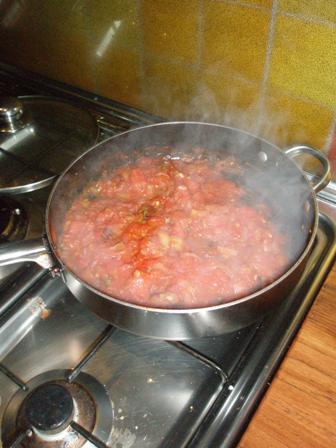
The pasta sauce in the making

TimoM4

TimoMM

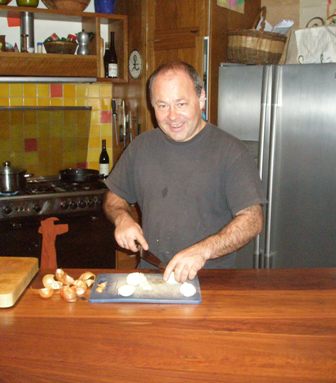
The magician at work, this time in the kitchen and not in the wine cellar

We had a great time. The children played all afternoon. We walked the vineyard and Timo showed me where he shot a deer. Then we went to get some of that venison for us to take home. The “Brotzeit” led to dinner and then it was time to drive home to our own vineyard in Glenburn. Good news is that Timo is planning to make Riesling again in 2009 and maybe the following years.

For sales and enquiries contact:
timomayer@bigpond.com.au

The following wines are for sale:
Bloody Hill Chardonnay
Bloody Hill Pinot Noir
Big Betty Shiraz
Mayer Close Planted Pinot Noir (also as the Dr. Mayer Pinot Noir)


The other Mosel: The wines of Luxembourg

September 2, 2009

Lux0

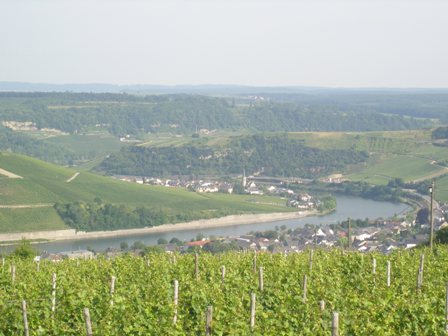
Luxembourg vineyards along the Mosel seen from the German side in Wellen

Having grown up in Trier, Mosel the Grand Duchy of Luxembourg is no stranger. As a teenager we used to drive to Luxembourg City to enjoy its night-life visiting the famous discotheque “Blow up” and thereby expose ourselves in a kind of pan-European experience, populating the dance floor amid dancers from Belgium, Holland, France, Germany and Luxembourg.
Lux1

Mosel river with Nittel in the foreground (German side) and Machtum (Luxembourg side)

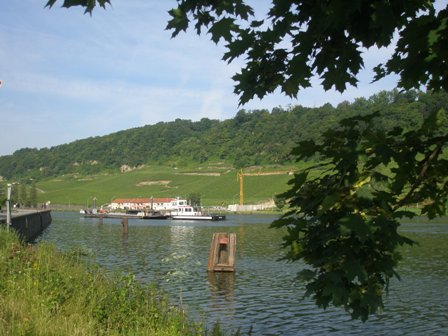
The above photo shows the Mosel valley, in the foreground the wine village of Nittel on the German side, and in the background the Luxembourg village of Machtum/Miechtem along the “Route du Vin”, the road which leads the visitor through the picturesque vineyards and wine villages of Luxembourg. I took these photos during my last visit to Trier at the end of June when I cruised along the river visiting both Grevenmacher and Nittel.

One of the best kept secrets as regards European wines are the fine wines of Luxembourg. Total production is about 12.4 million litres of which more than half is exported (mostly to Belgium and Germany). The total area under vines is about 1300 ha only which is about a third of the Yarra Valley. Luxembourg is a kind of artisan wine producer, where the winery sector is dominated by small family-enterprises, whereas large, corporate-wine industrialists shine through their almost complete absence. Of the odd 430 grape producers only about 60 have their own wineries. Most vignerons are members of a wine co-operatives at the village level.

Luxembourg is mainly a producer of dry, varietal white and sparkling wines (about 15% of total production). This is a stark contrast to the German side of the Mosel which has a strong tradition in semi-dry and sweet wine production.

Of the 15 approved wine varieties, Müller-Thurgau (Rivaner) accounts for about 29% of the area under vines followed by the Burgundy varietals (together almost 40%). Auxerrois (14%), Pinot Blanc (12%) and Pinot Gris (13%). Riesling covers only about 13% of the area in Luxembourg whereas it is the dominant grape variety on the German side of the Mosel. Luxembourg also has about 10% of the area under Elbling, the oldest wine variety in middle Europe, characterized by its high acidity which makes it ideal for the production of sparkling wines. Chardonnay and Gewürztraminer are other white varieties grown. Pinot Noir (about 7% of the area) is the most common red variety of Luxembourg.
Lux2

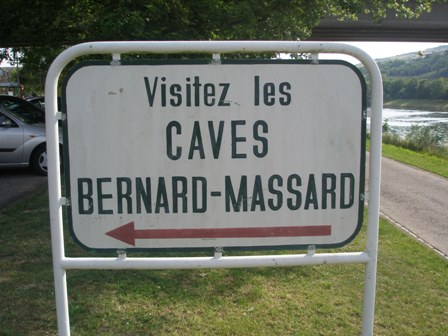
Parent house of Bernard Massard in Grevenmacher

On of the largest producers of still wines and crémants (bubbly/sparkling for my Australian readers) is Bernard Massard. Bernard Massard is also well known in Trier where the company has a large office and wine cellars in the middle of the town centre (Jakobstrasse), but Bernard Massard owns and operates vineyards also along the Loire river in France. The parent house of the company is located in Grevenmacher. More than 30,000 visitors come to see the extensive wine cellars

Lux3

Bernard Massard owns two vineyards along the Mosel: Domaine ‘Thill’ in Schengen (12 ha under vines) and Domaine ‘Clos des Rochers’ in Grevenmacher and Wormeldange (18 ha) with a combined production of about 120,000 bottles (or 10,000 cases) per year. Through the sparkling production in Trier about 3 million bottles of crémants and other sparling wines are sold. The French vineyards (Caves Monmousseau at Montrichard and La Petite Cave at Ronchamp) along the Loire river produce mainly crémants (Crémants de Loire and Touraine sparkling wines) and a variety of local wines.

Lux4

Domaine ‘Clos des Rochers’ in Grevenmacher

Lux5

Vineyards near Mertert/Wasserbillig

The bulk of Luxembourg’s family vineyards and wineries is much smaller than Bernard Massard. Because of the long tradition of viticulture in the villages and hamlets along the Mosel, many vintners come from families who have a strong family tradition in grape growing and wine making. Many families are related through intermarriage and therefore many wineries have combined family names most of which you will have never heard of.

Representing these strong traditions I would like to mention only three smaller wineries. I apologise to all the others; I know many of you deserve a full portrait.

Caves René Bentz, Wellenstein (5.2 ha)
The vineyards are located in Wellenstein, Remich, Wintringen and Bech-Kleinmacher. Main variety is Müller- Thurgau, however the most important varieties are Riesling, Pinot Gris, Pinot Blanc and Auxerrois. The Riesling wines of the Gottesgôf selection are worth trying, and so is the 2007 Pinot Gris Côteau Wellenstein.

Domaine Viticole Charles Decker, Remerschen (4 ha)
Charles Decker has a clear vision of his wines. He is one of the few who cultivates Muscat Ottonel grapes and experiments with German new varietals such as Siegerrebe, an aromatic grape. He specialises in sweet wines. Try his Muscat Ottonel wines but also the Chardonnay and the Pinot Gris are commendable.

Caves Kayl-Noesen Nic et fils, Remerschen (6 ha)
This is a very young undertaking, with the winery established only about 5 years ago. Before that the family produced grapes and sold the fruit to other wineries. The young vintner who studied oenology in Germany, manages the estate with his father. The classic varieties of Luxembourg are the wines you should try. Their Auxerrois, Pinot Blanc and Pinot Gris are ideal wines consumed with fine cuisine.

Lux6

The mouth of the Sauer river at Wasserbilligerbrück meeting the Mosel

It is worth visiting Luxembourg and its vineyards and wineries. Stop at any nice café or wine bar and try the local Elbling or go for the more elaborate cool climate Auxerrois, Pinot and Riesling wines.

Information about Luxembourg and its wines:

I found the following book very useful (in German): “Weine und Crémants aus Luxemburg”, Einkaufsführer 2009, Meininger Verlag (www.meininger.de), Neustadt, Weinstrasse.

A very informative article about Luxembourg can be found on http://www.wine-pages.com/features/luxembourg-wine.htm
.

But also the Wikipedia write-up gives the newcomer a very good overview.

The fourth source of useful information comes from http://www.vins-cremants.lu/en/winegrowers/alphabetical_listing.html

Reichsrat von Buhl: ‘2007 Forster Ungeheuer Grand Cru dry Riesling’

August 31, 2009

UngeheuerGG1

Embossed on the bottle the sign for ‘Grosses Gewaechs’

I had not had a Grand Cru (or as the Germans say: Grosses Gewaechs) wine for a while. Fortunately, I had participated in a wine quiz of the German wine magazine “Weinwelt” some time ago and won a bottle of Riesling. Not any Riesling, it turned out, but a ‘2007 GG Forster Ungeheuer dry Riesling’ produced by Reichrat von Buhl, Pfalz.

I was completely taken aback when my mother handed me the packet. I could not believe my luck: first time participate, first time win a price. I carried my treasure back to Bangkok and stored it carefully for a special occasion.

UngeheuerGG2

The freshly opened bottle

The occasion came faster than expected. Although the cellaring potential of this wine is 12 to 18 years (!), it only lasted a couple of months in my care. Sunday family lunch was just the right time and place for a treat.

UngeheuerGG3

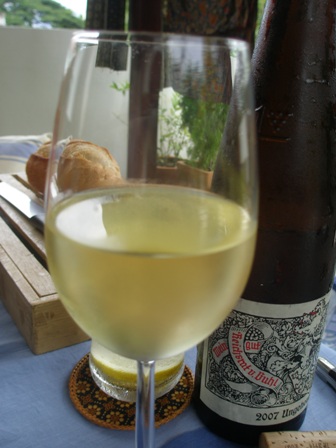
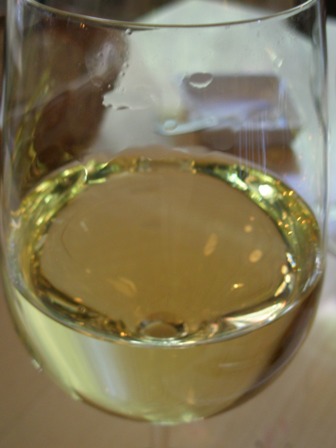
A beautiful straw colour in the glass

This is a beautiful wine, powerful, complex and dense, with citrus and mineral characters. It did not overpower the food, though it could just stand on its own, enjoyed just as a glass of wine. The peccorino Sardo on the fish was the right match for the dry Riesling (12.6%).

UngeheuerGG4

Flounder with Peccorino Sardo

UngeheuerGG5

The salad

Needless to say, one bottle was not enough. That’s why I recommend if you have the opportunity stock up on this noble drop, buy a crate, a dozen or whatever, in any case more than one bottle. The whole Sunday the taste lingered on my palate and could not be deleted from my mind.

Reichsrat von Buhl has a long tradition of excellence, family-owned since more than 150 years, it was leased in 1989 to an operating company owned by two Japanese businessmen. I found this fact quite remarkable, I must say. Another remarkable fact is that it was also owned for some time by the family of the grandfather of the current German Economics Minister, Dr. Karl-Theodor Freiher zu Guttenberg.

The commitment to excellence, however, has remained the same or is even stronger than ever, I guess.

Address:
ReichsratvonBuhl
Source: from the website www.reichsrat-von-buhl.de/english/kontakt.htm


Wine shopping in Healesville, Yarra Valley

August 16, 2009

Barrique

For a long time I wanted to write about my wine shopping experience in Healesville, a charming tourist town in the Yarra Valley, about an hour’s drive from Melbourne. One can find a jewel of a wine store in this rural retreat, called Barrique. I took the photo above Christmas last year.

Barrique2

This is the old shop front

When visiting Healesville again in July 2009, I was shocked to not see the above signpost in the old place. I was afraid that the global financial crises and the bush fires might have let to the closure of this little wine shop. Alas, it had only moved a block further along the main street into the city centre. I was so happy when I found it again.

Barrique3

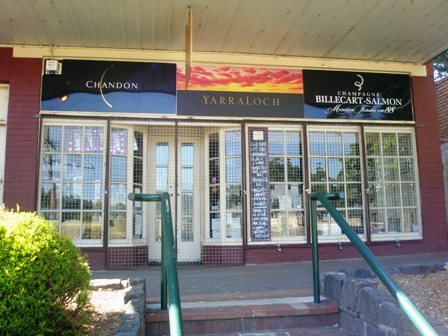
The “new” Barrique, a block further up the main street

I could not resist the temptation. Previously, I had bought German wines from this shop. I dashed in to see what was on offer. The wines are beautifully displayed. There was so much out there. I could not stop browsing through the shelves.

Barrique5

The inside of Barrique

Barrique4

So many bottles

Barrique6

Wines from all over the world
Barrique7

The “German box” with selected Riesling wines from various German wine regions

The box above announces some of the best German Riesling producers from Mosel, and Nahe. I just love Riesling wines. In the end I picked up four bottles, one from the Pfalz, three from the Mosel. I will not tell you what they were today. More about the tastings of these wines later. Stay tuned to the Man from Mosel River.
Cheers


Germany: Asparagus season

May 26, 2009

Asparagus1

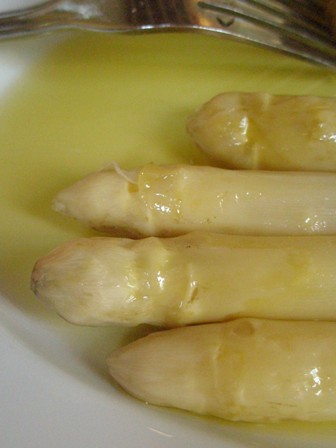
A spring delicacy in Germany

It is the asparagus season in Germany and I had the opportunity to indulge myself into quite a few “asparagus orgies”. Fresh white asparagus is so delicious. I like it with just some melted butter, a few potatoes, and maybe some fresh German ham.

Asparagus2

Tender asparagus tops

Asparagus3

Delicious potatoes

What wine do you drink with asparagus? Well, I had a simple Riesling from the Rheingau. But almost all white wines pair well with white asparagus. Germany is a Mecca for white wines. The recent edition of the “Weinwelt” (wine world) magazine identified four best buy whites to consume with asparagus. All were of different grape varieties (Vinho Verde, Silvaner, Sauvignon Blanc and Grüner Veltliner but no Riesling), and all can be purchased for under € 7.-, what a bargain. They were:

‘2008 Quinta de Azevedo Vinho Verde’ by Sogrape Vinhos, Portugal;

‘2008 Grüner Silvaner, dry’ by Weingut Manz, Rheinhessen;

‘2008 Tour de Pocé Sauvignon Blanc Réserve’ by Pierre Chainier, Touraine, France;

‘2008 Grüner Veltliner Hundschupfen, dry’ by Weingut Hagn, Mailberg, Austria.

I have not tried any of them as yet but reading the review brought tears to my eyes, my nose was hallucinating, and my taste buds seemed to feel the crispness of the wines.

Asparagus4

My “simple” Rheingau Riesling


Spring in Schoden, Saar

May 25, 2009

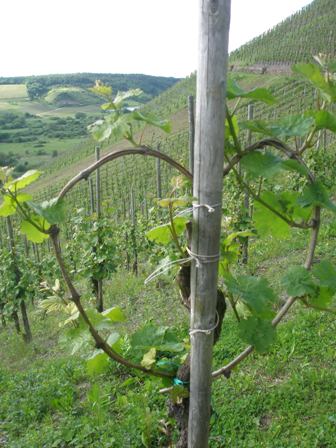
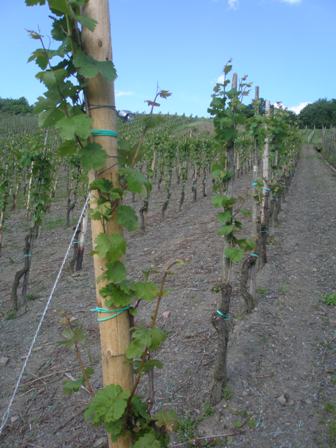
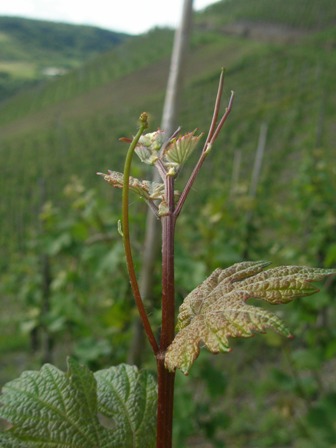
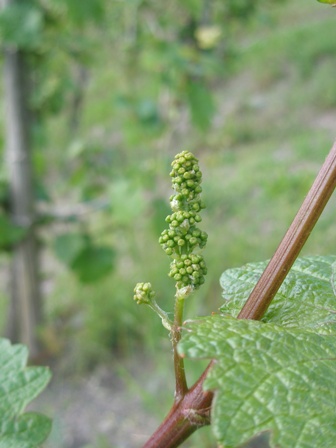
Spring was in full force when I visited Germany recently. The sky was blue and everything was fresh, a young green covered the land. As always I accompanied my friend Heinz on the hunt in Schoden, Saar. We took a tour around the 500 ha of hunting ground rented from the local land owners association (“Gehoeferschaft).

I took photos of the vines at “Herrenberg” one of the best terroirs at the steep hillside overlooking the Saar valley.

Sch1

The canes are bent down and arranged in a circle

Sch2

The Herrenberg vineyards are very steep

Sch3

The view downwards

Sch4

New shoots

Sch5

The flowers are almost ready

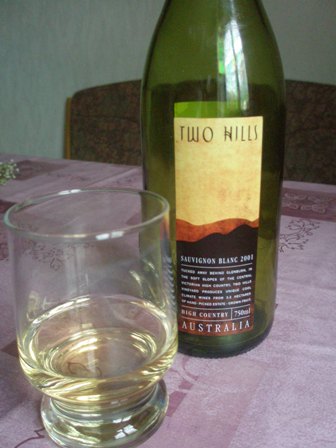
And guess what I found in my mothers cellar? A rare bottle of ‘2001 Two Hills Vineyard Sauvignon Blanc’.
The colour of the wine was still a splendid light straw, and it was drinkable. Of course it had lost its zest, almost no finish but it was still OK with my meal, I must say. A clean white wine.

Schx


Wine heaven – my visit to Berlin

May 16, 2009

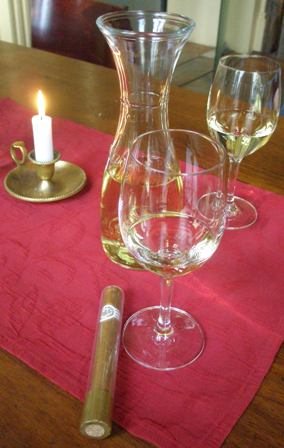
Wineandcigar

During my brief visit to Berlin, I tasted quite a few fine wines. I do not want to bore you with long stories. The following three wines are, according to my taste buds, highly commendable.

‘2007 Sauvignon Blanc Baron de Philippe de Rothschild, Languedoc-Roussillion, France

I do not know much about French wines, but this SB is just perfect. I loved it with the fresh asparagus dish. It had all the varietal character of an SB and a crispness which blew me away. Very dry with wonderful passion and kiwi fruit aromas with a formidable minerality.

‘2006 Merlot Weingut Leopold Aumann, Tribuswinkel-Thermenregion, Austria

Austrian wines are the vogue in Germany (highest increase in exports to Germany this year). This Merlot by Leopold Aumann was an excellent example of the high art of wine making by our Austrian neighbours. I could not get enough of it, soft and full blown fruitiness.

‘2007 Künstler Kirchenstück Dry Riesling’, Rheingau, Germany

“Kirchenstück” is one of the oldest (1271 !!!!) and best “terroirs” of the Rheingau. This young and very dry Riesling is a wine with great finesse, filigree and a wonderful lingering finish. I am sure it will ripen well in the bottle and in your cellar. If you can get hold of some bottles: buy, buy, buy.

Soon more about fine wines. Germany is just a Mecca for wine lovers (so are France and Austria).


Lunch at Lutter and Wegner in Berlin

May 15, 2009

lundwberlin1

Some time ago when in Berlin I had lunch at Lutter and Wegner in Weinhaus Huth, near Potsdamer Platz. I love the atmosphere of this cosy little restaurant. Lutter and Wegner has two more restaurants I know of in Berlin, at “Fischerhuette”, at the very picturesque “Schlachtensee” (a lake within the city boundaries) and “Gendarmenmarkt” in the centre of town (but there is another one in Charlottenburg).

lundwberlin2

I had ‘gnocchi with mushrooms’ which you can see in the picture above and drank a glass of the house wine, a Riesling from the Rheingau wine region. Needless to say the gnocchi were delicious and the wine was too.

lundwberlin5

I sat next to the wall where all kinds of German wines were on display. This is why I show you the pictures below. All the good names of German vintners and wine producers were among them, Diel, Dr. Loosen, Joh. Jos. Pruem to name only a few and many others as you can see.

lundwberlin3

lundwberlin4

Some time later, I learned from a city tour guide, that “Weinhaus Huth” (wine shop) used to be the place where Konrad Adenauer, the first German chancellor after World War II used to buy his wine.

In March 1877 the wine merchant Christian Huth bought the plot of land and built a villa there which housed also his wine business. The present building dates back to 1911/12 and replaced the villa. It consists of s steel-concrete structure so that the weight of the wine bottles could be stored. This structure protected it from the destruction of two major wars.

The building was the last old structure at the Potsdamer Platz and therefore it was called “the last house at Potsdamer Platz”. That was during the time of the cold war and before the wall came down. After 1989 and the reunification of Germany the Potsdamer Platz was again situated at the centre of the city and a building boom started. In 1990 Daimler-Benz AG bought the building. After renovation it was transformed so that again a restaurant could move in again, which is Lutter and Wegner. If you visit Berlin, I highly recommend that you visit “Weinhaus Huth” or any other of the Lutter and Wegner restaurants.

Address:
Lutter and Wegner im Weinhaus Huth
Alte Potsdamer Strasse 5
10785 Berlin
Tel.: +49-30-25294350


Riesling from the Rheingau, Germany: Baltasar Ress “Von Unserem”

May 6, 2009

sole1

Beautiful sole

Another delicious lunch. We had sole, asparagus and potatoes . The wine I had selected to go with the meal, I had found by accident in Tops supermarket in Thonglor, Bangkok. Frankly speaking I had never heard about Balthasar Ress and his wines.

From the website I learned later that the winery is managed by the 5th generation of the Ress family and that it had been founded in 1870. Unbelievable for us Australians. The estate is listed in the 2009 issues of the “800 Best Wineries in Germany” but rated as going donw in quality somewhat. Well, I cannot confirm this.

sole2

As you know, I just love Riesling wines. For someone from the Mosel it is just heavan on a stick, paradise so to say. The dry Riesling which I selected, a bottle ‘2006 “Von Unserem” Balthasar Ress’ (11.5% Vol. Alc.) from the Rheingau, Germany was not cheap.

Thailand’s wine prices are high due to the tax imposed on imported wines. I paid about 1,000 Bath, which is a little more than 20 EURO whereas the same vintage can be bought in Germany for about 5.10 or so Euro. “Von Unserem” roughly translates into English stands for “of our own drop” indicating that the vintner and his family have made this wine to their preferred drink, solely for them, so to say.

sole3

The quality of this dry Riesling is very good; the price in Germany very reasonable. Having access to it here in Bangkok is a treat, a wonderful thing and we enjoyed this bottle tremendously with our seafood meal.

The colour is light straw, the wine is zesty and fresh with beautiful citrus and tropical fruit aromas. It has structure and substance and a nice finish, lingering on for quite some time. Citrus bomb of the noble kind, I would say.

The next day we went back and bought all the bottles left of this wine on the shelf in Tops supermarket. Putting them into my wine fridge was a great satisfaction. More Sunday lunches with a good German Riesling wine are ahead of us. The good life, Epicurus would be proud of me. Life is just so beautiful.

If you visit the Rheingau, please check also out the villeages of Eltville and Hattenheim. It’s so beautiful there along the Rhein river. Indonesian colleagues I once took their thanked me from the bottom of their hearts and tears in their eyes. The term “paradise” comes to mind as the appropriate label.

Address:
Balthasar Ress
OT Hattenheim,
Rheinallee 7
65347 Eltville am Rhein
Tel.: +49-6734-91950
www.balthasar-ress.de