German Riesling: Weingut Robert Weil

October 21, 2010

2008 Robert Weil Estate Riesling dry

A friend of mine made me taste this wine some time ago in Berlin. I brought a bottle of the 2008 vintage back to Bangkok. During the visit of a wine-maker friend from Australia, I opened my treasure trove, and the Robert Weil Riesling, from Rheingau, Germany was one of the many bottles of fine wine which we sampled.

The winery Robert Weil is a well known household name among Riesling producers and wine connoisseurs in Germany. As many of the German wineries, Robert Weil goes back a fair bit. The winery was founded in 1875. Although vineyards were among the family properties in the village of Kiedrich, Rheingau for some time.

The founder of the winery, Dr. Robert Weil, was a professor of German language at the Sorbonne University in Paris. The change in career turned out to be very beneficial for the professor and his descendants as well as the wine fraternity.

With about 3,100 ha under vines, the Rheingau is one of the smaller German wine regions. Robert Weil bought some of the best locations (terroir) and vineyards in the vicinity of Kiedrich and thereby consolidated his winery. Today, the total area under vines is about 75 ha. This is more than just a small family vintner.

Many of the vines are 50 and more years old. Plant density is between 5,000 and 6,000 vines per hectare (quite dense in comparison with the 2,700 vines on my own vineyard). The operation is characterized by the use of organic fertilizers and the minimization of the use of industrial pesticides.

The wines of Robert Weil are regular award winners. The winery is among the top 10 of the German Riesling Forum.

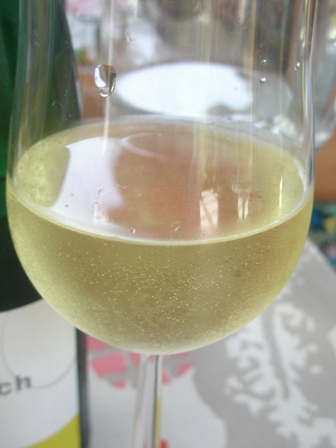
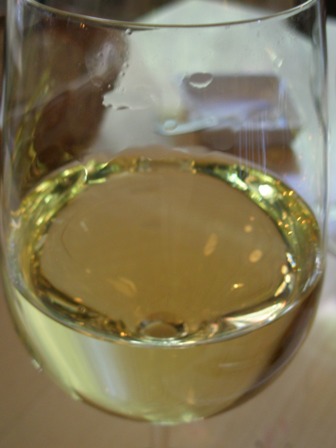
Beautiful colour of the Robert Weil Estate Riesling

The colour of the wine is pale straw (12% alcohol). The 2008 vintage is still a young wine; it is fresh and spritzy with lemon and lime aromas and some mineral notes. The residual sugar is about 8 grams. The wine is fruity with a well balanced acidity; it has a good structure and a long finish.

The pity was: I had only one bottle. Wine is just not suitable for air travel.

The Rheingau is a beautiful place and just a stone throw away from Frankfurt airport. if you have the chance just go and check it out yourself. Cheers mate

Address:
Weingut Robert Weil
Mühlberg 5
D-65399 Kiedrich / Rheingau

Tel.: +49-6123 2308 begin_of_the_skype_highlighting              +49-6123 2308      end_of_the_skype_highlighting begin_of_the_skype_highlighting              +49-6123 2308      end_of_the_skype_highlighting begin_of_the_skype_highlighting              +49-6123 2308      end_of_the_skype_highlighting begin_of_the_skype_highlighting              +49-6123 2308      end_of_the_skype_highlighting
Fax: +49-6123 1546

info@weingut-robert-weil.com
www.weingut-robert-weil.de

Opening hours:
Monday to Friday 8.00 – 17.30 h
Saturday 10.00 – 17.00 h
Sunday 11.00 – 17.00 h


Sunday lunch in March

March 14, 2010

Since the beginning of this year, we have a new rule as regards the family cooking: every Sunday another member of our family is preparing the family feast. It was my turn last Sunday (more about this another time) and today my daughter Lucy (15) took on the role of the chef.

She presented us with salmon with salsa and a guacamole. In addition we had a fresh salad which is very nice in 35 Celsius heat. Mama helped a little but not much. It was delicious, as you can see from the photos below. What a great lunch this was.

The recipe came from the delicious magazine (December 2005/January 2006): Cajun salmon with corn salsa.

One mixes a table spoon each of coriander, dried tyme and oregano, cumin, and dried garlic, adds two table spoons of pimento (sweet smoked paprika) and olive oil and mixes this in high heat in a pan. The salmon fillets are rubbed with the mix, then cooked for about two minutes on one side and one minute on the other. After that you transfer them to a heated oven of about 180 Celsius where they are cooked for about 3-5 minutes. Serve with the salsa and guacamole.

The salad

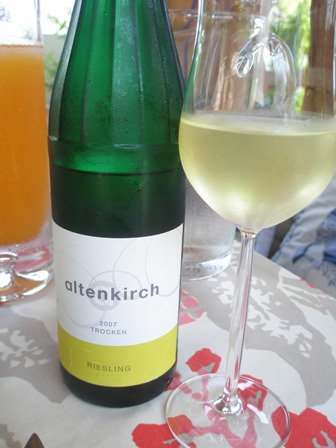
The wine, however, was my department. Thanks to Mathias and Beatrix we still had a bottle of ‘2007 altenkirch Rieling, trocken’ by Friedrich Altenkirch in Lorch, Rheingau, Germany.

The wine is German Riesling at its best. With only 12% alc. vol. it has zest and finesse and the typical citrus flavours. It is a blend from different locations and made to be enjoyed young. The single vineyard wines from very steep slopes the winery produces are regularly awarded all kinds of medals. Altenkirch is worth a visit if you are visiting the Rhine river.

Address:
Winery Friedrich Altenkirch
Binger Weg 2
D-65391 Lorch /Rheingau
Germany
Tel: +49 67 26 / 83 00 12
Fax: +49 67 26 / 24 83
www.weingut-altenkirch.de
www.altenkirch-winery.com


“Second-Christmas-Day” Party

December 27, 2009

The 26 December is called the “2nd Christmas day” in my native Germany. Since my father’s birthday fell on the 25 and was not celebrated because of Christmas, the 2nd Christmas day was usually the day his friends came to visit and congratulate him for his birthday.

Well, in this quasi tradition, we invited friends and acquaintances to our humble home for a Christmas barbecue, merging German and Australian customs of our family. I was very busy grilling pork and chicken, therefore no photos of the results of my labour at my “Weber grill”. Moreover, I grilled some veggies for the vegetarians among us (I was commended for the quality and the good taste). Margit had made various potato and bean salads; we had greens and white bread.

There are also no photos of the wines we consumed. Just two of the desserts. But a heck of a party it was. The 9 adults and the 9 children had a good time, as the two photos below show.

The “long” table

From 4 to 58 years old, 18 people around the table

The desserts:

Le Notre, the best dessert maker in town

The home made Pawlowa, Australian delight

Matthias and Beatrice had provided most of the wine (and the Le Notre dessert). We drank some beautiful drops. Here are the highlights:

‘2005 Rocky Passes Syrah’ (our last bottle) was perfect for the event: a Christmas party Australian style. It’s a beautiful example of cool climate Shiraz from our Upper Goulburn Wine Region. Vitto Oles makes great wines. James Halliday gave the 2005 Syrah 94 points.

‘2007 Altenkirch dry Riesling’, Lorch, Rheingau/Germany. Friedrich Altenkirch is a very well known vintner. Some of his wines were just rewarded silver and bronze medals at the International Wine Challenge and the 2009 Decanter World Wine Awards. The 2007 Riesling is young and fizzy, a solid German wine. The wine-maker, Tomoko Kuriyama, comes from Japan not a common trait of German wineries.

‘2005 Château La Raze Beauvallet, Cru Bourgeois’ from Medoc, Bordeaux, France. The château (45 ha) is owned by the Sourice family and has retained the original ‘cru Bourgeois’ classification from the 1930s because of the wine quality. The wine style is fruity and soft, easy to drink.

Needless to say, we had some bubbly as well, mostly from Taltarni, Australia. We will do this again.


The best 10 German dry Riesling wines

November 25, 2009

It was a bit disappointing for a native from the Mosel River to read through the list of best dry Riesling wines of Gault Millau’s newly released wine guide 2010.

Among the best German dry Riesling wines of 2007 and 2008 there was not a single one from the Mosel, Saar or Ruwer.

I know that my home region is more famous for its semi-dry and sweet Rieslings but…

The good news it that a wine from the Nahe where my materal grandfather had introduced me to dry wines many decades ago was ranked the second highest.

Moreover, the vintner of the year is also from the Nahe. Tim Fröhlich (35) was awarded this prestigious title. The family estate Schäfer-Fröhlich is one of the best wineries in the Nahe Region and produces outstanding dry and sweet wines.

The winner for best dry Riesling (with 96 points) was a wine from the Pfalz, a ‘Forster Kirchenstück GC’ by Dr. Bürklin-Wolf (70 €). Emrich-Schoenleber received 95 point for a ‘Halenberg Grosses Gewächs’ (29 €). Among the top ten five Riesling wines came from Pfalz, two from Rheingau and Rheinhessen each and one wine from the Nahe.

That the Franconian wines were missing from the list was a further disappointment. Also in Franconia the 2007 and 2008 vintages were outstanding (as is the 2009).

Two other wines received 95 points, a ‘Abtserde Grosses Gewächs by Keller Estate, Rheinhessen and a ‘Forster Pechstein GC’ also by Dr. Bürklin-Wolf, Pfalz (35 €). 94 points were awarded to three wines: a ‘Deidesheimer Hohenmorgen GC’ by Dr. Bürklin-Wolf (35 €), a Rüdesheimer Berg Schlossberg by Georg Breuer, Rheingau (40 €) and a ‘G-Max’, also by Keller Estate, Rheinhessen (I found a price of 160 € from an internet sales website). From some chat on the internet I got the impression that you won’t see a bottle on any shelf. This wine is “rationed” and reserved for special customers. Keller estate was “the producer of the year 2006” of Gault Millau.

Two wines were given 93 points: ‘Kastanienbusch Grosses Gewächs’ by Rebholz Estate, Pfalz (32 €), and ‘Rüdesheimer Berg Rottland Alte Reben Goldkapsel’ by Josef Leitz, Rheingau (65 €). Wine number 10 received 92 points and it was a ‘Birkweiler Kastanienbusch Schiefer’ by Siener Estate, Pfalz (16.50 €). This is the only wine in my price-range.

Needless to say that all the wine gurus of the world have written about these wines and these producers, John Gilman, Jancis Robinson, Eric Assimov to name only a few. Some of the wine reviews you can find on the internet, some of them are linked by the specific estate named above. It seems there is lots of research to be done.

Go wine enthusiast. You can, of course, also buy the wine guide, Gault Millau.


The best German vintners and wine makers

June 1, 2009

Threewinegods

The wine gods (photo taken from a building in Berlin)

Its certainly a great honour to be called “vintner of the year”. Since 1994 Gault Millau, Germany’s wine guide and major authority regarding wine, wine business and the wine sector, is awarding the “vintner of the year” award.

Today the total number of vintners of the year is 16, seven of which come from the Mosel wine region. The current one, however, comes from the Pfalz (Knipser brothers).

But in the years 2007 (Theo Haart, Mosel), 2005 (Kartaeuserhof, Ruwer), 2001 (Loosen, Mosel), 1998 (Mueller-Scharzhof, Saar), 1996 (Joh. Jos. Pruem, Mosel), 1995 (von Schubert, Ruwer) and 1994 (Fritz Haag, Mosel) the vintner of the year came from my home, the Mosel river and its tributaries.

(Remark: the Mosel wine region was originally called: Mosel-Saar-Ruwer)

No other German wine region has provided that many “champions”. So far the Nahe and Pfalz wine regions had two vintners of the year; and Rheinhessen, Rheingau, Frankonia, Ahr and Baden had one each (for the names of the vintners of the year: Gault Millau).

I came about this fact only by accident while researching a story, I was going to write. I have to find more Mosel wines here in Bangkok, I guess. Wish me luck.


Germany: Asparagus season

May 26, 2009

Asparagus1

A spring delicacy in Germany

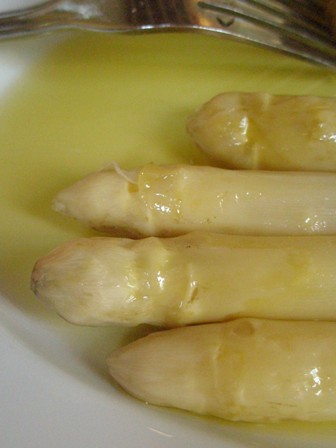
It is the asparagus season in Germany and I had the opportunity to indulge myself into quite a few “asparagus orgies”. Fresh white asparagus is so delicious. I like it with just some melted butter, a few potatoes, and maybe some fresh German ham.

Asparagus2

Tender asparagus tops

Asparagus3

Delicious potatoes

What wine do you drink with asparagus? Well, I had a simple Riesling from the Rheingau. But almost all white wines pair well with white asparagus. Germany is a Mecca for white wines. The recent edition of the “Weinwelt” (wine world) magazine identified four best buy whites to consume with asparagus. All were of different grape varieties (Vinho Verde, Silvaner, Sauvignon Blanc and Grüner Veltliner but no Riesling), and all can be purchased for under € 7.-, what a bargain. They were:

‘2008 Quinta de Azevedo Vinho Verde’ by Sogrape Vinhos, Portugal;

‘2008 Grüner Silvaner, dry’ by Weingut Manz, Rheinhessen;

‘2008 Tour de Pocé Sauvignon Blanc Réserve’ by Pierre Chainier, Touraine, France;

‘2008 Grüner Veltliner Hundschupfen, dry’ by Weingut Hagn, Mailberg, Austria.

I have not tried any of them as yet but reading the review brought tears to my eyes, my nose was hallucinating, and my taste buds seemed to feel the crispness of the wines.

Asparagus4

My “simple” Rheingau Riesling


Wine heaven – my visit to Berlin

May 16, 2009

Wineandcigar

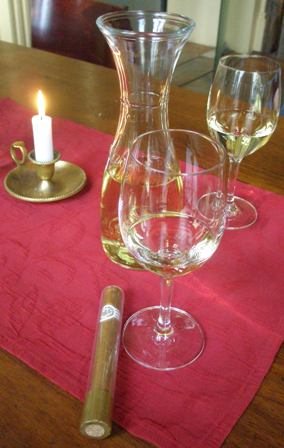
During my brief visit to Berlin, I tasted quite a few fine wines. I do not want to bore you with long stories. The following three wines are, according to my taste buds, highly commendable.

‘2007 Sauvignon Blanc Baron de Philippe de Rothschild, Languedoc-Roussillion, France

I do not know much about French wines, but this SB is just perfect. I loved it with the fresh asparagus dish. It had all the varietal character of an SB and a crispness which blew me away. Very dry with wonderful passion and kiwi fruit aromas with a formidable minerality.

‘2006 Merlot Weingut Leopold Aumann, Tribuswinkel-Thermenregion, Austria

Austrian wines are the vogue in Germany (highest increase in exports to Germany this year). This Merlot by Leopold Aumann was an excellent example of the high art of wine making by our Austrian neighbours. I could not get enough of it, soft and full blown fruitiness.

‘2007 Künstler Kirchenstück Dry Riesling’, Rheingau, Germany

“Kirchenstück” is one of the oldest (1271 !!!!) and best “terroirs” of the Rheingau. This young and very dry Riesling is a wine with great finesse, filigree and a wonderful lingering finish. I am sure it will ripen well in the bottle and in your cellar. If you can get hold of some bottles: buy, buy, buy.

Soon more about fine wines. Germany is just a Mecca for wine lovers (so are France and Austria).


Lunch at Lutter and Wegner in Berlin

May 15, 2009

lundwberlin1

Some time ago when in Berlin I had lunch at Lutter and Wegner in Weinhaus Huth, near Potsdamer Platz. I love the atmosphere of this cosy little restaurant. Lutter and Wegner has two more restaurants I know of in Berlin, at “Fischerhuette”, at the very picturesque “Schlachtensee” (a lake within the city boundaries) and “Gendarmenmarkt” in the centre of town (but there is another one in Charlottenburg).

lundwberlin2

I had ‘gnocchi with mushrooms’ which you can see in the picture above and drank a glass of the house wine, a Riesling from the Rheingau wine region. Needless to say the gnocchi were delicious and the wine was too.

lundwberlin5

I sat next to the wall where all kinds of German wines were on display. This is why I show you the pictures below. All the good names of German vintners and wine producers were among them, Diel, Dr. Loosen, Joh. Jos. Pruem to name only a few and many others as you can see.

lundwberlin3

lundwberlin4

Some time later, I learned from a city tour guide, that “Weinhaus Huth” (wine shop) used to be the place where Konrad Adenauer, the first German chancellor after World War II used to buy his wine.

In March 1877 the wine merchant Christian Huth bought the plot of land and built a villa there which housed also his wine business. The present building dates back to 1911/12 and replaced the villa. It consists of s steel-concrete structure so that the weight of the wine bottles could be stored. This structure protected it from the destruction of two major wars.

The building was the last old structure at the Potsdamer Platz and therefore it was called “the last house at Potsdamer Platz”. That was during the time of the cold war and before the wall came down. After 1989 and the reunification of Germany the Potsdamer Platz was again situated at the centre of the city and a building boom started. In 1990 Daimler-Benz AG bought the building. After renovation it was transformed so that again a restaurant could move in again, which is Lutter and Wegner. If you visit Berlin, I highly recommend that you visit “Weinhaus Huth” or any other of the Lutter and Wegner restaurants.

Address:
Lutter and Wegner im Weinhaus Huth
Alte Potsdamer Strasse 5
10785 Berlin
Tel.: +49-30-25294350


Riesling from the Rheingau, Germany: Baltasar Ress “Von Unserem”

May 6, 2009

sole1

Beautiful sole

Another delicious lunch. We had sole, asparagus and potatoes . The wine I had selected to go with the meal, I had found by accident in Tops supermarket in Thonglor, Bangkok. Frankly speaking I had never heard about Balthasar Ress and his wines.

From the website I learned later that the winery is managed by the 5th generation of the Ress family and that it had been founded in 1870. Unbelievable for us Australians. The estate is listed in the 2009 issues of the “800 Best Wineries in Germany” but rated as going donw in quality somewhat. Well, I cannot confirm this.

sole2

As you know, I just love Riesling wines. For someone from the Mosel it is just heavan on a stick, paradise so to say. The dry Riesling which I selected, a bottle ‘2006 “Von Unserem” Balthasar Ress’ (11.5% Vol. Alc.) from the Rheingau, Germany was not cheap.

Thailand’s wine prices are high due to the tax imposed on imported wines. I paid about 1,000 Bath, which is a little more than 20 EURO whereas the same vintage can be bought in Germany for about 5.10 or so Euro. “Von Unserem” roughly translates into English stands for “of our own drop” indicating that the vintner and his family have made this wine to their preferred drink, solely for them, so to say.

sole3

The quality of this dry Riesling is very good; the price in Germany very reasonable. Having access to it here in Bangkok is a treat, a wonderful thing and we enjoyed this bottle tremendously with our seafood meal.

The colour is light straw, the wine is zesty and fresh with beautiful citrus and tropical fruit aromas. It has structure and substance and a nice finish, lingering on for quite some time. Citrus bomb of the noble kind, I would say.

The next day we went back and bought all the bottles left of this wine on the shelf in Tops supermarket. Putting them into my wine fridge was a great satisfaction. More Sunday lunches with a good German Riesling wine are ahead of us. The good life, Epicurus would be proud of me. Life is just so beautiful.

If you visit the Rheingau, please check also out the villeages of Eltville and Hattenheim. It’s so beautiful there along the Rhein river. Indonesian colleagues I once took their thanked me from the bottom of their hearts and tears in their eyes. The term “paradise” comes to mind as the appropriate label.

Address:
Balthasar Ress
OT Hattenheim,
Rheinallee 7
65347 Eltville am Rhein
Tel.: +49-6734-91950
www.balthasar-ress.de


Connoisseurs delight: a wine tasting in Berlin of a special kind

January 15, 2009

schlau0

While in Berlin an old friend of mine, Gerhard Schlaudraff, had invited me spontaneously to join and celebrate his birthday in his new home near Warschauer Platz. Since Gerhard is not only a wine lover but a real wine expert, the feast promised to be something special. And indeed, it turned out to be a wine tasting of a special kind.

schlau1

I was about an hour late and many wines had been already swallowed up by gay drinkers. I came just in time for the two reds, the ‘1995 Corton Grand Cru Domaine Bonneau du Martray and the ‘1996 Grand Vin Château Beychevelle Saint-Julien’.

We all agreed that the two wines should have been drunk some time ago, they had, unfortunately, already passed their prime. That’s why we moved on swiftly without loosing too much time.

schlau21

The ‘2003 Kuenstler Reichestal Spaetburgunder’ from the Rheingau was a ripper of a wine. It can hold itself against the best Pinot Noirs from Burgundy. The wine was well balanced despite the “horror” announcement of 15% alcohol on the label. So forget about France and Burgundy and explore this wonderful drop from the Rheingau. More and more Germany is showing itself as a Pinot Noir producer of high distinction. My tip: get a bottle of this wine now and enjoy it, preferably over a good meal, with family and friends.

schlau3

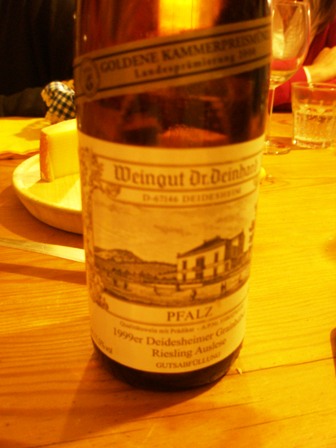
After that we moved on to sweet wines for dessert. We started with a ‘1999 Deidesheimer Grainhübel Riesling Auslese’ from Weingut Dr. Deinhard, Pfalz. This wine was “heaven on a stick”, a dessert Riesling which you want to try. Our eyes rolled in their sockets with delight and our taste buds were exposed to an opulence and richness from which mere human palates are often excluded.

schlau4

The last wine came from my adopted home, Victoria, Australia. It was a Muscat from Rutherglen, a wine region about three hours north from our own place in Glenburn.

The ‘Chambers Rosewood Vineyards Grand Muscat’ was the highlight of the evening. Chambers produces outstanding Muscat wines of superior quality. The average age of its Grand cuveés is about 70 years.

The Chicago Wine Company gives the wine 98 out of a 100 and has given up to describe the wine, because tasting notes would read the same year after year.

For me this wine was the perfect ending to an utterly enjoyable wine and birthday celebration. From here on only spirits with a much higher alcohol content could be taken. I left the diners to it when I made my way home on the subway.