Restaurant review: Weinhaus Spielberg, Randersacker/Franconia

May 13, 2010

Randersacker

The settlement of Randersacker, Franconia

One of my favourite wine regions in Germany is Franconia. My maternal grandparents came from this part of the country. My grandfather, Hans Heinrich Schuessler, was the man who introduce me to the pleasures and the mystery of grape wine. He was a native of Reichenberg, a small hamlet just south of the city Wuerzburg, the capital of the region. Randersacker is situated at the opposite side (from Reichenberg) of the Main river. We visited the place while touring Germany some time ago.

Spielberg1

The inscription on the Bocksbeutel bottle reads: In vino veritas

The market town of Randersacker was first mentioned in a historical record in 779 AC. The historical centre of the town, though small, is quite nice and worth visiting. We were on our way back to Wuerzburg but wanted to have dinner at Weinhaus Spielberg.

Franconia produces outstanding wines, mostly Sylvaner/Silvaner but I like also the Riesling wines. It’s speciality is the Bocksbeutel, a wine bottle in the form of an ellipsoid. This is what we came for when we selected Weinhaus Spielberg as our target.

Spielberg2

A coaster of Weinhaus Spielberg

Weinhaus Spielberg is a traditional country inn where solid German food and good local wines are served. We ordered some local specialities, especially typical Franconian dishes. The two pictures below might give you an idea what food I have in mind. We had the house wine with the food, a very refreshing, young and delicious Silvaner.

Spielberg4

Spielberg3

The service is very efficient, the waiters are friendly and very helpful. At times the Weinhaus is very busy. However, there is no need to fret, you will highly satisfied with what you will get. My credo: visit the place yourself, and see with your own eyes, taste with your own taste buds and have fun in Franconia.

Address:
Weinhaus Spielberg
Stefanie Sokoll
Lurzengasse 3
97236 Randersacker

Tel.: +49-931 / 708391
Fax: +49-931 / 709957
E-Mail: Spielberg-AS@t-online.de
www.weinhaus-zum-spielberg.de

Opening hours:
Monday – Sunday: 11 – 24 h
Friday: open from 17.00 h
closed: Thursday


Restaurant review: Gasthaus Bidinger, Schoden

May 5, 2010

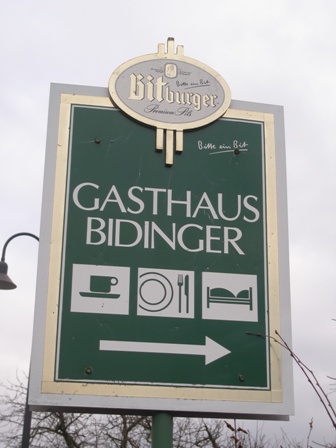
Bidinger00

Show me the way

It’s a public holiday in Thailand today (coronation day), and this might be the reason why I am in a reminiscing mood, the dominant “mood of old people”. But Gasthaus Bidinger (Gasthaus/Gasthof = inn) in the hamlet of Schoden, Saar would be a nice place to visit today. Lunch at Bidinger is one of my favourites when with my mother in Trier, Mosel. The food is traditional German country tucker, solid and substantial, and very enjoyable.

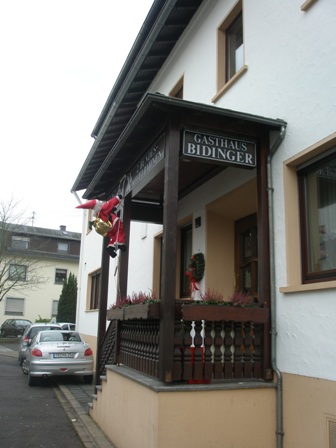
Bidinger0

Gasthaus Bidinger, front entrance

Apart from rustique rural food, Gashof Bidinger offers also a nice selection of traditional drinks, for instance Bitburger Pils beer and the local apple-pear cider, called “Viez”. Viez is usually a quite sour, low alcohol drink widely consumed by the local peasantry. Mixed together with some sparkling water it is very refreshing in summer. Moreover, Bidinger also bottles his own local wines. The Saar produces some of the best Riesling wines in Germany, and is one of my favourite wine regions.

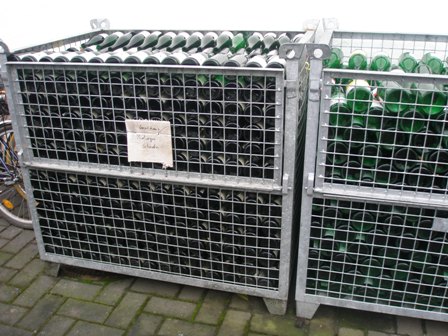
Bidinger2

Many empty bottles

Bidinger3

“Moselaner” apple cider, locally called: Viez

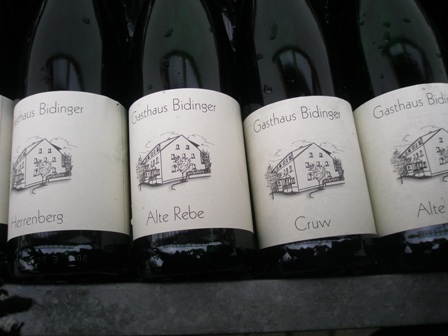
Bidinger1

Wines from the Saar

I would love to be at the Saar today. If you have the chance to visit, do so. It’s a jewel, hidden away somewhat but still easily accessible. A visit to the Saar can be combined with a trip to see Trier, the oldest German city and Luxembourg, just next door.

Address:
Gasthaus Bidinger,
Klosterstr. 30,
54441 Schoden
Tel: +49-(0)-6581/99260
Fax: 06581/99261
e-mail: Gasthaus-Bidinger@t-online.de
www.gasthaus-bidinger.de


The top German Vintners or the VIP club of German wineries: VDP

March 1, 2010

The logo of the VDP

VDP stands for “Verband Deutscher Praedikatsweingueter”. The German can be freely translated as “Association of German Wineries of Excellence”. The VDP is a club-like organisation with 196 member wineries.

It was founded in 1910 and celebrates this year its 100th anniversary. According to its website, VDP is the oldest association of the top quality wine estates. membership requirement is to adhere to the standards of the association which includes among others the strict limitation of yields. There is an inspection and certification process in place which members must submit to in oder to not loose the membership status. It is supposed to uphold the high quality of the produce.

The sign of quality are the eagle (no surprise for Germans who have made it part of their national insignia) and the cluster of grapes, usually embossed on the bottles of their “Erstes Gewaechs” comparable to France’s “premier cru”, wine made from grapes from the best terroir or locations.

The members of the association sell about 35 million bottles per year, for an average price of about 9 Euro /bottle. 80% of their production is sold on the domestic market, 20% is exported. Almost half of the bottles are sold directly to consumers.

The members come from all German wine regions. More than half of them (acounting for about 6% of all Riesling plantings worldwide) produce the finest Riesling wines Germany has to offer. In 1990 it had 161 members. Since then 73 wineries have left and 108 have joined the association.

According to www.riesling.de it’s newest three members are:

Klaus Zimmerling, Saxonia
Konrad Schloer, Taubertal
Thomas Seeger, Baden

Some of my favourite producers are members of the association, for instance Van Volxem Wine Estate in Wiltingen at the Saar.


Anniversary of Thai-German relations celebrated in style with German wine

December 3, 2009

The other day Lufthansa celebrated it’s 50 years of scheduled flight services to Bangkok, Thailand. I was invited to a function at the Mandarin Oriental Hotel which provided not only a splendid backdrop to the event but also supplied the guests with very jummy culinary delights.

Also the wines, a red and a white, both from Germany, were first class. Lufthansa served a 2008 Spätburgunder from Meyer-Näkel, Ahr and a 2008 Riesling from Hermann Dönnhoff, Nahe. What a treat. I could not believe my luck.

When I was a student of agriculture at Bonn University, one of my fellow students, came from the nahe wine region. She had a sticker on her car reading: “Nahewein ein Edelstein”, freely translated as “Wine from the Nahe a gemstone” (unfortunately this does not rhyme as the German slogan). Both wines were gemstones, indeed.

In the end the Riesling somehow blended better with the food, a mix of Thai, German, and other cuisines served in small portions in a snack-type fashion. The anniversary was celebrated in style with beautiful visualizations (among them old photos from good old Bangkok), street food, a twist dancing group, sepia photo taking, a choir and other singers. I wish Lufthansa many more successful years with their venture in Thailand.

PS: I did not bring a camera and therefore do not possess any photos. I also somehow forgot to study the labels of the bottles carefully. That’s a cumbersome affair for me if waiters are serving.


The best 10 German dry Riesling wines

November 25, 2009

It was a bit disappointing for a native from the Mosel River to read through the list of best dry Riesling wines of Gault Millau’s newly released wine guide 2010.

Among the best German dry Riesling wines of 2007 and 2008 there was not a single one from the Mosel, Saar or Ruwer.

I know that my home region is more famous for its semi-dry and sweet Rieslings but…

The good news it that a wine from the Nahe where my materal grandfather had introduced me to dry wines many decades ago was ranked the second highest.

Moreover, the vintner of the year is also from the Nahe. Tim Fröhlich (35) was awarded this prestigious title. The family estate Schäfer-Fröhlich is one of the best wineries in the Nahe Region and produces outstanding dry and sweet wines.

The winner for best dry Riesling (with 96 points) was a wine from the Pfalz, a ‘Forster Kirchenstück GC’ by Dr. Bürklin-Wolf (70 €). Emrich-Schoenleber received 95 point for a ‘Halenberg Grosses Gewächs’ (29 €). Among the top ten five Riesling wines came from Pfalz, two from Rheingau and Rheinhessen each and one wine from the Nahe.

That the Franconian wines were missing from the list was a further disappointment. Also in Franconia the 2007 and 2008 vintages were outstanding (as is the 2009).

Two other wines received 95 points, a ‘Abtserde Grosses Gewächs by Keller Estate, Rheinhessen and a ‘Forster Pechstein GC’ also by Dr. Bürklin-Wolf, Pfalz (35 €). 94 points were awarded to three wines: a ‘Deidesheimer Hohenmorgen GC’ by Dr. Bürklin-Wolf (35 €), a Rüdesheimer Berg Schlossberg by Georg Breuer, Rheingau (40 €) and a ‘G-Max’, also by Keller Estate, Rheinhessen (I found a price of 160 € from an internet sales website). From some chat on the internet I got the impression that you won’t see a bottle on any shelf. This wine is “rationed” and reserved for special customers. Keller estate was “the producer of the year 2006” of Gault Millau.

Two wines were given 93 points: ‘Kastanienbusch Grosses Gewächs’ by Rebholz Estate, Pfalz (32 €), and ‘Rüdesheimer Berg Rottland Alte Reben Goldkapsel’ by Josef Leitz, Rheingau (65 €). Wine number 10 received 92 points and it was a ‘Birkweiler Kastanienbusch Schiefer’ by Siener Estate, Pfalz (16.50 €). This is the only wine in my price-range.

Needless to say that all the wine gurus of the world have written about these wines and these producers, John Gilman, Jancis Robinson, Eric Assimov to name only a few. Some of the wine reviews you can find on the internet, some of them are linked by the specific estate named above. It seems there is lots of research to be done.

Go wine enthusiast. You can, of course, also buy the wine guide, Gault Millau.


Moufflon leg and Loch Riesling

October 15, 2009

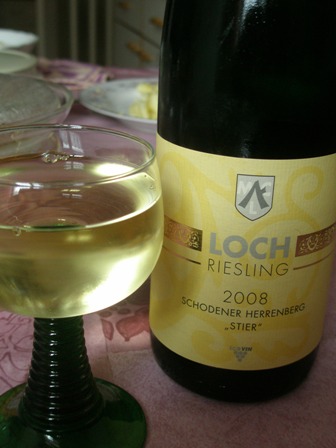
Loch1

When I am at home in Trier, Mosel my mother cooks for me. This time Heinz had shot a young moufflon (a kind of wild sheep) in Schoden. He prepared a leg of the lamb and we had it the traditional way. It was simmering on low heat for ages. The meat was tender and had a fine gamy taste.

This feast was accompanied by a wine from the same place, a ‘2008 Schodener Herrenberg “Stier” by Weinhof Herrenberg and the Loch family in Schoden. This Riesling shows that it was made by hand. It has a fine character, is minerally and fruity with good acidity and length, a perfect Saar wine to be enjoyed right away or cellared for a couple of years.

Nothing could be more perfect, I thought. The moufflons might have roamed the very location of the Herrenberg, the vineyard where the Loch Riesling was produced. I consumed the fruits of the land, the forests of Schoden and the dedicated vintners from the Saar. I am glad my mum is such a good cook. Cheers

Loch2

It’s vintage time at the Saar right now. Why not go on an outing and drive along the romantic Saar river, visit wineries and enjoy rustic German food?

Address:
Claudia and Manfred Loch
Weinhof Herrenberg
D-54441 Schoden/Saar
Tel.: +49-6581-1258
Fax: +49-6581-995438
info@lochriesling.de
www.lochriesling.de


2008 Loch Riesling

October 10, 2009

Loch0

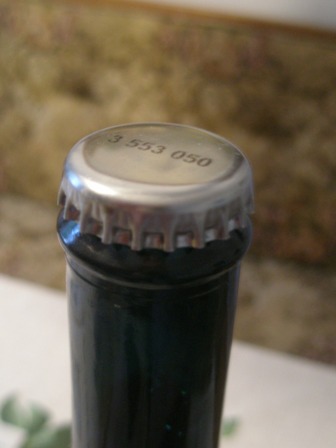
When I opened the first bottle produced by Weinhof Herrenberg, a ‘2008 Loch Riesling’, a was quite surprised when I found a it to be closed with a metal cap.

Loch00

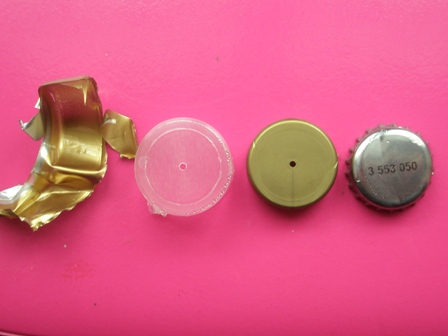
This was the first time in my life that I was confronted with such a kind of enclosure. In the process of getting to the wine unwrapping some of the plastic, I first thought it would be a glass stopper. But then I discovered the metal cap. Whow, all my traditional gear, my corkscrews, were useless and could be pushed aside and I searched for a beer bottle opener.

Loch000

The above picture shows all the elements of the metal cap including the plastic covering it.

The Loch Riesling is a clean wine typical for the Saar. Aromas of tropical fruit, fully ripened, were displayed. The wine was fresh, a little spicy, with good structure and a medium finish. I had it without food, just like that, on a beautiful autumn afternoon. The golden colour of the wine reflecting the golden autumn sun. I recommend you try it.

Address:
Claudia and Manfred Loch
Weinhof Herrenberg
D-54441 Schoden/Saar
Tel.: +49-6581-1258
Fax: +49-6581-995438
info@lochriesling.de
www.lochriesling.de


Weinhof Herrenberg – Loch Riesling, Schoden, Saar

October 8, 2009

My friend Heinz was kind enough to help me out. He dropped by the Weinhof Herrenberg in Schoden, Saar, on his way back from the hunt and bought three bottles of Loch Riesling. I had planned to visit the Loch family winery for some time but never managed to get there. There was always something else when visiting Trier, my hometown nearby, a birthday, a visit, a train to catch etc.

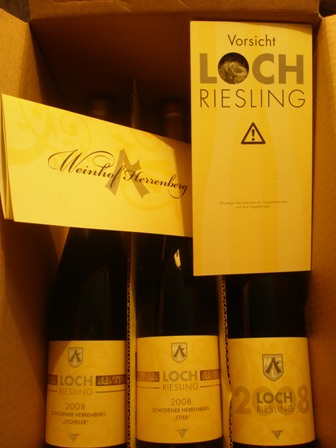
Heinz brought back the box shown below and three different Loch Riesling wines, all of the 2008 vintage. Regular visitors of my blog know that I am a Riesling lover, especially if they were grown along the Saar, my favorite provenance of German Riesling wines.

LochRiesling2

The treasures from Weinhof Herrenberg and the two brochures

The three wines were a ‘2008 LochRiesling’ (8.90 Euro/bottle), a blend of Riesling grapes from various vineyards, a ‘2008 Schodener Herrenberg “Stier”‘ (12.90) and a ‘2008 Schodener Herrenberg “Stoveler”‘ (13.90), both wines from my favorite ‘terroir’, a very steep vineyard called “Herrenberg” bordering a forest and enticing large groups of wild pigs and deer to visit and taste the sweet grapes during vintage time. I had walked the vineyard and heard about the Loch wines but never tried a single drop. It was high time to change that.

LochRiesling3

2008 Loch Riesling wines from Schoden, Saar

I also love the brochure with the “whole” (the “Loch” in German) explaining the philosophy of Claudia and Manfred Loch, the proprietors and vintners of the boutique winery “Weinhof Herrenberg”, which is the basis for their wine-making. In short, the Loch’s aim for authenticity, uniqueness, they reject designer wines but quest for a unique character and truthfulness.

The brochure is a very unusual one, telling people why to keep their hands off LochRiesling wines and what the weaknesses of the wines are: for instance that their wines are unknown, consumer hostile, old fashioned, egoistic, lawless, dangerous and limited (in numbers of bottles!). I like this brochure.

LochRiesling5

The “Loch” brochure with a whole in it

The wine list also includes wines from locations in Ockfen and Wiltingen, two famous Saar wine villages. The “Beerenauslese” wines are not available any longer. The Loch’s also produce a dry, sparkling wine. All wines are reasonably priced.

LochRiesling4

The current wine list

You might wonder what they taste like? Well, I will tell you more about this at a later blog entry. But if you are near Schoden or in the vicinity of the Saar, please visit the Loch family vineyard at Weinhof Herrenberg. If you cannot visit in person, visit the website which is very informative.

Address:
Claudia and Manfred Loch
Weinhof Herrenberg
D-54441 Schoden/Saar
Tel.: +49-6581-1258
Fax: +49-6581-995438
info@lochriesling.de
www.lochriesling.de


Restaurant review: Schlosshotel Cecilienhof, Potsdam

October 1, 2009

cecilienhof

Schlosshotel Cecilienhof

I had the great pleasure to participate in a formal dinner at Schlosshotel Cecilienhof in Potsdam. This hotel is part of a historic castle of great significance: it was the site for the Potsdam Conference which brought peace to Europe at the end of World War II. It was in this building that Truman, Churchill and Stalin (among others) negotiated the fate of Germany in 1945. But I will not bore you with too much history today.

The dinner was a very enjoyable affair: I had great company, the food was excellent, the wines were very, very drinkable and the service was eminently suitable. I went for the seafood choice below: first a salmon starter followed by a “Zander” (pike perch) fillet.

Zander0

The starter made of salmon

Zander

“Zander”/pike perch fillet for main course

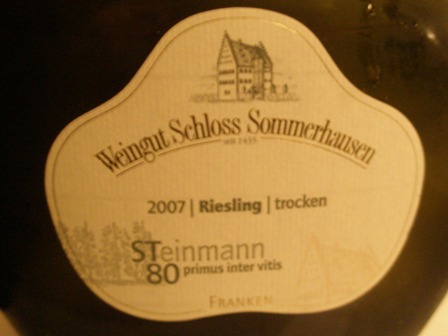
I also tried both wines on offer. The choice for white consisted of a ‘2007 Weingut Schloss Sommerhausen Riesling dry’ from Frankonia in Germany and was an excellent pairing with the starter. Schloss Sommerhausen is located between Ochsenfurt and Wuerzburg, the home of my maternal grandfather who introduced me to the wines from Frankonia.

I just love Riesling and Silvaner wines from Frankonia, but they also produce excellent Spaetburgunder and many other wines. The shape of the Frankonian wine bottles is unique (only the sweet Meteus wines from Portugal can also be found in such bottles), they are called “Bocksbeutel”.

Sommerhausen Riesling

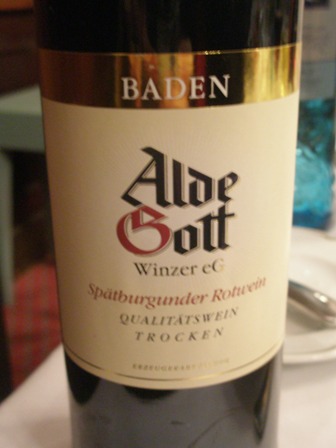
But I also wanted to taste the Pinot Noir, a young wine from 2008, ‘Alde Gott Spaetburgunder dry’ from Baden. This was my second Pinot Noir from Baden since I arrived in Germany and I must say, both wines (the other one was from Affental) were excellent.

Both are produced by wine co-operatives. “Alde Gott” is located in Sasbachwalden, a village near the cities of Buehl and Baden-Baden were also the wine co-operative of Affental can be found.

AldeGott

Addresses:
Weingut Schloss Sommerhausen
Familie Steinmann
Ochsenfurter Straße 17–19
97286 Sommerhausen
Tel. 0 93 33/2 60
Fax 0 93 33/14 88

Wine sales at Schloss Sommerhausen
Steinmann family
Hauptstraße 25
97286 Sommerhausen
Tel. +49 – 93 33/2 60
Fax +49 – 93 33/14 88

Opening hours:
Mo. – Fr. von 9.00 – 18.00 Uhr
Sa. von 10.00 – 16.00 Uhr
Public holidays 10.00 – 14.00 Uhr

Wine Co-operative Sasbachwalden
Talstraße 2
D-77887 Sasbachwalden
Tel.: +49-07841 – 20 29 – 0
Fax: +49-7841 – 20 29 18
E-Mail: info@aldegott.de


Autumn in Berlin – Affentaler Spaetburgunder

September 27, 2009

Abendstimmung

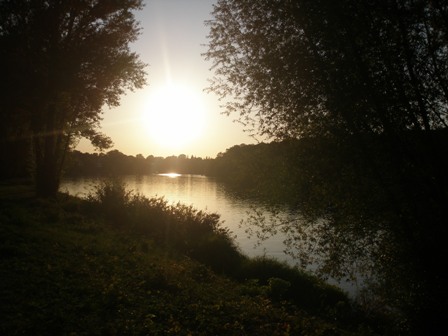
Evening at Griebnitzsee, near Berlin and Potsdam

I am in Germany right now attending meetings and conferences. Ever since I landed in Hamburg, the weather has been fine, with mild and sunny autumn days.

Today is election day and at about 18 h we will know who is going to govern the Germans for the next four years. Last night we were all invited by our boss to dine at his home. He and his wife are known for their hospitality. One of the wines on offer came from Baden, a famous German wine region. I must admit that I am rather ignorant about it’s wines.

Affentaler

2008 Affentaler Spaetburgunder 1.5 liter bottle – look at the colour

I was presented with a glass of ‘2008 Affentaler Spaetburgunder’ (12.5% vol. alc.). Needless to say, that I had never heard of “Affentaler”. And only while writing this blog entry I learned that the producer of this excellent German Pinot Noir is a wine co-operative. “Affental” is located 10 km south of Baden-Baden and belong to the city of Buehl.

This is a very elegant wine, fruity, dry and very harmonious, a thorough enjoyment. The 2007 vintage had earned 87 Parker points. The 1.5 liter bottle lasted a while but it was difficult to drink any other wine after we finished it. All of us wished for more. I will look out for it when shopping for wine next time.