Murrindindi

February 15, 2007

What is “Murrindindi”, you might ask? This is a location in central Victoria along the Murrindindi River. It is also the name of the shire where Two Hills Vineyard is located (www.murrindindi.vic.gov.au).

According to Wikipedia the Woiwurrung people lived in these parts of the Upper Goulburn when the first white settlers arrived in 1837. In the Woiwurrung language Murrindindi means “living in the mountains” and indeed this part of the Upper Goulburn Wine Region (www.uppergoulburnwine.org.au) is quite hilly and mountainous. It was all covered by forests.

There has never been a Murrindindi town. The first settlers (squatters as they are called in Australia) cleared the forests and farming and timber became the main industries in this region. A short lived gold rush began in 1868.
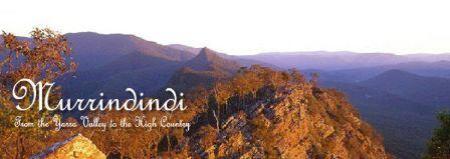
Murrindindi

Mountain view in Murrindindi

Although most of the area was deforested by the early 20th century, systematic protection and re-planting of trees has occurred and today the eastern part of the Melba Highway from Glenburn to Yea is in some parts quite densely forested again with Mountain Ash and other gum varieties.

Tourism is on the rise (www.murrindinditourism.com.au). Accommodation is easily available. There are good opportunities for trail riding, fishing, trail biking, and bush walking, specially along the Wilhelmina Falls and along the Murrindindi River.

Also the wine industry has made Murrindindi its home. Since the late 1980ies and the early 1990ies some vineyards were established in the Murrindindi area. In comparison with my native Mosel River, this might seem a rather short history of wine production. Indeed, vintners and winemaker here are true pioneers. There are fours vineyards in the vicinity:

▪ Penbro Estate
▪ Murrindindi Vineyards
▪ Yea Valley Vineyards and
▪ Two Hills Vineyard

All are members of the Upper Goulburn Wine Growers Association but only Penbro Estate has a website (www.penbroestate.com.au). There cellar door used to be the Glenburn Pub in Glenburn. Murrindindi Vineyard’s cellar door is at Marmelades Café in Yea, a small country town about 25 km to the north along the Melba Highway.

Whereas the Celtic Treverer had hundreds of years of site and varietals’ selection opportunities, so that today a rich and extensive knowledge base exists in the Mosel wine industry with well established vineyards and wineries.

The vintners in Murrindindi had only a couple of years of trial and error and are still searching.

We at Two Hills had to pull all our Cabernet grapes out because they would not ripen in the cool and harsh climate with its short autumns. They were replaced with Pinot Noir.

Last year was our first but promising Pinot vintage. The variety seems to be better suited to our conditions then the long ripening Cabernet. We plan to extend our vineyard and plant 0.4 ha of Chardonnay this year.
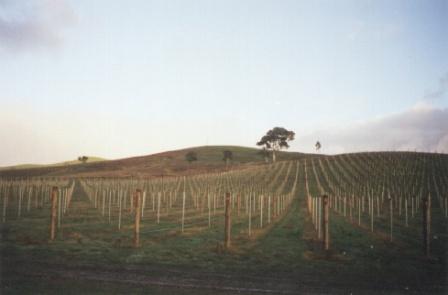
Vineyard in Murrindindi

Vineyard in Murrindindi


Two Hills Merlot

February 11, 2007

It was the perfect day for a Merlot. Actually any day is good for Merlot but in the tropics one has to be careful with alcohol of any kind. Nevertheless, we had to do some tasting today. 2001 was our first Merlot vintage. Nobody wanted to buy the fruit. This is why I decided to make all of it into wine. Alan Johns of Yering Farm (www.yeringfarm.com.au) did this for us.

All our wines are hand crafted. They come from a single site vineyard, Two Hills Vineyard in Glenburn, and are hand picked. The fruit was fermented in traditional open fermenters and aged in old French barriques to preserve the Merlot’s elegance and finesse. At 12.8 % alcohol it is not too “heavy”. It is medium bodied, dry with a good acidity and a long finish. Its subtle flavours of ripe forest fruit and its firm tannins give the wine a fine balance.

The Merlot Block

Two Hills Vineyard – Merlot Block, single site (3 1/2/ acres)

We do not have many bottles left of the 2001 vintage here in Jakarta, and in fact not many are left on our vineyard either. It has matured in the bottle and some of our friends like it better then the lighter more elegant 2004 vintage. 2001 was a warm year with a golden autumn to ripen the fruit in perfect conditions. Timo Mayer, our friend and winemaker at Gembrook Hill (www.gembrookhill.com.au), described it as an “umpf” wine, rich and heavy whereas the 2004 Merlot vintage is elegant with great finesse. Anyhow, we enjoyed the drop today far from the place where it was grown. It reduces the homesickness we feel from time to time.

If you want a bottle or two please call in the bottle shop of the Old England Hotel in Heidelberg/Melbourne (www.oldenglandhotel.com.au) and ask for Two Hills Merlot. If you are in Germany please contact Dr. Ulrich Hillejan (ulrich.hillejan@s-h-r.de). Zum Wohl. Salute.

Product Range THW

2001 and 2002 Sauvignon Blanc and 2001 Merlot vintages of Two Hills Vineyard


Burns Supper – Java St. Andrews Society

February 10, 2007

I will write more about Celts and Celtic traditions today. Friends of ours got flooded out and could not attend this year’s Robert Burns (1759 – 1796) Supper and the related celebrations of the Java St. Andrews Society (www.javastandrewsociety.com). They kindly passed the ticket on to us and we were welcomed as replacements by the Scots. Thanks again Liz and Walter for your generosity.

Burns Supper 2007

We sat at the “Holy Willie’s Prayer” table together with four Americans. Most men at the supper were in kilts and every time I see this, I want to buy a traditional Bavarian outfit (with leather trousers and so on) which would at least come a bit closer to this formidable dress for the Scottish men. We used to be members of the society many years ago but when our Scots friends at the time had left Jakarta we did not renew our membership. We had also attended quite a few Burns Suppers so that we knew what we were in for. A very memorable one was the first ever held on Chinese soil in Beijing in 1992.

Robert Burns is the beloved poet and lyricist of the Scots (the national poet). He is regarded as a pioneer of the Romantic movement and his poems and writings became a source of inspiration to the founders of both liberalism and socialism. Burns loved women and drink. Statues of Robert Burns can also be found in Australia (Sydney, Canberra and Adelaide). The celebration of his birthday (25th January) follows a fixed ritual.

The program in Jakarta looked as follows:

● The Selkirk Grace (by Sandy Duncan)

● Address to the Haggis (by Chieftain Scott Thompson)

● The Loyal Toast (by Tony McEwan)

● Songs of Burns (by Barbara and Alastair Speirs)

● The Immortal Memory (Robert Burns Live by Chris Tait)

● The Land we Live in and Absent Friends (by Ross Scholes)

● The Land we Hail From (by Brian Scott)

● To the Lassies (by Tony Milne)

● Holy Willie’s Prayer (by Jim Tait)

● The Reply from the Lassies (by Alex Faulds)

● Poems of Burns (Robert Burns Live by Christ Tait)

As customary at this occasion, the haggis (filled sheep’s stomach) is served. It is brought into the hall accompanied by pipe music and usually a guard of honour sometimes holding bottles of whiskey crossed in front of their chests like swords. The pipers were the Edinburgh Chevaliers flown in for the occasion and they entertained us very well. The speeches were well presented too. In addition a Robert Burns look alike (Chris Tait) gave quite a performance. For non-Scots it is at times difficult to follow but its great fun. I always enjoy listening to these old almost forgotten Celtic languages.

The dinner consisted of green pea soup followed by the customary haggis with neeps and tatties. As the main course, we had angus steak pie with new Ayrshire Potatoes, baby carrots and Iona parsley. The desert, McEwan’s Apple Tart and ice cream, we spiced with the whisky which was generously deposited on each table. This year it consisted of bottles of Johnny Walker (12 years old).

The Scots do not grow vines as we all know. We drank a 2004 Timber Ridge Shiraz, a wine from Western Australia. It showed a very lively, fruity character of black fruit, raspberry mainly. My palate detected cherries but I might have gotten it all wrong. The wine was clean and well balanced and surprised us. I had never heard of the vineyard. The next day I searched it on the internet. Unfortunately, the website of the Timber Ridge Vineyard is not yet operational. There is a vineyard of the same name in the USA but I could not find out more about the Western Australian venture, except tasting notes for the 2004 vintage.

For the Whiskey

The Whisky “Taster”


The Upper Goulburn Wine Region

February 1, 2007

Today, after all these Mosel meals, I want to take you back to Australia and write about the wine region in which our vineyard is located: the Upper Goulburn Wine Region. I also would like to inform you a little bit about the activities of the Upper Goulburn Winegrowers Association (UGWA; www.uppergoulburnwine.org.au).

The Upper Goulburn is located in central Victoria. The region derives its name from the Goulburn River which is one of the main features of the area. It is a cool-climate grape growing area setting it apart from most other parts of Victorian. The region has only recently been classified in the geographic indication system. Grapes, however, have been grown in this part of Victoria for almost 40 years. In comparison to the Mosel this is indeed a very young wine region.

The Geographic Indications Committee of the Australian Wine and Brandy Corporation (AWBC; www.awbc.com.au) determines wine zones, regions, sub-regions and their boundaries. The system was introduced after lengthy negotiations with the European Union which did not accept Australian wines unless it complied with European regulations. The Australian Wine and Brandy Corporation Act of 1980 was amended in 1993 to accommodate those requirements.

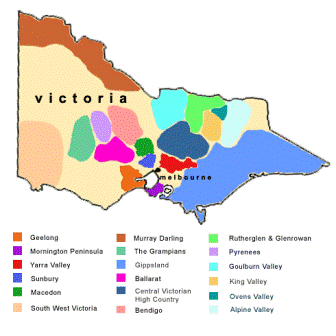
Map of the Victorian Wine Regions

Wine Regions of Victoria Map Dark blue formerly Central Victorian High Country and now divided in Strathbogie Ranges and Upper Goulburn Wine Region (www.wineaustralia.com/australia

The region is very diverse in terms of altitude, climate, temperature, rainfall, and soils. Site selection is of ultimate importance. Rainfall varies from 700 to 1400 mm. Some vineyards even rise to the snowline at 800 m. Many locations are ideally suited for sparkling wine production consisting of Chardonnay and Pinot Noir grapes. Aromatic varieties such as Riesling, Gewuerztraminer and Sauvignon Blanc can be found but also Cabernet Sauvignon, Merlot, Malbec and Shiraz. (www.greatwinecapitals.com/melbourne/mel_reg_centralvictorianhighcountry.html)

The Upper Goulburn is very picturesque and one of the gems of Victoria. It extends from Tallarook in the west to Mansfield, Lake Eildon and further north Lake Nillacootie. Regional centres like Yea, Alexandra and Eildon are located in the region. Mount Buller and its skiing slopes, the lakes, the small rivers and the high planes are a premium destination for national and international tourism.

Mount Buller

Mount Buller with snow cap

Two Hills Vineyard can be found at the most southern edge of the region on the way to Yarra Glen. Today there are about 25 wine labels and more than 30 vineyards in the region. Recently a branding workshop has identified the key characteristics of the region which include:

● high diversity of vineyards and wines
● climate very suitable for premium cool climate grapes and wines
● aromatic whites/sparkling wines and elegant reds
● hand picked and hand crafted grapes/wines
● family owned businesses
● environmentally aware producers
● low environmental footprint
● shared experience between producers and customers
● good infrastructure
● unknown – Victoria’s secret

From these few words it is clear where you have to spend your next holidays: in Central Victoria. See you there (www.visitvictoria.com/wineries).

Two Hills Vineyard

Two Hills Vineyard


From the Old to the New World: My Vineyard in Glenburn, Victoria

January 10, 2007

Today I want to take you to a small place in Central Victoria Glenburn, between Yarra Glen and Yea, about one hour northeast of the capital city of Melbourne. From there we drive about 5 km up north and turn right into Two Hills Road, a gravel road which will lead us to our vineyard.

The vineyard
Our vineyard facing north

It’s all grazing land here surrounded by gum forests of the national park. Most residents are retirees; many are weekenders. The vineyard is located on the right hand side on a 50 acres block (about 21 ha). It consists of about 1 ha Sauvignon Blanc (planted in 1996), 1 ha of Pinot Noir (planted in 2002) and 1.3 ha of Merlot (planted in 1997). The rest of the land is grassland with some small patches of gum trees and a small forest. A small river, Katy’s Creek, builds the boundary on one side.

Second Hill

Two Hills Vineyard towards our second dam

In 2001 we had our first vintage. Our Sauvignon Blanc of 2002 even won us a bronze medal at the Singapore Wine Show.The wines are available in Melbourne at the Old England Hotel in Heidelberg (bottle shop; www.oldenglandhotel.com.au), at the Berry Cafe in Dixons Creek (on the way from Yarra Glen to Yea) and in the Alexandra supermarket chain. In Germany my friend Dr Ulrich Hillejan (Gesellschaft fuer Unternehmensentwicklung mbH, www.s-h-r.de) sells our Merlot to other friends and family. At the moment we have only Merlot 2004 for sale. All the other wines have sold out which is of course good news for the producer and bad news for the consumer. 2006 was our most successful year so far. We had a good harvest (after a complete loss in 2005 due to adverse weather conditions), sold all our grapes, and most of our wines. The 2006 vintage of Merlot is ripening in French and American oak and will be bottled in March 2007.
We are selling most of the fruit to other wineries. Living abroad is not very conducive to wine marketing. Another friend, Steve Sadlier of Vineadvice from Yarra Glen, takes care of the vineyard management. He is our viticulturist. Our wines are made by another friend, Alan Johns, owner and winemaker of Yering Farm Wines (please visit their website at: www.yeringfarm.com.au).

The wine region is called the Upper Goulburn Wine Region Victoria (formerly Central Victorian High Country) and is promoted by various organisations among them the Upper Goulburn Winegrowers Association of which we are also a member (please visit their website: www.uppergoulburnwine.org.au). I took the map from this website. Unfortunately, it’s not up to date (we are not yet listed as members for instance) but it gives some idea of the location.
ugmap2.jpg