The other Mosel: The wines of Luxembourg

September 2, 2009

Lux0

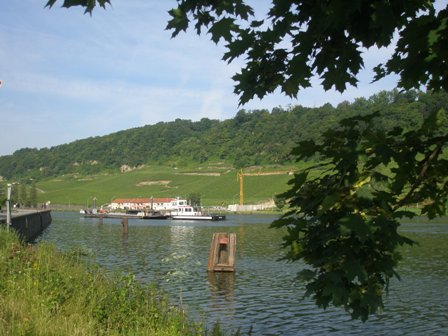
Luxembourg vineyards along the Mosel seen from the German side in Wellen

Having grown up in Trier, Mosel the Grand Duchy of Luxembourg is no stranger. As a teenager we used to drive to Luxembourg City to enjoy its night-life visiting the famous discotheque “Blow up” and thereby expose ourselves in a kind of pan-European experience, populating the dance floor amid dancers from Belgium, Holland, France, Germany and Luxembourg.
Lux1

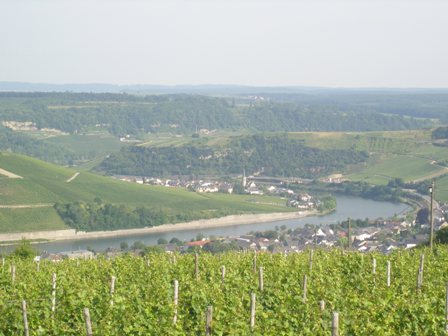
Mosel river with Nittel in the foreground (German side) and Machtum (Luxembourg side)

The above photo shows the Mosel valley, in the foreground the wine village of Nittel on the German side, and in the background the Luxembourg village of Machtum/Miechtem along the “Route du Vin”, the road which leads the visitor through the picturesque vineyards and wine villages of Luxembourg. I took these photos during my last visit to Trier at the end of June when I cruised along the river visiting both Grevenmacher and Nittel.

One of the best kept secrets as regards European wines are the fine wines of Luxembourg. Total production is about 12.4 million litres of which more than half is exported (mostly to Belgium and Germany). The total area under vines is about 1300 ha only which is about a third of the Yarra Valley. Luxembourg is a kind of artisan wine producer, where the winery sector is dominated by small family-enterprises, whereas large, corporate-wine industrialists shine through their almost complete absence. Of the odd 430 grape producers only about 60 have their own wineries. Most vignerons are members of a wine co-operatives at the village level.

Luxembourg is mainly a producer of dry, varietal white and sparkling wines (about 15% of total production). This is a stark contrast to the German side of the Mosel which has a strong tradition in semi-dry and sweet wine production.

Of the 15 approved wine varieties, Müller-Thurgau (Rivaner) accounts for about 29% of the area under vines followed by the Burgundy varietals (together almost 40%). Auxerrois (14%), Pinot Blanc (12%) and Pinot Gris (13%). Riesling covers only about 13% of the area in Luxembourg whereas it is the dominant grape variety on the German side of the Mosel. Luxembourg also has about 10% of the area under Elbling, the oldest wine variety in middle Europe, characterized by its high acidity which makes it ideal for the production of sparkling wines. Chardonnay and Gewürztraminer are other white varieties grown. Pinot Noir (about 7% of the area) is the most common red variety of Luxembourg.
Lux2

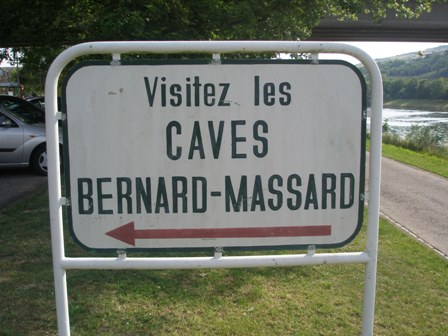
Parent house of Bernard Massard in Grevenmacher

On of the largest producers of still wines and crémants (bubbly/sparkling for my Australian readers) is Bernard Massard. Bernard Massard is also well known in Trier where the company has a large office and wine cellars in the middle of the town centre (Jakobstrasse), but Bernard Massard owns and operates vineyards also along the Loire river in France. The parent house of the company is located in Grevenmacher. More than 30,000 visitors come to see the extensive wine cellars

Lux3

Bernard Massard owns two vineyards along the Mosel: Domaine ‘Thill’ in Schengen (12 ha under vines) and Domaine ‘Clos des Rochers’ in Grevenmacher and Wormeldange (18 ha) with a combined production of about 120,000 bottles (or 10,000 cases) per year. Through the sparkling production in Trier about 3 million bottles of crémants and other sparling wines are sold. The French vineyards (Caves Monmousseau at Montrichard and La Petite Cave at Ronchamp) along the Loire river produce mainly crémants (Crémants de Loire and Touraine sparkling wines) and a variety of local wines.

Lux4

Domaine ‘Clos des Rochers’ in Grevenmacher

Lux5

Vineyards near Mertert/Wasserbillig

The bulk of Luxembourg’s family vineyards and wineries is much smaller than Bernard Massard. Because of the long tradition of viticulture in the villages and hamlets along the Mosel, many vintners come from families who have a strong family tradition in grape growing and wine making. Many families are related through intermarriage and therefore many wineries have combined family names most of which you will have never heard of.

Representing these strong traditions I would like to mention only three smaller wineries. I apologise to all the others; I know many of you deserve a full portrait.

Caves René Bentz, Wellenstein (5.2 ha)
The vineyards are located in Wellenstein, Remich, Wintringen and Bech-Kleinmacher. Main variety is Müller- Thurgau, however the most important varieties are Riesling, Pinot Gris, Pinot Blanc and Auxerrois. The Riesling wines of the Gottesgôf selection are worth trying, and so is the 2007 Pinot Gris Côteau Wellenstein.

Domaine Viticole Charles Decker, Remerschen (4 ha)
Charles Decker has a clear vision of his wines. He is one of the few who cultivates Muscat Ottonel grapes and experiments with German new varietals such as Siegerrebe, an aromatic grape. He specialises in sweet wines. Try his Muscat Ottonel wines but also the Chardonnay and the Pinot Gris are commendable.

Caves Kayl-Noesen Nic et fils, Remerschen (6 ha)
This is a very young undertaking, with the winery established only about 5 years ago. Before that the family produced grapes and sold the fruit to other wineries. The young vintner who studied oenology in Germany, manages the estate with his father. The classic varieties of Luxembourg are the wines you should try. Their Auxerrois, Pinot Blanc and Pinot Gris are ideal wines consumed with fine cuisine.

Lux6

The mouth of the Sauer river at Wasserbilligerbrück meeting the Mosel

It is worth visiting Luxembourg and its vineyards and wineries. Stop at any nice café or wine bar and try the local Elbling or go for the more elaborate cool climate Auxerrois, Pinot and Riesling wines.

Information about Luxembourg and its wines:

I found the following book very useful (in German): “Weine und Crémants aus Luxemburg”, Einkaufsführer 2009, Meininger Verlag (www.meininger.de), Neustadt, Weinstrasse.

A very informative article about Luxembourg can be found on http://www.wine-pages.com/features/luxembourg-wine.htm
.

But also the Wikipedia write-up gives the newcomer a very good overview.

The fourth source of useful information comes from http://www.vins-cremants.lu/en/winegrowers/alphabetical_listing.html


The South Pack: Young Australian winemakers on a mission

August 15, 2009

The wine glut in Australia makes wine marketing a true challenge. Many vignerons and wineries have to knock on endless doors of wine outlets, restaurants and retail shops. You get sick of it. Among others, that’s one of the reaosns why eight young independent winemakers from Victoria have created “their own thing”. They call themselves “The South Pack”.

SouthPack1

Three years ago they started their own roadshow to Melbourne and Sydney. Instead of going out and selling wine, they decided that people should come to them. They look for a suitable location, a restaurant, a hotel or any other suitable facility and invite the top trades and restaurant people to come for a tasting: meet the maker and his wines. Usually it’s accompanyied by food and music and great fun.

SouthPack2web

The eight young winemakers (actually they are nine people) knew each other through the wine business and are friends and mates. This year the roadshow will be conducted for the third time. Last year, also Brisbane was included. Attendence is by invitation only but numbers at the shows have multiplied every year. This year will be no different. There is a great interest to meet the originators, the magicans, the winemakers and have them talk about their products: hand carfted artisan fine wines of ourstanding qualities. These wines are not like the industrial liquids, technically well made wines but a bit ordinary, normal, faceless.

SouthPack3

Meet the unusual. I only know one of the eight personally, Timo Mayer, a longtime friend. Timo is the winemaker of Gembrook Hills in the Yarra Valley and has his own vineyard and label. He made our award winning ‘2002 Two Hills Sauvignon Blanc’. He told me all about South Pack. I was exited to learn about this initiative and its immediate success.

Even if you have not been invited, just pick up some of their wines. Most of them you can buy online. Here is where to find and contact them:

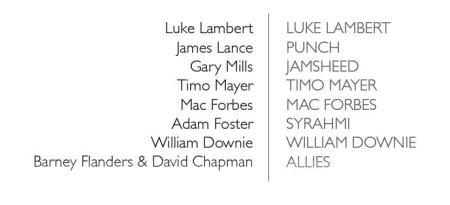
Luke Lambert: mainly Syrah from St. Andrews, Yarra Valley and Nebbiolo from Heathcote.
www.lukelambertwines.com.au

James Lance – Punch: The winery in the Yarra Valley was severely affected by the bushfires, produces Chardonnay, Pinot Noir and Cabernet Sauvignon
www.punched.com.au

Gary Mills – Jamsheed (named after a famous Persian king): Shiraz and Gewuerztraminer
www.jamsheed.com.au

Timo Mayer: Bloddy Hill he calls his vineyard on the top of a windy peak overlooking the Yarra Valley, most of his 2.5 ha are under Pinot Noir, some Chardonnay and some Shiraz
www.timomayer.com.au

Mac Forbes: wines come from the Yarra Valley (lots of Pinot Noir and Chardonnay) but also the Strathboogie Ranges (Riesling). The so called “alternative wines” are made from fruit from other wine regions in Victoria. Here you’ll find varieties such as Barbera, Gruener Veltliner, and Blaufraenkisch
www.macforbes.com.au

Adam Foster -Syrahmi: another winery from Heathcote with beautiful Shiraz wines
I could only find references ot his wines but not a proper website.

William Downie: solely Pinot Noir wines are made by William, the fruit comes from the yarra Valley, Mornington Peninsula and Gippsland
www.williamdownie.com.au

Barney Flanders and David Chapman – Allies: Allies is a collaboration between Barney and David. They produce a variety of wines (one label is called “Garagiste”, implying garage wines of made of excellent fruit; there must be a lot of French influence!?). Their Pinot and Chardonnay wines come from the Mornington Peninsula, the Shiraz comes from Heathcote (no surprise).
www.allies.com.au


Wine tasting: Upper Goulburn selection

July 30, 2009

UpperGoulburnWines

Three of the four wines

When up on our vineyard in Glenburn, Central Victoria we do not only drink our own wine, but sample also quite a few, mainly local wines. Some of them I have introduced to you before (Rees Miller Estate and Kinloch Wines).

The four wines, we tried recently, were the following:

Lost Valley Winery, ‘2004 Hazy Mountain Merlot’ (14.0% alc.), from the Upper Goulburn
Mount Samaria, ‘2005 Shiraz Cabernet’ (13.5% alc.), Upper Goulburn
Girdwood Estate, ‘2005 Pinot Noir’ (16.0% alc.!!!), Alexandra, Upper Goulburn

The fourth wine came from the King Valley, just north west of The Upper Goulburn wine region.

DALZOTTO, ‘2002 Cabernet Sauvignon’ (13.5% alc.), King Valley

MtSamaria

Mount Samaria has a wombat on his label.

I do not want to describe each wine (I hate tasting notes), but a short summary is warranted.

Unfortunately, the Pinot Noir from Girwood Estate was somehow off. I had a strange smell and must somehow gone bad. We will have to try again.

I loved the Merlot from Lost Valley Winery. What a ripper wine with all the qualities of an excellent single variety wine. Also the Shiraz Cabernet from Mt. Samaria is a very nice wine and need to be praised. Both wines show that members of our association produce outstanding cool climate wines.

Also the King Valley wine from Dal Zotto was just lovely (excellent). It seems that we will not be able to visit this cool climate wine region during this visit. After the bush fires, there is just too much to do out here on our farm. Moreover, winter is an ideal time for cleaning up the bush, the land and the vineyard.

We will continue tasting various local wines. Soon more, stay tuned.


The best German vintners and wine makers

June 1, 2009

Threewinegods

The wine gods (photo taken from a building in Berlin)

Its certainly a great honour to be called “vintner of the year”. Since 1994 Gault Millau, Germany’s wine guide and major authority regarding wine, wine business and the wine sector, is awarding the “vintner of the year” award.

Today the total number of vintners of the year is 16, seven of which come from the Mosel wine region. The current one, however, comes from the Pfalz (Knipser brothers).

But in the years 2007 (Theo Haart, Mosel), 2005 (Kartaeuserhof, Ruwer), 2001 (Loosen, Mosel), 1998 (Mueller-Scharzhof, Saar), 1996 (Joh. Jos. Pruem, Mosel), 1995 (von Schubert, Ruwer) and 1994 (Fritz Haag, Mosel) the vintner of the year came from my home, the Mosel river and its tributaries.

(Remark: the Mosel wine region was originally called: Mosel-Saar-Ruwer)

No other German wine region has provided that many “champions”. So far the Nahe and Pfalz wine regions had two vintners of the year; and Rheinhessen, Rheingau, Frankonia, Ahr and Baden had one each (for the names of the vintners of the year: Gault Millau).

I came about this fact only by accident while researching a story, I was going to write. I have to find more Mosel wines here in Bangkok, I guess. Wish me luck.


Portugal – The sparkling wines of Lamego

February 19, 2009

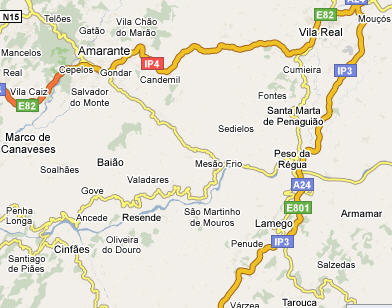
The Douro wine region in Portugal is not only famous for its red and port wine production. There is also a place were a wonderful sparkling wine is produced. The picturesque town of Lamego, considered the birthplace of port wine, was the target of a Sunday afternoon drive last August along the upper Douro river. Lamego is well known for the only sparkling wine produced in this region. So off we went along the river through a wonderful summer’s landscape with blue sky and a very dry wind.

lamego0

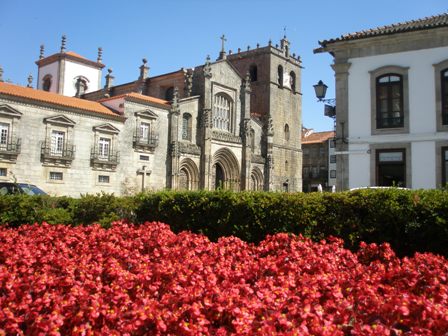
Park, church and stairs in Lamego, Portugal

We drove up from Peso da Régua at the Douro where we had lunch and which is about 12 km from Lamego. We returned the same way except that we did not follow the Douro river on our way back but we took the highway through the mountains which was faster.

lamego00

A scenic spot with church in the city of Lamego

As with all places in Europe, their history has been shaped by many a people. Lamego has seen Roman masters and the Visigoths, it was battleground in the wars of the Moors and Christians. Historically Lamego is significant because it was here that the first king of Portugal, Alfonso Henriques, was declared king by noblemen in 1143. Today, Lamego has about 9000 residents in the city walls proper, and another 17,000 live in the surrounding villages and the countryside.

lamegox

There is not only ham but also local cheeses

lamego000

Local produce can be bought from small shops – can you see our bottles?

lamego1

We dashed in one of these small local shops before the afternoon closure to buy two bottles of the legendary sparkling wine of Lamego. We grabbed the last two bottles available without consideration for brand nor price, jumped into the car and went straight home because of the advanced time.

Later at home at Quinta do Gatao we chilled the bottles and I took the photos below.

lamego2

This is the first bottle

Our booty consisted of a dry red and a semi-dry white sparkling from Caves da Raposeira, located in Lamego. Both wines where very fruity. The red displayed red berry aromas, the white a more fruit salad type fragrance. We tasted them before we had dinner, just like that, as a apperitif so to say, just delicious at a hot summers day. Both wines come from Raposeira’s flagship brand called “Reserva”, their premium and super-premium segments are called “Super Reserva” and “Old Reserva” respectively. We will have to try those another time.

lamego3

This is the second bottle.

Our dash to Lamego was just too short. We have to come back and explore the Caves in the town proper. The wines we had secured, were very much to our liking. It’s a pity that we do not know where to get them here in Bangkok.

Address:
Caves da Raposeira
Lugar da Raposeira
Apartado 9
5101-909 Lamego, Portugal
Te.: (351)-254655003

mapoflamego


Wild pig from Schoden, Saar

January 31, 2009

schoden111

The village of Schoden (left) at the Saar River

The Saar is one of my favourite tributaries of the Mosel river. I love its wines, the landscape, the villages and the people. In early December I was roaming the region again, and visited Schoden, a small village near Wiltingen, where my friend Heinz and his mates have rented a hunting territory for many years.

schoden12

Herrenberg, one of the best terroirs in Schoden, left the Saar river

There is also a vineyard and boutique winery called Herrenberg which is owned and operated by Claudia and Manfred Loch. The vineyard above belongs to them. Their wines are hand crafted and award winning.

schoden13

The vines are ready for pruning, single vines where two canes are tied down

schodenkeiler1

A young wild boar killed in early December offering good quality game

The forest along the Saar are inhabited by various wild animals. Particularly numerous and very difficult to hunt down are wild pigs. Wild pigs inflict huge damages to fields, orchards, paddocks and from time to time even on vineyards. But if a young pig has been successfully killed, the meat makes a wonderful lunch or dinner or both.

schodenkeiler21

Liver and kidneys of the wild pig above

Here is a wild pig goulash recipe:
-500 to 800 gr. of wild pig meat
-some bacon
-onions
-some oil
-tomato paste
-150 ml red wine
-350 ml of extract from boiling game
-sour cream
-laurel, tyme and juniper berries
-salt and pepper.

If you want to enjoy it with mushrooms, you could add a selection of various wild forest mushrooms, preferably “funghi porcini” (Steinpilze in German). I just love them; they are great with wild pig.

The cooking process is like any other goulash. Add the sour cream at the end so that the goulash is not too watery.

My tip: buy the wild pig meat from the hunter if you can and make sure the animal was “not too old” (buy meat from year-old animals). This is easy if you live in Germany.

As the pairing with wine is concerned, I suggest a good red (14% alcohol), preferably a Malbec from Argentina or a Tempranilo from Spain or a Barolo from Italy. A GMT from Australia, maybe from McLaren Vale, would also do. Of course you could also have a Saar Riesling with it. From Schoden I recommend a Riesling from the Loch family of Herrenberg.


Jean-Paul’s Vineyard, Yea

January 30, 2009

Recently I had the opportunity to taste wines from Jean-Paul’s Vineyard in Yea, Victoria, a boutique vineyard owned and operated by Will de Castella. The de Castella philosophy is, “it’s all about the fruit”. The vineyard is organic/biodynamic certified. Will produces hand crafted, award winning wines of excellent quality. Jean-Paul’s Vineyard also recently joined our association, the Upper Goulburn Winegrowers Association.

jean-pauls12

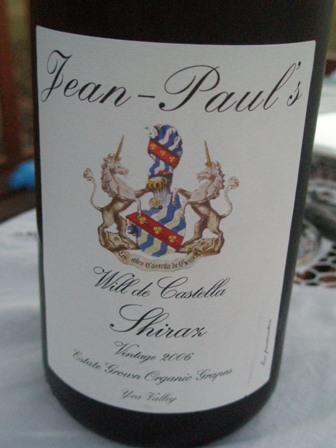
‘2006 Jean-Paul’s Vineyard Shiraz’

I bought a bottle of ‘2006 Jean-Paul’s Shiraz’ and a bottle of ‘2004 Jean-Paul’s Bold Colonial Red’ from the Yea super market. Recently the ‘2005 vintage Shiraz’ was awarded 94 and the ‘2005 Bold Colonial Red’ 88 points by James Halliday. I guess that the different vintages might not have been significant as regards the quality of the wine. Who can taste a one or two point difference anyway.

Both wines were consumed together with friends over hearty Australian country meals. To say it from the outset, I loved both wines; they were delicious. Since I am more of a Shiraz than a CabSav drinker, I personally prefer the Shiraz.

If you are in the vicinity of Yea, grab some bottles of these wines, it’s a bargain. I also recommend to visit the Jean-Paul’s Vineyard website and order from there directly.

jean-paulss11

‘2004 Jean-Paul’s Vineyard Bold Colonial Red’

By the way: Will de Castella’s great grandfather was Hubert de Castella, the pioneer of the wine industry in the Yarra Valley establishing vineyards such as St Hubert’s near Yarra Glen.

Will and his wife Heather live since 1988 near Yea and produce small quantities of fruit from which distinct wines are made which won accolades for their outstanding quality.

Address:
Jean-Paul’s Vineyard
Post: RMB 6173
YEA VICTORIA 3717
AUSTRALIA
Phone: 03 57972235
Email: william@jeanpaulsvineyard.com.au
http://www.jeanpaulsvineyard.com.au


Phylloxera in the Yarra Valley

January 8, 2009

On December 23 another outbreak of phylloxera in the Yarra Valley was confirmed. This is the third infection since 1. December 2006. Phylloxera is a small aphid that lives on the roots of grape vines. Despite almost a century of research no remedy has been found so far. An infection will inevitable lead to the death of the vine. Grape growers, vintners, wine makers and winery owners are concerned that the spread of the disease cannot be contained.

A new “Phylloxera Infested Zone” called the Maroondah PIZ has been declared around the known infested sites, with the boundary set at a minimum of 5km from all known phylloxera affected properties, and taking into account physical features including roads and rivers.

phylloxera-zone-yv-web

The Maroondah PIZ

One can see the affected vineyard from St Hubert’s road, near Punt Road Winery. It has obviously been treated. The dead vines are without any leaves.

The four photos below show some of the symptoms we look out for. All four photos come from a brochure called “Inspecting Vineyards for Phylloxera” on vine desease from South Australia.

phyll1

phyll3

phyll4

phyll2

Early signs of phylloxera

We at Two Hills Vineyard are very concerned too. Our wine is made in a winery in the Yarra Valley (Yering Farm Wines) and some of our contractors and vineyard workers are also working on vineyards there.

In order to not contract the vine disease we are attempting a certification with a protocol in place which will prevent our vines from being affected sometime in the future. It’s quite fortunate that we have no visitors in the vineyard and do not participate in the wine tourist trade. However, all people working in the vineyard and their equipment need to take proper precautions. We hope it will work.


Upper Goulburn Wines Shine

January 3, 2009

In the summer edition of the ‘Upper Goulburn Food and Wine Cultural News’ newsletter also the wines from this rather new wine region (our wine region!) are mentioned.

One of the “popes” of the wine industry, James Halliday, has included wines from the Upper Goulburn Wine Region in his 2009 edition of the Wine Companion.

The following summary rates some of the regions wines:

2006 Barwite Upper Goulburn Riesling (87)

2006 Buller View Cabernet/Shiraz/Merlot (88 )

2006 Cheviot Bridge Yea Valley Shiraz (94)

2006 Delatite Polly Sparkling Gewuerztraminer (88 )

2006 Growlers Gully Shiraz (90)

2005 Jean Paul’s Vineyard Shiraz (94)
2005 Jean Paul’s Bold Colonial Red Cab/Sav (88 )

2005 Kinloch Wines Mary Friend (90)
2007 Kinloch Sauvignon Blanc (87)

2005 Lost Valley Thousand Hills Shiraz (89)
2007 Lost Valley Cortese (88 )

2004 Mount Cathedral Reserve Merlot (94)
2005 Mount Cathedral Reserve Merlot (90)
2005 Mount Cathedral Chardonnay (89)

2006 Mount Samaria Tempranillo (88 )

2006 Murrindindi Don’t tell your Dad Shiraz (89)
2006 Murrindindi Chardonnay (88 )
2005 Murrindindi Family Reserve Cabernet (88 )

2005 Myrtlevale Vineyard Cab/Sav (88 )

2006 Rubicon Lorna’s Vintage Chardonnay (88 )

2006 Sedona Estate Yea Valley Shiraz (90)

2005 Snobs Creek VSP Shiraz (89)
2006 Snobs Creek Dolcetto Syrah (88 )
2005 Snobs Creek Wooded Chardonnay (87)

2005 Tallarook Chardonnay (92)
2005 Tallarook Marsanne (90)
2006 Tallarook Rousanne (90)

The rating demonstrates once again that the wines from the Upper Goulburn Wine Region are of superior quality. Amzing is also the wide range of varieties and wine styles. It’s a pity that our wines were not included in the tasting. But we have been slack with wine marketing in Australia during the last 12 months.

While celebrating Christmas we tried for the first time a wine from Will de Castella, a ‘2006 Jean Paul’s Vineyard Shiraz’ (the following vintage of the above ’94 point wine’). What a fabulous wine this was. Intensive aromas of plum and blackberry filled our mouths. Our only regret was that we had only one bottle. I bought the wine in the Yea Supermarket (about 20 A$).

jean-pauls1

jean-pauls2

PS: By the way, our wine growers association has upgraded its website. Please check it out, its much better than before: www.uppergoulburnwine.org.au


Welcome 2009

January 1, 2009

clouds2009

Clouds over the hills around Healesville with mount St. Leonard (1028 m) to the left

As customary, we spent Christmas and New Years Eve with Michael, my brother in law, and his lovely wife Helen in their cosy family home in Healesville, Victoria. Boy did we have a great time. The time went by just too fast for the six of us.

The year 2008 is gone and with it the anxiety, the joy, the disappointments, the chagrin and the happiness. We deplore the losses, and welcome the changes.

The past year brought great changes to our family. We moved from Jakarta/Indonesia to Bangkok/Thailand, experienced a new job, a new school, a new environment, a new culture to get acquainted with and it will take us some more time to adjust, to understand, to appreciate, and to feel at home.

For 2009 our expectations are high. Our ambitions at Two Hills Vineyard are to continue to produce first grade fruit for excellent wines. Despite the loss of about 50% of our Pinot Noir grapes due to a severe frost at the end of October, we are very optimistic about the coming vintage. The Sauvignon Blanc fruit look very good, and our Merlot is in a good condition. The Chadonnay vines, now one year old, prosper and we have very few losses.

alan-johns1

Tasting the 2008 Two Hills Merlot with Alan Johns, owner and winemaker of Yering Farm Wines

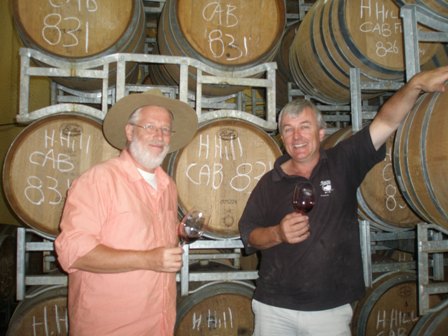
Our 2008 Merlot also showed promising first results. At Yering Farm, we tasted the young wine from various barrels. The wine was fruity, had good structure for a medium bodied wine, and the tannins were just right. We hope it will mature nicely so that we can present our customers with another excellent vintage of our flagship red wine from Two Hills Vineyard.

th2008new

Two Hills Vineyard, Sauvignon Blanc (left) and Chardonnay (right)

Temperatures are low for this time of the year but we had some rains which helped to make everything looking very green. A little digging, however, shows that the soil is still very dry and that we urgently need more rains. The general drought has bot been broken as yet.

A new year means new opportunities. Also in 2009 grapes will be grown, wines will be made, and we will get ample material to apply our taste buds to. Sampling fine wines and enjoy them with good food, either within the family or with our friends, will be our prime pastime in the 12 months to come. Hope you can join us. Cheers and a happy New Year to you all.

PS: I write this new blog entry from our vineyard. Yes, we installed a broadband internet connection on the last day of 2008. From now on, I do not have to hurry to a wireless spot (35 km from here) or any other place with an internet connection. Blogging will take a new dimension. Hurray!